

Women's grappling brings together Brazilian Jiu-Jitsu, No-Gi, wrestling and submission grappling, but learning it is about more than knowing the names of different techniques. This guide explains how women train, what beginners can expect on the mat, how positions and submissions work, and how Gi and No-Gi training differ. It also covers grappling clothing, fit, shorts, compression layers, training gear, competition preparation and practical ways to improve over time.
Women's grappling brings together several ways of controlling, escaping, taking down and submitting an opponent. Brazilian Jiu-Jitsu, No-Gi BJJ, wrestling and submission grappling all sit within the broader grappling world, although each places different emphasis on particular skills.
The easiest way to understand grappling is to look at what actually happens on the mat. You learn positions, practice techniques with a partner, work through different situations and eventually try those skills during live rounds. After enough training, familiar positions start to make more sense. You begin to recognize what your partner is trying to do and what options you have next.
Clothing becomes part of that experience too. A rash guard, grappling shorts, compression layer or Gi can feel very different once you are sweating, moving across the mat and training with another person. Fit, fabric, construction and competition requirements all come into play.

Table of contents
1. What Is Women's Grappling?
Grappling focuses on controlling another person through positioning, takedowns, clinching, ground control, escapes and submissions instead of relying primarily on punches and kicks.
Brazilian Jiu-Jitsu is one form of grappling. Wrestling, judo, sambo and submission grappling use many of the same broad physical skills while following different rules and emphasizing different positions.
Women can train in mixed classes, women-only classes or programs that combine several grappling styles. A women's BJJ class may spend considerable time on BJJ fundamentals and positional work. A women's wrestling or submission grappling class may place more attention on takedowns, scrambles and competition situations.
The class format can change the experience quite a bit, so it helps to know what type of grappling you actually want to learn before choosing a program.
2. How Do Women Train in Grappling?
Walk into a typical grappling class and you may see several different types of training happening within the same session.
A class can begin with movement drills such as shrimping, bridging and technical stand-ups. The coach then demonstrates a technique and students practice it with a partner. At this stage, the goal is usually to understand the movement rather than force it through resistance.
The next step might be positional training. One person starts in guard while the other tries to pass. One athlete may begin underneath side control and work on an escape. The starting position gives both people a specific problem to solve.
Live rounds change the situation again. Your partner is no longer simply giving you the movement — both people are trying to improve their position, escape, pass, sweep or submit.
Beginners often spend more time drilling and working through controlled positions before they become comfortable with harder live rounds. That progression gives you a chance to learn how to move safely while becoming familiar with the pace of grappling.
3. How Should Women Choose a Grappling Academy?
The academy you train at can shape your experience just as much as the style you choose.
Start by looking at how the gym introduces beginners. A good first class should give you enough instruction to understand what you are doing instead of throwing you straight into an unfamiliar situation. Watch how coaches supervise students and how new people are paired with training partners.
Training intensity is worth noticing too. A room full of experienced athletes may train hard, but beginners still need room to learn at an appropriate pace. Being able to ask a question, slow down a drill or tell a partner that something does not feel right is part of a healthy training environment.
Clean mats, clear communication and respectful training partners are practical things to look for. If women-only classes are available, you may also want to try one and compare it with the regular classes.
There is no need to judge an academy entirely from its website. A trial class can tell you much more about how the gym actually operates.
4. What Happens in a Woman's First BJJ Class?
Your first BJJ class can feel strange simply because so many positions and movements are unfamiliar.
You may warm up, learn one or two basic techniques, practice with a partner and watch more experienced students train. Some academies invite beginners into live rounds, while others let new students spend their first class learning the basics.
A coach may pair you with someone who understands how to control the pace and help a new student learn. You do not need to arrive knowing how to shrimp, pass guard or escape mount — those skills are part of what you are there to learn.

5. How Often Should Women Train Grappling?
Training frequency depends on your schedule, recovery and goals.
Someone attending one or two classes each week has more time between sessions for recovery and laundry. A person training four, five or six times a week has a different routine. Clean clothing, dry Gis, recovery time and enough training gear become part of the weekly schedule.
Consistency also gives you more opportunities to recognize positions. A movement that seemed confusing during the first week can become familiar after seeing the same situation repeatedly.
More classes do not automatically mean better progress. Training needs to fit into a routine you can maintain.
6. What Techniques Do Women Learn in Grappling?
Women learn the same fundamental grappling techniques taught to other students. Individual application can look different because athletes have different sizes, strengths, mobility, body proportions and training partners.
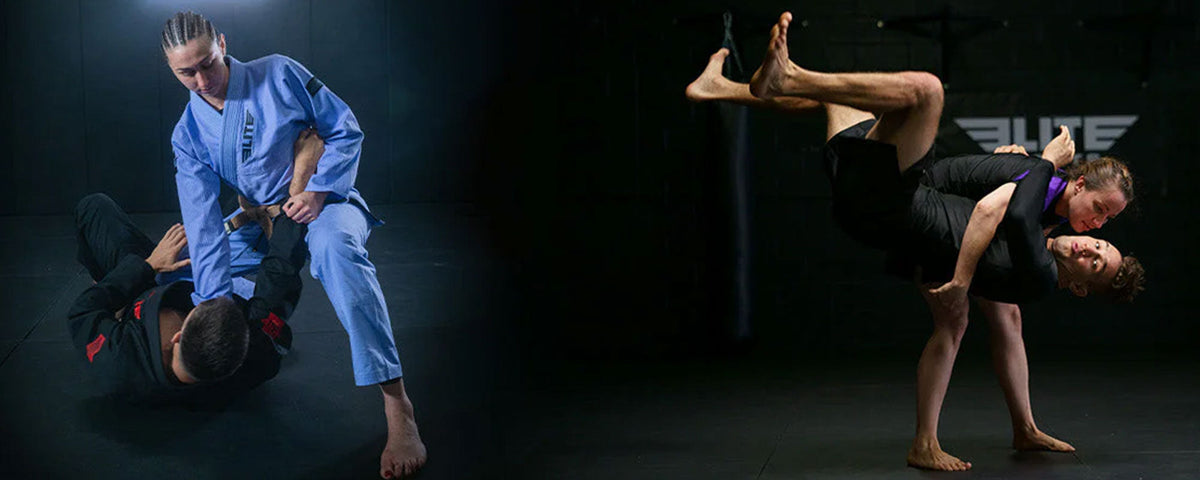
Grappling can begin from standing, where takedowns and throws become important. Once the action reaches the ground, guard, sweeps, escapes, passing, positional control and submissions become major parts of the game.

6.1. Standing and Takedowns
Grappling does not have to start on the ground.
You may learn how to control distance, establish grips, enter a takedown and finish in a controlled position. Wrestling-style single legs and double legs are common examples, while BJJ and judo introduce other entries and throws.
Getting the opponent to the floor is only part of the exchange. The position you reach after the takedown can determine what happens next.
6.2. Guard
Guard describes a family of positions where the person on the bottom uses their legs and body position to control the opponent.
That can seem counterintuitive when you first see it. In many other sports, being underneath another person would mean losing the position. In BJJ, the bottom player can use guard to manage distance, attack, sweep and create opportunities to move.
6.3. Sweeps
A sweep allows the person on the bottom to reverse the position and come on top.
Guard work therefore involves more than staying safe underneath an opponent. Frames, grips, angles and timing can help disrupt balance and create an opportunity to change positions.
6.4. Escapes
Escapes help you get out of a position where your opponent has established control.
Take mount as an example: an escape can involve creating space, controlling your opponent's position and moving your hips until you recover a more favorable position.
The exact movement changes with the situation. The basic idea stays straightforward — improve your position before looking for the next attack.
6.5. Guard Passing
Guard passing is the process of getting around an opponent's leg and body control so you can establish a stronger position.
Different passes use pressure, movement, changes of angle or control of the legs and hips. You may learn several approaches because the same pass does not feel the same against every training partner.
6.6. Positional Control
Once you pass the guard, you may work toward positions such as side control, mount or back control.
These positions restrict movement and create opportunities to advance or attack. Learning how to hold a position is just as useful as learning how to reach it.
6.7. Submissions
Submissions are techniques designed to make an opponent signal that they want the action stopped.
Chokes and joint locks are common examples. Beginners learn these gradually, with controlled practice and safe training taking priority over trying to finish an attack as quickly as possible.
7. Are Women's Grappling Techniques Different From Men's?
The techniques themselves are not separated into a completely different system for women and men. The way an individual uses them can change considerably.
A technique that feels easy against someone close to your size can feel different against a partner with longer legs, a wider base or significantly more body weight. You may need to adjust your angle, timing, frames or positioning.
Body proportions can influence which positions feel natural as well. Someone with long legs may enjoy certain guard positions, while another athlete may prefer wrestling entries, pressure passing or a different guard style.
Training with different body types gradually teaches you which details need adjustment. The technique remains familiar, but the way you apply it becomes more adaptable.
8. Women's BJJ vs No-Gi Grappling
Brazilian Jiu-Jitsu can be trained with a Gi or without one.
| Gi BJJ | No-Gi BJJ | |
|---|---|---|
| Clothing | Gi jacket and pants | Rash guard and grappling shorts or other close-fitting training clothing |
| Grips | Clothing grips are part of the game | No traditional Gi grips |
| Common control areas | Sleeves, collar, jacket and body | Head, arms, wrists, legs and hips |
| Training feel | More friction and clothing-based grips | Faster grip changes and more body control |
| Competition | Rules depend on the organization | Rules depend on the organization |
Gi training gives you a jacket and pants that become part of the grappling system. Sleeves, collars and other parts of the uniform can become gripping points.
No-Gi removes those traditional clothing grips. A collar grip, for example, is no longer available in the same way. Athletes rely more heavily on controlling the head, arms, wrists, legs and hips.
The training can feel different even when the position is familiar. Trying both formats can give you a much better sense of which style you enjoy.
9. What Is Women's No-Gi Grappling Like?
No-Gi grappling removes the traditional Gi grips, which changes how athletes control one another.
You will see people controlling the head, wrists, arms, legs and hips while using body position to limit movement and create openings.
Clothing also behaves differently. A rash guard keeps the upper body covered without loose fabric, while grappling shorts or compression layers need to move with the body during guard work, takedowns and scrambles.
Women's No-Gi classes can be mixed or women-only depending on the academy.
10. Is No-Gi BJJ the Same as Submission Grappling?
The terms are closely related, but they describe different things.
No-Gi describes a format of BJJ training or competition in which athletes do not use the traditional Gi. The clothing changes the available grips and influences how athletes control each other.
Submission grappling is broader. A submission grappling ruleset can bring together techniques from BJJ, wrestling, judo and other grappling disciplines. A No-Gi BJJ match can therefore be considered submission grappling in some competitive contexts, but the terms are not interchangeable in every setting.
The difference becomes clearer when you look at what the competition rewards. Some events are built around BJJ positions and scoring, while others place greater emphasis on takedowns, submission attempts or a particular ruleset.
11. Women's Grappling vs Wrestling vs MMA
These sports share plenty of techniques, but the training priorities are different.
| Sport | Main emphasis | Common training focus |
|---|---|---|
| Brazilian Jiu-Jitsu | Ground control and submissions | Guard, passing, escapes, positional control and submissions |
| Wrestling | Takedowns and control | Entries, takedowns, scrambles and top control |
| MMA | Grappling combined with striking | Takedowns, clinch work, ground fighting, striking and cage work |
| Submission grappling | Grappling and submissions | Takedowns, positional control, escapes and submissions |
Wrestling puts major attention on takedowns, control and scoring or pinning positions. Brazilian Jiu-Jitsu gives more attention to positional control, escapes and submissions. MMA combines those grappling skills with striking, clinch work and fighting against the cage.
Submission grappling sits closer to the BJJ side of the spectrum because submissions and positional control play such a large role.
Watching the sports makes these differences easier to see. A wrestling match can spend a large portion of its time fighting for takedowns and top control. A BJJ match can spend considerable time working from guard and searching for submissions.

12. What Do Women Wear for BJJ and No-Gi?
The clothing you need starts with the class format.
Gi BJJ generally requires a BJJ Gi and belt. No-Gi BJJ and submission grappling commonly use a fitted rash guard with grappling shorts, although some women prefer compression shorts or spats underneath.
A first class does not require a complete collection of specialized clothing. A fitted athletic top and suitable shorts may be enough for a No-Gi class that permits them.
For regular Gi training, you can build a wardrobe around different Gi weights, colors and fits.
13. What Makes Women's Grappling Gear Different?
The physical demands of grappling are the same regardless of who wears the clothing, but fit can create different problems for different body shapes.
A pair of shorts might sit comfortably around the waist and feel restrictive through the hips or thighs. Another pair might leave enough room through the legs but feel loose around the waist.
Look at the relationship between your waist, hips and thighs when judging fit. Rise plays a role too — a pair can feel comfortable while standing and shift once you sit into guard, bridge or move through a scramble.
The thigh opening, inseam, liner placement and crotch construction all contribute to how the garment behaves.
14. What Fabric Should Women Look for in Grappling Clothing?
Fabric changes the way clothing feels throughout a training session.
Synthetic materials such as polyester and nylon are common in grappling clothing. Elastane or spandex may be added to provide stretch.
Pay attention to four things when comparing materials: how far the fabric stretches, how well it recovers, how it handles moisture and how quickly it dries. Repeated contact with mats and training partners also puts wear on the fabric.
Fabric weight changes the feel of a garment as well. A lighter material may feel more comfortable in a hot gym, while heavier fabric can feel more substantial.
15. Why Do Seams Matter in Grappling Clothing?
Seams can become noticeable when clothing repeatedly bends, stretches or presses against the mat.
A seam positioned directly in a high-friction area may feel different from one placed away from the pressure point. Reinforced stitching can add strength to areas that experience repeated pulling.
Flatlock stitching can reduce the raised edge against the skin. A gusset can provide additional room around the crotch for movement.
Construction tells you how a garment was designed. It still needs to work with your particular body shape and fit.
16. What Waistband Should Grappling Shorts Have?
Grappling shorts commonly use elastic, an internal drawcord or both.
Elastic provides the basic hold. An internal drawcord allows a more precise adjustment when the waist needs tightening.
A wider waistband distributes pressure over more of the waist. A flat waistband can reduce bulk against the body.
Move around in the shorts before deciding whether the waistband works for you. Squatting, sitting and bringing your knees toward your chest will reveal more than standing in front of a mirror.
17. What Makes Grappling Shorts Different From Regular Gym Shorts?
Regular athletic shorts can work for some grappling sessions, but ground training puts different demands on them.
You spend time sitting, squatting, sprawling and moving against another person. Pockets, hard hardware and excess fabric can become inconvenient.
Grappling shorts commonly use stretch fabric, an adjustable waistband, reinforced construction and a cut designed for ground movement.
If you already own athletic shorts, put them through a few normal grappling movements before buying another pair. Watch what happens to the waistband, thigh opening, seams and fabric when your body changes position.
18. How Should Women Choose Grappling Shorts for Their Body?
Start with measurements rather than the product photograph.
Measure your waist where the waistband will sit. Then measure around the fullest part of your hips and seat. If the manufacturer provides a thigh measurement, compare that with the fullest part of your thigh as well.
A waist measurement alone does not tell you how the shorts will fit through the hips. Someone between sizes may need to consider both measurements before choosing.
Rise and inseam deserve attention too, particularly if you already know that shorts tend to feel too short or restrictive during ground movement.
19. Women's Grappling Shorts vs BJJ Shorts vs MMA Shorts
The terminology overlaps, but the products can have different intended uses.
BJJ shorts generally describe shorts designed for Brazilian Jiu-Jitsu and No-Gi training. Grappling shorts can cover a wider range of submission grappling clothing.
MMA shorts may look similar while using a cut or construction intended for mixed martial arts training.
The name on the product page tells you less than the construction. Look at the waistband, fabric stretch, length, seams, pockets and hardware before deciding whether a pair suits your training.
20. What Are Women's No-Gi Grappling Shorts?
Women's No-Gi grappling shorts generally use lightweight synthetic fabric with stretch, an elastic waistband and some form of adjustment.
Some designs use a single outer layer. Others combine an outer short with an inner compression layer.
A two-layer design can provide additional coverage without requiring a separate compression garment underneath. The inner layer still needs to sit comfortably around the thighs and hips.
Women-specific designs can account for differences in waist, hips, thighs and rise. Other products use unisex patterns. Actual measurements tell you more than the label alone.
21. Should Women Wear Compression Shorts or Spats?
Compression shorts provide a close-fitting layer around the upper legs. Spats extend farther down the legs and provide additional coverage.
Some women prefer a compression layer underneath grappling shorts. Others are more comfortable wearing shorts alone.
The choice can also change with the type of training. Someone who dislikes exposed skin during ground exchanges may prefer the additional coverage of a liner or spats, while another athlete may want the lighter feel of a single layer.
22. What Length Should Women's Grappling Shorts Be?
Shorter shorts expose more of the thigh and reduce the amount of material around the leg. Longer shorts provide more coverage.
The same nominal length can feel different depending on your rise, thigh shape and the cut of the garment. Looking at the actual inseam gives you a better idea of where the hem will sit.
Competition rules can place additional limits on length. Under current IBJJF rules, women's No-Gi shorts must cover at least halfway down the thigh and must not extend more than about 15 cm (6 inches) above the knee. The rules also specify that shorts cannot have pockets unless those pockets are completely stitched shut. Buttons, zippers, exposed drawstrings and plastic or metal components that could present a risk to an opponent are also prohibited.
23. High-Cut Shorts or Longer Shorts?
A higher cut leaves more of the thigh exposed and reduces fabric around the leg.
Longer shorts offer more coverage and may feel better for someone who prefers a lower hem.
If your thighs are fuller or more muscular, compare the actual thigh opening and inseam instead of relying on the model photograph. Two shorts with similar listed lengths can fit very differently.
24. The Five-Move Floor Test
A new pair of shorts can look fine while standing still and behave differently once you start moving. Five simple movements can reveal most of the obvious fit problems.
- Deep squat: Watch the waistband and seat. Notice whether the waistband digs into your waist or the seat pulls sharply.
- Knees to chest: Check the rise and thigh opening. The fabric should move with your legs without pulling hard across the hips.
- Shrimp: Watch the waistband and side seams as your hips move. Twisting, sliding or sharp pulling deserves attention.
- Bridge: Focus on the waistband and seat. Significant shifting can become distracting once you start training.
- Sit back into guard: Check the liner, thigh opening and seams. A liner that rolls or seams that press into the skin can point toward a different size or cut.
The test takes only a few minutes and gives you useful information that a product photograph cannot.
25. What Should Beginners Wear to Their First No-Gi BJJ Class?
Keep your first outfit simple.
A fitted athletic top or rash guard with suitable athletic shorts can work for a beginner. Avoid loose clothing and exposed hard hardware that could interfere with training.
You do not need to build a competition wardrobe before attending your first lesson. Start with clothing suitable for the class, learn what feels comfortable during training and add specialized pieces as your routine develops.
26. What Gear Does a Woman Need for Grappling?
A basic No-Gi setup can be surprisingly small.
A rash guard, suitable grappling shorts and, if you prefer one, a compression layer cover the basic clothing side of many No-Gi classes. A mouthguard may also be useful or required depending on the training environment.
Gi training adds a properly fitted Gi and belt. Water and a towel are useful additions for regular sessions.
27. How Can Women Build a Practical Training Wardrobe?
Your schedule tells you how much clothing you actually need.
One or two weekly sessions leave more time to wash and dry your training clothes. Several sessions each week require a little more planning.
Consider a 6 a.m. class followed by another session the next morning. The clothes from the first session need to be washed, dried and ready again. The same problem appears with Gi training - leaving a damp Gi inside a closed bag until the next morning can turn a simple laundry task into an unpleasant surprise.
Competition preparation adds another layer. Clothing that works perfectly well for everyday training may not meet a tournament's uniform requirements.
28. How Can Women Improve Their Grappling Skills?
Improvement becomes easier when you learn positions instead of collecting isolated techniques.
Start by identifying where you are and where you want to go. Under side control, you may need to escape or recover guard. From guard, you may work toward a sweep or submission. On top, your next task may be passing, controlling or advancing your position.
The pieces begin connecting with experience. A guard pass can lead to side control. Side control can lead to mount. An escape from mount can return you to guard. A failed submission can create a scramble and lead somewhere completely different.
Learning grappling is therefore more than memorizing techniques - you are learning how one position leads into another.
29. How Does Training With Different Partners Affect Progress?
Every training partner gives you a slightly different problem.
A partner with long legs may make certain guard positions feel unfamiliar. A heavier partner may make pressure and frames more noticeable. A faster partner may force you to work on timing.
That variety teaches adjustment. Grappling does not happen against a standardized body, so learning how to adapt becomes part of the skill itself.
Controlled training also gives both partners room to learn. You can work through the position without turning every drill into a competition.
30. How Can Watching Grappling Videos Help?
Videos can make a position easier to understand before you try it yourself.
Instead of watching dozens of techniques at once, focus on one position or movement. Look at what happens immediately before the technique begins. Notice where the athlete places the hands, hips and legs. Then watch how the position changes.
That approach can make a short video much more useful than simply collecting techniques.
Bring questions from what you watched into your next class. A coach can see your movement in person and help you make adjustments that a screen cannot show.
31. Can Women Compete in Grappling?
Women compete in BJJ, No-Gi and submission grappling events across different organizations.
Preparing for competition involves more than learning techniques. You need to know your division, weigh-in procedure, registration details, uniform requirements and event rules.
Competition clothing deserves particular attention because the rules for a tournament may not match the clothing you normally use in training.
32. What Are the Current IBJJF Clothing Rules for Women?
For IBJJF competition, women's No-Gi shorts must cover at least halfway down the thigh and cannot extend more than about 15 cm (6 inches) above the knee. Pockets are not permitted unless they are completely stitched shut.
IBJJF also prohibits buttons, zippers, exposed drawstrings and plastic or metal components that could present a risk to an opponent.
Women may wear shorts, compression shorts, compression pants or skin-tight spats in the permitted black, white, black-and-white, and rank-color combinations. Unlike the men's division, women are also permitted to compete in full-length spats on their own, without board shorts worn on top.
The No-Gi rash guard must be elastic and skin-tight and must cover the torso down to the shorts' waistband, showing the permitted percentage of rank color.
Women competing in Gi divisions must wear a stretchy or elastic shirt that hugs the body underneath the Gi. It can be short- or long-sleeved and does not have to follow the No-Gi color requirements.
For the exact current requirements before a tournament, always confirm against the official IBJJF rulebook, since federations periodically update uniform specifications.
33. How Should Women Care for Grappling Clothing?
Training clothing picks up sweat and should be washed after use rather than left inside a closed bag.
Follow the garment care label for washing temperature and drying instructions. High heat can affect elastic materials and fabric shape when the manufacturer advises against it.
Let clothing dry thoroughly before storing it.
A quick check after washing can also catch changes in stretch, seams, waistbands or fit before they become noticeable during training.
34. Common Questions About Women's Grappling
What should I buy first if I am completely new to grappling?
Start with what your first class actually requires. A No-Gi student may only need a suitable athletic top and shorts, while a Gi class requires a Gi and belt. There is little reason to buy specialized competition gear before you know what type of training you enjoy.
How can I tell if grappling shorts fit correctly before training?
Use your measurements first, then try the shorts through movement. A deep squat, knees to chest, shrimp, bridge and seated guard position can expose problems that are easy to miss while standing.
Why do shorts that fit my waist sometimes feel wrong during BJJ?
Waist size does not describe your entire lower body. The relationship between your waist, hips, thighs, rise and inseam can change how a pair behaves during ground movement. A comfortable waistband does not guarantee that the rest of the garment has enough room.
Is women's BJJ or No-Gi better for learning grappling?
They teach overlapping skills through different clothing and grip systems. Gi BJJ gives you jacket and sleeve grips, while No-Gi relies more heavily on body control. Trying both formats can show you which style of training you enjoy.
Do I need competition-specific clothing for normal grappling classes?
No. Training clothing and competition clothing serve different purposes. Everyday training can focus on comfort, movement and durability. Competition clothing also has to meet the requirements of the organization running the event.
35. Final Thoughts
Women's grappling is a broad part of combat sports that includes BJJ, No-Gi, wrestling and submission grappling. The techniques can take you from standing exchanges into guard, passing, positional control, escapes and submissions.
The training side is just as important as the technique itself. Finding an academy where beginners receive proper instruction, training partners communicate well and the pace allows you to learn can make the first few months much easier.
Clothing becomes simpler once you understand your own routine. Someone attending two classes a week has different needs from someone training six times a week. Someone focused on Gi BJJ will build a different wardrobe from someone who spends most of their time in No-Gi.
Fit deserves attention too. Look at your waist, hips, thighs, rise and inseam instead of relying only on a product photograph. Then move in the clothing before deciding whether it works.
A deep squat can reveal one problem. A shrimp can reveal another. Sitting into guard can show you what happens when the garment actually meets the movements you perform during training.
Competition adds its own requirements, particularly when you enter an organization with specific uniform rules such as the IBJJF.
Once those practical pieces are in place, you can focus on the part that brought you to the mat in the first place: learning how to move, solve positions and become better at grappling.



Leave a comment
This site is protected by hCaptcha and the hCaptcha Privacy Policy and Terms of Service apply.