
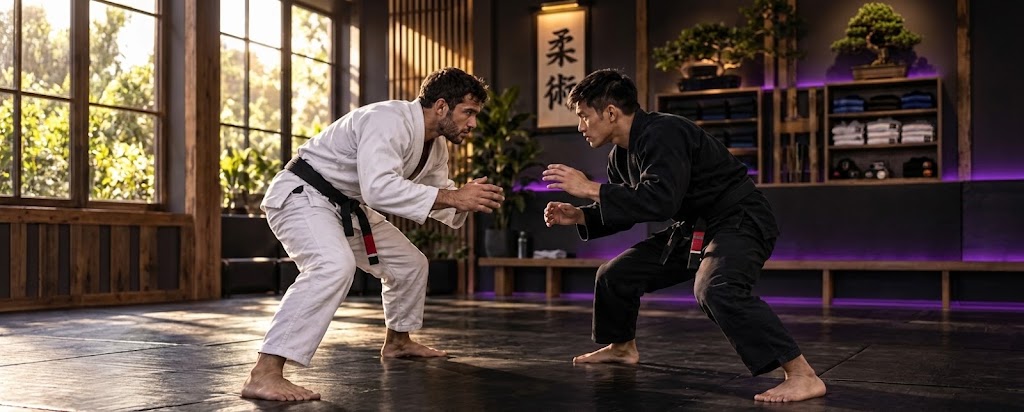
Quick Answer: What Are the Types of BJJ Players?
The main types of BJJ players are the wrestler, the guard player, the pressure player (tank), the leg locker, the scrambler and the technician. Each has a signature way of winning and a predictable weakness, and most grapplers combine one main style with traits from the others as they improve.
- Wrestler: wins with takedowns, control and relentless pace.
- Guard player: wins from the bottom with grips, sweeps and patience.
- Pressure player (tank): wins on top with heavy, efficient weight.
- Leg locker: wins by controlling and attacking the lower body.
- Scrambler: wins with speed, transitions and constant movement.
- Technician: wins with timing, small details and efficiency.
Table of contents
Walk into a jiu-jitsu gym in a city you have never visited and you will not know a single face. Give it ten minutes and you will still know everyone. There is the person already crouched in a wrestling stance while the rest of the room fixes their belts. There is the one who sits down the second a round starts. There is the heavy partner who makes side control feel like a parked car. There is the one who stares at your feet like a menu.
These are the main types of BJJ players, and once you can recognize them, rolling gets easier to read, easier to plan and a lot more fun.
The six types of BJJ players are the wrestler, the guard player, the pressure player (often called the tank), the leg locker, the scrambler and the technician. Each one has a signature way of winning and a predictable hole in the game. Most grapplers lean toward one type early on and slowly borrow from the others as they progress.
This is not a list of techniques. Think of it as a field guide to the people you will actually train with: what they believe about themselves, what they are really like to roll against, and what to do about it.

1. Types of BJJ Players
Player type |
Main strength |
Common leak |
Best way to handle them |
|---|---|---|---|
Wrestler |
Takedowns, control, relentless pace |
Neglects submissions, leaves arms exposed |
Make them pay for sloppy limbs, keep your frames and guard alive |
Guard player |
Comfort on bottom, grips, sweeps |
Weak standing game, struggles once passed |
Pass patiently, stay heavy, never rush into their traps |
Pressure player (tank) |
Heavy, patient top control |
Slow in chaotic transitions |
Move early, keep angles, do not fight weight with strength |
Leg locker |
Lower-body control and entanglements |
Over-chases feet, can be tunnel-visioned |
Stay out of entries, control the hips, learn basic leg defense |
Scrambler |
Pace, transitions, hard to pin |
Creates their own problems, tires fast |
Stay calm, slow the pace, let them make the mistake |
Technician |
Efficiency, timing, details |
Can get frustrated by ugly, resistant rolling |
Make it messy and pressure the details they rely on |


1.1 The Wrestler
You can spot the wrestler before the round even begins. Knees bent, neck thick, hands out front, eyes on your hips. While everyone else is tying a belt, the wrestler is already mentally shooting a double leg.
Wrestlers arrive in jiu-jitsu with a head start that beginners underestimate. They know how to move another human being somewhere that person does not want to go. That is not just takedowns. It is head position, inside control, pressure, balance, timing and the willingness to explode when a door opens.
The best quality a wrestler has is relentlessness. You defend the first shot and think you are safe. Then comes a second attempt, then a body lock, then a mat return, and suddenly you are underneath someone who seems personally offended by the idea of guard. They do not need the exchange to look pretty. They only need it to keep moving their way. That mentality travels with them into every position. If you are in half guard and recover your knee, they simply try again.
That is also where the leak lives. Some wrestlers treat submissions as optional side quests. They can dominate an entire round and then leave an arm somewhere no sane grappler would leave it. A calm guard player looks at that and sees a gift.
How to beat a wrestler in BJJ: do not fight their strongest game. Keep your hands busy with frames and grips on the feet, create angles instead of meeting force with force, and play a guard that makes top pressure uncomfortable. If you want to see how this looks at different experience levels, our breakdown of a wrestler against BJJ belts shows how the matchup changes as the belts get higher, and how rules, fatigue and round order change a wrestling vs BJJ match explains why the same two people can get very different results.
If you are the wrestler, your next project is simple: learn to enjoy bottom position, and learn to finish.

1.2 The Guard Player
If the wrestler looks at standing grappling and thinks the fight is about to start, the guard player looks at it and thinks, why are we wasting time? Then they sit down in front of you with zero apology.
The guard player has made peace with the floor. More than peace, really. They own real estate down there. They know which grip leads where, which angle opens which sweep, and how to make a position that looks hopeless feel strangely inconvenient for you.
Their biggest strength is comfort underneath another person. Most beginners hate being on the bottom. Guard players built a whole game around it: frame, create distance, off-balance, recover, attack. A great one makes passing feel less like a physical contest and more like paperwork. You clear one grip and another appears. You almost pass and a knee shows up from nowhere.
The best guard players are patient. They want you to move, because movement causes reactions and reactions create openings.
The weakness is the other half of the sport. Some guard players develop a beautiful bottom game and a standing game that mostly consists of sitting down faster. Their cardio on their feet becomes theoretical, and when a pass finally lands you can almost watch the system reboot.
How to beat a guard player: pass with structure rather than speed. Control the hips, keep your posture, and do not walk into positions where their legs have the best leverage. These guides help: how top half guard control beats rushing the pass, the easiest passing system for gi and no-gi, and body lock passes and their types. If you are the guard player, the 4 corners rule for guard retention will keep that real estate from getting repossessed.


1.3 The Pressure Player (the Tank)
Every gym has one. Sometimes he is enormous. Sometimes he is not even that big, which is worse, because a real pressure player is defined by how weight is used, not how much there is.
The tank gets on top and gravity suddenly joins the academy. Nothing dramatic happens, and that is the horrible part. No explosion, no wild scramble. Just slow, educated, patient pressure. You frame and the frame disappears. You make space and the space gets removed. You try to breathe and, well, you will have to negotiate.
The tank's greatest skill is making ordinary positions miserable. Side control becomes a personal crisis. Half guard becomes a mortgage. Mount becomes a long conversation with your life choices.
What separates a good pressure player from someone who just lies on you is weight distribution. Anybody can lie on a person. The tank knows exactly where to put weight so you end up carrying it, when to relax, when to tighten, and when to move half an inch instead of six. That efficiency is why they often look lazy while you are fighting for your soul. The tank appears to be waiting for a bus.
The downside is mobility. If a position turns chaotic, the tank may discover that the floor has speed limits. And a tank who relies on size instead of skill can be exposed by smaller, technical grapplers. But the technical version is bad news, because now the weight has software.
How to beat a pressure passer: move early, before the weight settles. Angles, hip movement and recovering your frames in the first seconds matter far more than strength. To understand why small shifts decide these exchanges, read how to master weight distribution in BJJ.
1.4 The Leg Locker
You are doing normal jiu-jitsu. Passing, framing, maybe a little pressure. Then the leg locker notices your foot and looks at it the way you look at dessert.
The leg locker has a different map of the human body. Most people see two arms, two legs, a torso and a head. The leg locker sees projects. A foot appears for half a second and their attention leaves the rest of the match entirely.
The myth is that leg locking means grabbing a foot and cranking something odd. At a high level it is much more organized than that. Good leg entanglement players think in terms of control: position, alignment, distance, rotation, escapes, counters. They are not chasing random submissions, they are building a system for controlling the lower body. Many grapplers spend years thinking about the upper body and then meet someone who treats legs like an entire second sport.
The downside is obsession. Leg lockers can become that friend who discovers a new topic and brings it into every conversation. Passing guard? Leg lock. Mount? Leg lock. Lunch? Inside position, please.
There is also a safety side to this style. Leg attacks put torque on knees and ankles, and the damage can happen faster than the pain warns you. Many gyms and competitions limit which leg locks are allowed at lower belt levels, so check your academy's and event's rules, and tap early and often. For the cautionary side of grappling, see dangerous BJJ submission techniques you should avoid.
How to beat a leg locker: do not feed them your feet. Control the hips, keep your legs from getting trapped in the first place, and learn the basics of leg-lock defense before you need them. Even if you never plan to attack the legs, you have to understand them, because eventually someone will grab your foot and your education becomes urgent.

1.5 The Scrambler
The scrambler does not believe in stable positions. Stable positions are for people with patience. The scrambler wants movement, transitions, half-finished attacks and bad angles that somehow become good ones.
This partner is exhausting. You almost pass and they invert. You almost take the back and they roll. You almost settle into side control and they create a scramble so confusing that both of you briefly forget whose guard it is.
Their main weapon is pace, and not only cardio. They are comfortable making decisions fast. While others wait for a clean position before acting, the scrambler acts while the position is still being invented. In competitive grappling, where transitions can decide a match, that matters a lot. Scramblers are hard to pin, hard to settle and very hard to make boring.
But chaos cuts both ways. Constant scrambling also creates openings. A calm opponent can wait for the scrambler to manufacture their own problem. Sometimes a scrambler escapes a bad spot, strings together three beautiful transitions, nearly takes the back, loses it, flips, attacks, misses, and ends up in exactly the same bad position from forty seconds earlier. The audience thinks "amazing." Then they think "why?"
How to beat a scrambler: refuse to play their speed game. Take slower, safer steps, keep your base, and make them work for every inch. Their gas tank is often their real opponent. To build the movement skills that scramblers rely on (or to start building them yourself), try these 12 BJJ movement drills, and read control-based vs movement-based jiu-jitsu to see where the scrambler fits in the bigger picture.
1.6 The Technician
The technician is the one everyone wants to become. At least in theory: calm, efficient, precise. And annoying, because they never look like they are working hard.
You are using everything you have: frames, strength, explosiveness, cardio, childhood memories. The technician changes one grip, shifts one knee, adjusts one angle, and your entire plan quietly gets cancelled.
What sets them apart is details, not a bigger pile of moves: where the elbow points, where the weight sits, when a grip matters and when it does not, how much space is enough, how much pressure is actually necessary. That is why they often look slow. They are not slow, they are early. If you are early, you never need to rush. The problem is solved before it becomes dramatic.
The worst part of rolling with a technician is that they make you feel responsible for your own suffering. The wrestler forces the issue. The tank crushes you. The scrambler overwhelms you. The technician lets you make one small mistake and quietly builds a house on it.
The weakness is perfectionism. Some technicians want the clean answer so badly that messy resistance irritates them. Real rounds are ugly. People do stupid things, move wrong and refuse to give textbook reactions. The best technicians learn to stay clean without needing the world to cooperate.
How to beat a technician: make the round ugly. Disrupt their rhythm, stay unpredictable, and do not give them the exact reaction they are waiting for. Basic habits help here, so revisit how to stop being the beginner who feels lost if you are still building your fundamentals.
2. One Position, Six Different Brains
The clearest way to see the types is to put all six in the same position. Take half guard:
- The wrestler sees a place to drive and flatten.
- The guard player sees an entire operating system.
- The tank sees a place to make you regret breathing.
- The leg locker sees your lower body getting suspiciously close.
- The scrambler sees a temporary inconvenience.
- The technician sees the one detail everyone else is ignoring.
Same position, six different brains. Two students can take the same class from the same coach and six months later barely be playing the same game. One falls for pressure, another for movement, another for control, another for timing. That is not a flaw in the art. It is one of the main reasons people stay in jiu-jitsu for years: the system is wide enough to let your personality leak into your technique.
3. How to Find Your BJJ Player Type
Not sure which one you are? Ask yourself a few honest questions after your next few rounds:
- Where do I feel comfortable? On top, on bottom, or in the middle of a scramble?
- What do I reach for when I am stuck? Force, speed, patience, or a new angle?
- What do training partners say after rolling with me? "Heavy," "slippery," "annoying," or "I never saw it coming"?
- Which part of my game do I secretly avoid? That is usually your weakest position, and the next thing to train.
Your answers rarely produce a perfect match. Most people are one main type with a bit of a second. That is normal, and it is the starting point, not the destination. If you are brand new, our guide to what feels normal in your first classes is a good place to start before you worry about labels at all.
4. Does Body Type or Age Decide Your Style?
It influences it, but it does not lock you in. Heavier, stronger grapplers often drift toward pressure and top control. Lighter, more mobile ones often enjoy guard work, scrambling and movement. People with a wrestling or judo background tend to start on their feet. Those are tendencies, not rules, and plenty of grapplers build great games that go against their body type.
If size is a concern, these strategies for smaller fighters show how to turn a disadvantage into a plan. And a background in standing grappling is easier to use than people think, which is the point of how much judo you really need in BJJ.
Your style will change as you do. Injuries, age, training partners, gym culture and your own curiosity will all reshape it.
5. Gi vs No-Gi: How the Types Change
The same person can play very differently depending on what they wear. In the gi, grips on lapels, sleeves and pants tend to reward patient guard players, pressure passers and technicians, because there is more to hold and control. In no-gi, the lack of fabric tends to reward wrestlers, scramblers and leg lockers, who thrive on speed, scrambles and lower-body control. These are general tendencies, not guarantees, but they explain why many grapplers feel like a different athlete when they switch. For a fuller comparison, see gi vs no-gi BJJ and which to start with.
Whichever type you are, gear that fits well matters more than most people admit. A gi that is too loose gives a guard player free grips, and one that rides up or tears slows a wrestler down. If you are choosing one, how to choose a BJJ gi based on your body type is worth a quick read, and when you are ready to compare options, you can browse our full BJJ gi collection.
6. Which BJJ Player Type Is Best?
Wrong question. Each type brings something real:
- The wrestler brings pressure and control.
- The guard player brings patience and reactions.
- The tank brings weight and positional dominance.
- The leg locker brings a completely different map of the lower body.
- The scrambler brings movement and adaptability.
- The technician brings efficiency.
The truly scary grappler is the one who starts combining them. A wrestler who is comfortable on bottom. A guard player with real takedowns. A tank who can move. A leg locker with a strong passing game. A scrambler who knows when to settle. A technician who can turn ugly when the clean answer disappears. At that point an archetype stops being a limitation and becomes a weapon. If you want help deciding how aggressive to be while you build all this, defensive or offensive: which approach is right for BJJ is a useful companion.
There is also a fun side effect. Once you know these types, you can sometimes read a partner's belt level and background within a minute of rolling, which is exactly the game behind guessing a BJJ belt after one minute of rolling.
7. Frequently Asked Questions About BJJ Player Types
What are the main types of BJJ players?
The six most common types of BJJ players are the wrestler, the guard player, the pressure player (tank), the leg locker, the scrambler and the technician. Many grapplers are a mix, with one dominant style and traits from others.
What is the difference between a guard player and a guard passer?
A guard player is comfortable on the bottom and attacks with sweeps and submissions from guard. A guard passer works from the top to get past the legs and establish a controlling position. Passing styles are often grouped into pressure-based and speed-based approaches, and strong passers blend both.
How do I find my own BJJ style?
Notice where you feel most comfortable, what you do when you are stuck, and what your training partners say about rolling with you. Then experiment with positions you avoid. Your natural style gets you started; your weaknesses decide what happens next.
Which BJJ style is best for beginners?
There is no single best one. A simple approach is to learn solid fundamentals (posture, frames, escapes, basic passes) while noticing which type of game feels natural, then build outward from there.
Can you change your BJJ style over time?
Yes. Most experienced grapplers do. Age, injuries, new training partners and competition rules all push a style to evolve, and a well-rounded game usually combines several types.
How do you beat a wrestler in BJJ?
Avoid giving them the exchanges they want. Keep your frames and grips active standing, create angles, defend takedowns early, and stay alert for the submissions they tend to neglect.
How do you beat a pressure passer?
Move before their weight settles. Angles, hip movement and early framing beat strength. Do not try to bench-press a heavy partner off you.
Do leg lockers have a weak point?
Leg lockers can become tunnel-visioned and sometimes neglect upper-body control and passing. Control the hips, keep your legs out of entanglements, and make them play a wider game.
8. Final Thoughts
Next time you walk into a BJJ gym, look around. The wrestler is crouched before the round starts. The guard player is already sitting. The tank is slowly walking toward someone who has made a questionable life decision. The leg locker is staring at feet. The scrambler is sweating before class has even begun. And the technician is sitting in the corner, looking completely relaxed.
That one is probably the person you should be worried about.
Use the types of BJJ players as a map, not a box. Learn what your natural style gives you, be honest about what it hides, and keep borrowing from the other five. That is how a style becomes a game, and a game becomes yours.



Leave a comment
This site is protected by hCaptcha and the hCaptcha Privacy Policy and Terms of Service apply.