
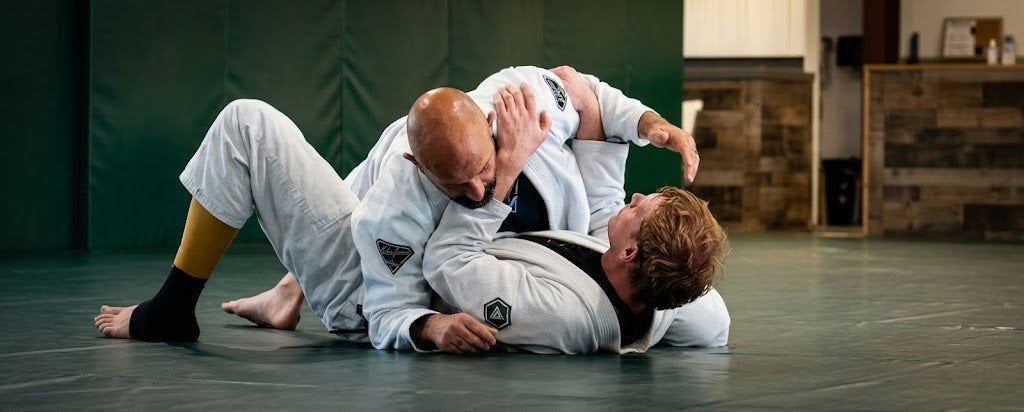
Quick Answer: You can make an educated guess about someone's Brazilian Jiu-Jitsu experience by observing their posture, positional awareness, defensive reactions, transitions, and ability to control an opponent. However, one minute of rolling is not enough to determine someone's belt rank reliably.
An experienced practitioner may demonstrate better timing, positional control, and decision-making, but these characteristics vary between individuals. A belt rank is awarded through an instructor-led promotion process, not determined by the outcome of a single sparring round.
Table of contents
Imagine stepping onto the mats with a training partner wearing a white belt. You exchange grips, move between positions, defend an attack, and try to gain control. But there is something you do not know: the person in front of you might actually be a blue, purple, brown, or even black belt.
Could you identify their actual rank after just 60 seconds of rolling?
That is the idea behind the one-minute BJJ belt guessing challenge. Instead of judging someone by the color around their waist, you have to pay attention to how they move, react, defend, and control the exchange.
It sounds simple until you try it. Someone with years of grappling experience might use very little energy, while a newer practitioner could move constantly and attempt several attacks. Strength, athleticism, previous grappling experience, and personal style can make the difference difficult to judge.
The real challenge is recognizing technical experience rather than confusing physical activity with skill.

1. How Does the One-Minute BJJ Belt Challenge Work?
The challenge follows an interesting format: 15 practitioners enter the rolling area, but everyone wears a white belt regardless of their actual rank.
The person conducting the challenge has one minute to roll with each participant and guess their real belt color.
There is no opportunity to rely on the usual visual clue. Everyone appears to be a beginner, so the only way to make a prediction is by paying attention to what happens during the exchange.
The challenge also includes a charitable element. According to the video's introduction, every incorrect prediction results in a $100 donation to the Guardian Foundation. The video describes the foundation as providing free Brazilian Jiu-Jitsu training equipment and mentorship to underserved young people.
This adds another reason to get the predictions right. Each round becomes more than an exercise in identifying an experienced grappler.
But what exactly should someone look for when trying to recognize another practitioner's experience?
2. 5 Things That Can Reveal a Grappler's Experience During Rolling
A belt color does not automatically explain everything about a person's ability. However, certain habits can provide useful clues when watching someone grapple.


2.1 Posture and Body Positioning
One of the first things to observe is how someone positions their body.
A beginner may struggle to maintain posture while defending guard, particularly when an opponent controls their head, arms, or balance. They might lean too far forward, expose their arms, or use unnecessary strength to escape an uncomfortable position.
A more experienced practitioner may understand how posture affects balance and control.
Instead of immediately forcing an escape, they may adjust their weight, establish a better base, and work toward improving their position.
Good posture is not simply standing or sitting upright. It means maintaining a position that allows you to defend, attack, and transition without unnecessarily exposing yourself.

2.2 Defensive Awareness and Reactions
Attacking is exciting, but defensive ability can reveal a great deal about someone's grappling experience.
Watch how a practitioner responds when an opponent establishes side control, mount, or back control.
Do they immediately panic and attempt to push their opponent away? Do they leave space for submissions? Or do they recognize the danger, protect their arms and neck, and begin working toward an escape?
Experienced practitioners often understand that defending a position requires several connected actions rather than one explosive movement.
For example, escaping mount may require creating frames, controlling distance, moving the hips, and recovering guard.
A person who understands these details may make an escape look surprisingly effortless.
2.3 Guard Retention and Positional Control
Guard retention is another useful indicator of technical development.
When someone is playing guard, pay attention to whether they can maintain distance, manage grips, recover their legs, and prevent their opponent from establishing a dominant position.
A less experienced grappler may focus on grabbing an opponent without understanding how to maintain effective defensive positioning.
Someone with more experience may use small adjustments to prevent a pass before it becomes a serious problem.
The same applies to top control.
Instead of rushing toward a submission, an experienced grappler may first secure their position, control the opponent's movement, and gradually improve their attacking opportunities.
The ability to maintain a position under resistance is often more revealing than how many techniques someone attempts.
For a closer look at this particular skill, explore our guide to BJJ guard retention drills.

2.4 Timing, Transitions, and Decision-Making
A grappling exchange rarely follows a perfectly planned sequence.
An opponent reacts, changes direction, defends an attack, and creates new opportunities. The ability to recognize those changes is an important part of Brazilian Jiu-Jitsu.
A beginner might focus on completing one technique even after the opportunity has disappeared.
A more experienced practitioner may recognize the defense and immediately transition to another position or attack.
For example:
A guard pass attempt may create an opportunity to take the back.
An opponent defending an armbar may expose a different submission.
A failed sweep may create an opportunity to recover guard.
An opponent's movement may provide an opening for a positional transition.
These reactions demonstrate an understanding of how different techniques connect.
However, not every experienced practitioner uses the same approach. Some favor pressure passing, while others prefer guard-based attacks, wrestling, takedowns, or submission chains.
The important thing is not identifying a particular style. It is recognizing whether the practitioner can adapt when their original plan stops working.
Our guide to rolling tips for Gi and No-Gi Brazilian Jiu-Jitsu explores additional aspects of effective rolling.
2.5 Energy Management and Composure
Another interesting detail is how someone manages their energy.
Newer practitioners sometimes approach every exchange with maximum intensity. They push, pull, scramble, and attempt to escape using strength, even when a smaller adjustment would be more effective.
More experienced grapplers may understand when to apply pressure and when to conserve energy.
They might appear relaxed while controlling a position, waiting for their opponent to make a mistake rather than forcing an immediate result.
This does not mean every experienced grappler rolls slowly or that athletic beginners always move excessively. Different body types, competition backgrounds, and personal styles influence how people train.
Still, composure under pressure can provide another useful clue when evaluating someone's grappling experience.
3. Why Is It So Difficult to Guess a BJJ Belt After One Minute?
Even someone who has spent years training Brazilian Jiu-Jitsu can struggle to identify another person's rank from a short exchange.
There are several reasons.
Previous grappling experience: Someone who previously trained wrestling, judo, or another grappling discipline may enter BJJ with strong balance, takedowns, and positional awareness. Their movements can look more advanced than their BJJ rank suggests.
Athletic ability: Strength, speed, flexibility, and coordination can make a practitioner appear more experienced than they actually are.
Different training styles: Not every academy emphasizes the same techniques. One purple belt may specialize in guard retention, while another may focus heavily on wrestling and pressure passing.
Limited observation time: A person might not demonstrate their strongest techniques during a short round. They may spend most of the minute defending, adjusting their position, or getting familiar with their opponent.
Different competition experience: Some practitioners compete regularly, while others focus primarily on recreational training. This can influence their confidence, intensity, and reactions during live rolling.
These differences explain why belt guessing is entertaining but unreliable as a formal assessment.
4. What Is the Difference Between BJJ Belt Ranks During Rolling?
Although it is impossible to establish someone's rank from one minute of sparring, the adult BJJ belt system represents different stages of development.
| Belt | General development | What you might observe |
|---|---|---|
| White | Learning foundational movements and positions | Developing posture, escapes, and positional awareness |
| Blue | Building a stronger technical foundation | More consistent defense, basic attacks, and guard work |
| Purple | Connecting techniques into a developed game | Improved transitions, combinations, and adaptability |
| Brown | Refining technical details and strategy | More precise control, timing, and positional decisions |
| Black | Extensive technical understanding and experience | Highly developed control, efficient movement, and strategic awareness |
These are broad descriptions, not universal performance requirements. Two practitioners wearing the same belt can have very different strengths.
Belt stripes also provide additional information about progress within a rank, although their award criteria vary between academies.
For a closer explanation, read our article about what BJJ belt stripes actually mean.
5. Does Rolling Ability Determine Your Official BJJ Belt Rank?
No. Performing well during a rolling session does not automatically make someone eligible for a higher belt.
Brazilian Jiu-Jitsu promotions are generally determined by an instructor who evaluates a student's development over time.
Depending on the academy, that assessment may consider:
Technical understanding and the ability to apply techniques against resistance.
Consistency and training experience.
Defensive ability and positional awareness.
Adaptability against different training partners.
Attitude, discipline, and contribution to the academy.
Competition performance, where relevant.
The International Brazilian Jiu-Jitsu Federation (IBJJF) also publishes graduation requirements for recognized belt ranks, including minimum ages and time requirements.
However, meeting a minimum requirement does not automatically guarantee promotion. An instructor's assessment remains important.
This is why a one-minute challenge should be treated as an entertaining test of observation, not a replacement for proper belt evaluation.
6. Try the One-Minute BJJ Belt Guessing Challenge Yourself
You do not need to be an advanced grappler to enjoy this challenge. In fact, trying it with training partners can help you become more observant about how people move.
Here is a simple way to organize your own version:
Choose your participants: Invite practitioners with different training backgrounds and experience levels.
Keep the belts hidden: Have everyone wear the same belt color or remove visible rank indicators where appropriate.
Set a one-minute timer: Each participant gets the same amount of rolling time.
Observe their movements: Pay attention to posture, defense, transitions, positional control, and composure.
Make your prediction: Guess the participant's actual belt before revealing their rank.
Compare your predictions: Review which observations helped and where your assumptions were incorrect.
Keep the rounds controlled and agree on appropriate intensity beforehand. The goal is to observe technical differences, not to turn a friendly challenge into an unnecessary competition.
You can also make the activity more interesting by asking spectators to guess each participant's belt before the actual rank is revealed.
The best part is discovering how often your first impression can be wrong.
7. Why Proper BJJ Training Gear Matters at Every Belt Level
Whether someone is attending their first class or has spent years developing their grappling game, suitable training equipment matters.
In Gi Brazilian Jiu-Jitsu, the uniform and belt are constantly exposed to gripping, pulling, and movement. A comfortable fit and durable construction help practitioners focus on training rather than constantly adjusting their equipment.
Your belt also identifies your recognized rank during training and competition. It needs to remain secure around your waist while allowing you to move comfortably.
If you need a replacement or want to prepare for your next training session, explore our Brazilian Jiu-Jitsu belts collection.
Choose the appropriate belt color for your current rank and check your academy's requirements before purchasing.
8. Frequently Asked Questions
Can you identify a BJJ belt by watching someone roll?
You can make an educated guess by observing posture, defensive awareness, positional control, transitions, and decision-making. However, rolling ability alone cannot reliably establish someone's official belt rank.
How long does it take to recognize someone's BJJ experience?
There is no fixed amount of time. An experienced coach may recognize certain technical habits quickly, but a short exchange provides limited information. Observing someone across multiple positions and training sessions gives a more complete picture.
What makes a blue belt different from a white belt in BJJ?
A blue belt generally has a stronger understanding of foundational techniques and can apply them more consistently during live rolling. A white belt is still developing basic movements, positional awareness, and defensive reactions. Individual abilities can vary considerably.
Can a white belt beat a black belt in BJJ?
Yes, it is possible under certain circumstances, but it is not a reliable indication of equal technical experience. Physical attributes, injuries, training conditions, and individual circumstances can affect the outcome of a particular round.
Does a higher BJJ belt always mean better rolling ability?
A higher belt generally represents greater recognized experience and development, but it does not guarantee that someone will outperform every lower-ranked practitioner in every situation. Size, athleticism, specialization, and previous grappling experience also matter.
Is competition necessary to earn a higher BJJ belt?
There is no universal competition requirement for every BJJ academy. Instructors generally evaluate a student's overall development, and competition may be one factor rather than a mandatory condition.
What is the hardest BJJ belt to identify during rolling?
There is no objectively hardest belt to identify. A practitioner may conceal their strengths, use an unfamiliar style, or spend the entire exchange defending. This makes distinguishing adjacent experience levels particularly challenging.
9. Final Thoughts
Guessing someone's Brazilian Jiu-Jitsu belt after one minute of rolling sounds like a simple challenge, but it reveals how much there is to observe beyond the color of a belt.
Posture, defensive awareness, positional control, timing, and decision-making can all provide clues about someone's experience. However, no single movement or successful submission can tell you everything about a practitioner.
The real lesson is that Brazilian Jiu-Jitsu is about much more than collecting techniques or wearing a particular belt color. It is about learning how to apply knowledge against resistance, adapting to different opponents, and continuing to improve over time.
Whether you are a beginner trying to understand the sport or an experienced practitioner testing your ability to read an opponent, the next time you watch a roll, pay attention to the small details. You might discover that the most experienced person on the mat is not always the one moving the fastest.




Leave a comment
This site is protected by hCaptcha and the hCaptcha Privacy Policy and Terms of Service apply.