
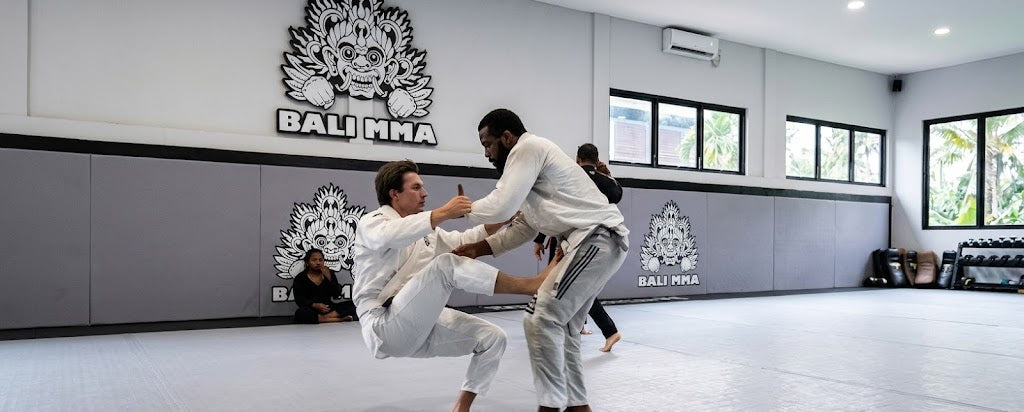
Who wins when a wrestler faces a BJJ black belt and the rules change halfway through? We break down a split-rules match: a freestyle round followed by a submission-only round with no guard pull. Learn why fatigue carries over, how match lengths compare, why a throw can score in wrestling but get you disqualified in BJJ, and how to train a mixed-rules round safely. Read the full guide on Elite Sports.
Table of contents
Most guides to wrestling vs BJJ compare the two arts on paper: takedowns on one side, submissions on the other. A wrestling vs BJJ match plays out differently. Once two athletes step on the mat, the rules, the clock and the order of the rounds matter as much as the techniques, and a split-rules format shows that better than any comparison chart.
This guide uses a recent two-round rematch as its example. Instead of repeating the usual differences between the arts, it answers a narrower set of questions: what happens when the rules change halfway through, why fatigue carries over from one round to the next, and how you can train for a mixed-rules bout.
Quick answer: In a split-rules wrestling vs BJJ match, a freestyle round tends to favor the wrestler and a submission-only round tends to favor the BJJ player. But fatigue carries over between rounds, so the athlete who manages energy across both rounds often matters more than the label on his art.

1. What Is a Split-Rules Wrestling vs BJJ Match?
A split-rules wrestling vs BJJ match is a grappling contest where each round uses a different rule set. Usually one round follows wrestling rules and the other rewards only submissions. Each athlete gets a round on familiar ground, and the interesting part is how well they adapt when the rules flip.
It is different from a normal match under a single rule set. It is also different from hybrid sports designed to blend both arts: United World Wrestling, for example, sanctions a grappling discipline that draws on freestyle wrestling, BJJ, judo, catch wrestling and sambo. A split-rules bout keeps the two rule sets separate and lets the athletes feel the contrast.
1.1. How the Rematch Was Set Up
Round |
Length |
Rules |
Extra restriction |
|---|---|---|---|
Round 1 |
5 minutes |
Freestyle wrestling, standing only, no sitting, no submissions |
None |
Round 2 |
5 minutes |
Submission only |
The BJJ athlete could not sit on the floor or pull guard |
No winner was announced. Instead, both athletes described how each round felt, and those comments are the most useful part of the match.


2. How Long Is a Split-Rules Match Compared With a Normal One?
The two rounds add up to a longer contest than a standard freestyle bout. A senior freestyle bout under United World Wrestling rules is two three-minute periods with a 30-second break, while IBJJF adult matches run from 5 to 10 minutes depending on belt.
Rule set |
Typical adult match length |
|---|---|
UWW senior freestyle wrestling |
2 periods of 3 minutes (6 minutes) |
IBJJF white belt |
5 minutes |
IBJJF blue belt |
6 minutes |
IBJJF purple belt |
7 minutes |
IBJJF brown belt |
8 minutes |
IBJJF black belt |
10 minutes |
This rematch |
2 rounds of 5 minutes (10 minutes), one rule set per round |
The wrestling round alone, at five minutes, ran close to the length of a full senior freestyle bout. A wrestler used to sprinting through two short periods has to keep the pressure on for much longer, and a BJJ athlete may face a pace he rarely sees in rolling.

2.1. Why Round Order Changes the Result
Fatigue carries over between rounds, and the order of the rules decides who pays for it. The wrestler said before the match that his plan for round one was to wear his opponent down so round two would be easier. The BJJ athlete said afterward that round two was hard because of what the first round had taken out of him.
The wrestler was not fresh either. After round one he said that some of his plan had not worked and that he was already tired. That detail matters: wearing someone out has a cost, and a lighter athlete spending explosive effort early can run low on energy too.
There is a simple reason a freestyle round is draining. It is built from short, explosive efforts such as hand fighting, level changes, shots, sprawls and throws. Jiu-jitsu rolling is demanding as well, especially for the grips and legs, but it often runs at a different rhythm, with more positional pauses. An unfamiliar rhythm can feel far more tiring than a familiar one.
Order matters because of this. With wrestling first, the BJJ athlete reaches his strongest round already tired. In theory, reversing the order would put the wrestler in that spot, although this rematch did not test it.
For an engine that holds up under this kind of pace, see our BJJ workout to improve stamina.
3. What Banning the Guard Pull Changes
Without a guard pull, the BJJ athlete has to win the standing exchange before his best game begins. Normally a BJJ player can sit or drop into guard and start working from the bottom. Taking that away means he has to bring the wrestler to the mat through a takedown or a trip, or fight from a standing clinch.
That is the area where wrestlers train the most. The BJJ athlete said he had some trouble on the feet but still tried to jump into submissions. The wrestler said there were fewer submissions and less ground grappling, and that he tried to get out every single time.
If you want to see why pulling guard is not always an option, read our article on what happens when you pull guard in the street.
4. Same Throw, Different Rule Book
A big throw is rewarded in freestyle wrestling and can get you disqualified in IBJJF jiu-jitsu. Under United World Wrestling scoring, a grand-amplitude throw is worth four points, or five if it lands the opponent directly in danger. IBJJF rules ban slams at every belt level, and a slam results in disqualification. The line between the two is control: a controlled takedown is legal in BJJ, while lifting an opponent and driving him into the mat is not.
In the rematch, the BJJ athlete said the throws hurt, and that is worth taking seriously. If you train BJJ and rarely practice falling, a wrestling-style throw can be much harder on your body than a normal sweep. Ask your coach to teach safe falling before you spar with wrestlers or judoka. For more on what is banned in competition, see our guide to illegal moves in IBJJF competition. Rules differ between events, so always check the current rulebook for yours.

5. Two Game Plans, Compared
Each athlete walked in with a different plan, and each plan carried a different risk.
Plan |
How it works |
Risk |
|---|---|---|
Wear him out early (the wrestler) |
Use the freestyle round to drain the opponent before the submission round |
Spending energy early can leave you tired too |
Beat him at his own game (the BJJ athlete) |
Match the wrestler's movement and pace in round one |
The standing exchange is the wrestler's specialty, and the BJJ athlete said his attacks met an immediate counter |
A third approach was not tested: pacing. An athlete who conserves energy in the round that suits his opponent, and saves it for the round that suits him, might look weaker early and stronger late. Whether that works depends on how much damage the early round does.
6. How to Train a Split-Rules Round
You can recreate a split-rules round safely in training, with a coach and a partner you trust. The goal is to find out what breaks when you are tired and the rules change.
- Agree on the rules first. Decide what is legal, what is banned (slams, for example) and how hard you will go.
- Round one: standing only. Work hand fighting, shots and defense for three to five minutes, with no guard pulling and no submissions.
- Round two: submissions only. Start standing and keep the no-guard-pull rule, so the BJJ player has to earn the ground.
- Note what fails. Is it your grips, your sprawl, your breathing or your decisions? That is your next training priority.
- Swap roles and repeat once you have rested.
Build the base outside these rounds. Our BJJ movement drills are a good warm-up for moving well while tired, and a fitted BJJ rash guard is a practical choice for no-gi rounds because it gives opponents less loose fabric to grab. Tap early, and stop if anyone is hurt.
7. What One Wrestling vs BJJ Match Can't Prove
A single rematch is an interesting data point, not a verdict on two martial arts. Four things limit what it shows:
- The weight gap: 17 kg is large. Our explainer on weight classes in combat sports covers why divisions exist.
- Custom rules: five-minute rounds, no guard pull and a hard rule switch are not any federation's format.
- No official result: nobody announced a score, and the comments are the athletes' own impressions.
- Two athletes: their conditioning, game plans and preparation are specific to them.
For belt-level patterns, see our guide to wrestler vs BJJ belts. For the broader differences between the arts, read BJJ vs wrestling.
8. Wrestling vs BJJ Match: Frequently Asked Questions
What is a split-rules wrestling vs BJJ match?
It is a grappling contest where each round follows a different rule set, usually one round of wrestling rules and one round where only submissions count. It shows how each athlete adapts when the rules change.
Does round order matter in a wrestling vs BJJ match?
Yes, because fatigue carries over. A freestyle round first drains energy before the submission round begins, which tends to help the athlete whose plan relies on pace. In this rematch, both athletes said the first round took a toll.
Why can't the BJJ player pull guard in some matches?
Banning the guard pull forces the BJJ athlete to win the standing exchange first. It removes his usual starting point and tests his takedowns and takedown defense.
How long is a freestyle wrestling match compared with a BJJ match?
A senior freestyle bout is two three-minute periods. IBJJF adult matches last 5 minutes at white belt, 6 at blue, 7 at purple, 8 at brown and 10 at black belt.
Is a freestyle throw the same as a slam in BJJ?
No. Freestyle scoring rewards big throws with four or five points, while IBJJF rules ban slams at every belt level and disqualify for them. A controlled takedown is legal in BJJ, and lifting an opponent and driving him into the mat is not. Always check the rules for your event.
Should BJJ players learn wrestling?
A little wrestling helps with takedowns and takedown defense, the areas where BJJ athletes are most exposed when guard pulling is banned. Start with our list of the 10 best wrestling moves for BJJ.
Who wins a wrestling vs BJJ match?
It depends on the rules, the clock, the weights and the skill level. In a split-rules match, the wrestler usually has the edge in the standing round and the BJJ athlete in the submission round, so energy often decides the rest.
9. Final Thoughts on Wrestling vs BJJ Matches
The lesson of a split-rules wrestling vs BJJ match is that energy and rules matter as much as the arts themselves. The wrestler brought pace and a plan to tire his opponent. The BJJ athlete brought a submission game that needed the right conditions to work. Both ended up tired, and both left with something to fix.
If you train either art, borrow from the other. Practice standing exchanges, learn to fall, and build a pace you can hold across more than one round. Do that, and a change of rules becomes a challenge you have prepared for instead of a surprise.



Leave a comment
This site is protected by hCaptcha and the hCaptcha Privacy Policy and Terms of Service apply.