
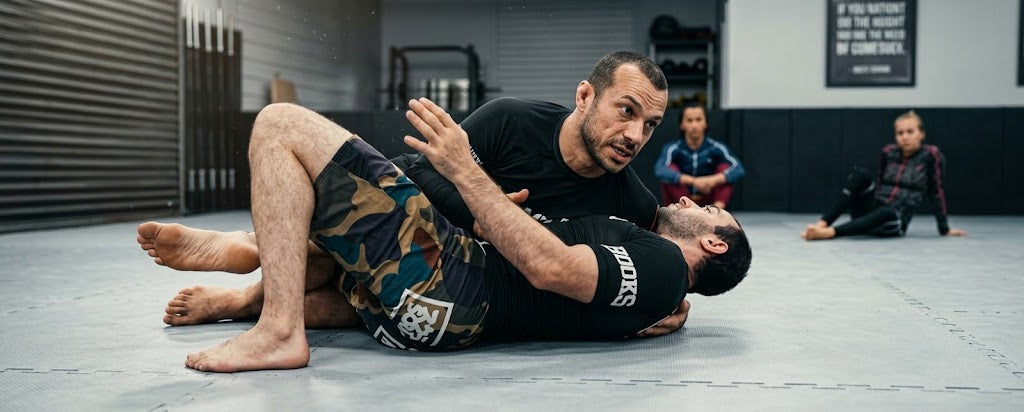
Quick answer: Top half guard is the passer's side of half guard. You have one leg trapped between the bottom player's legs, and you use crossface, hip pressure and underhook denial to flatten them. It scores no points on its own, but it drains the bottom player and sets up passes, back takes and chokes. Control first, pass second.
Table of contents
You have rolled in half guard hundreds of times. Most grapplers never stop to look at it. It is like water to a fish: it is everywhere, so nobody questions it. That is a mistake, because half guard BJJ decides more rounds than almost any other position. It is where passes are won, sweeps are set up and gas tanks run empty.
This guide explains what half guard is, how top half guard bjj works, why the points system pushes people to rush, how to control and pass it, how to escape it from the bottom and why even MMA fighters build their ground game around it. It does not repeat our technique lists on half guard submissions or half guard sweeps. It shows you the bigger picture those lists sit inside.
1. What Is Half Guard in BJJ?
Half guard is a position where the bottom player controls one of the top player's legs with both of their legs, while the other leg stays free. The top player has passed part of the guard but not all of it. The bottom player has not fully recovered full guard either, so the position sits in the middle.
The bottom player's version is called half guard. The top player's version is often called top half guard or half mount. Common bottom variations are knee shield (Z-guard), deep half guard, lockdown, and underhook or dogfight half guard. If you are new to guard positions, our guide to the top 5 guards for BJJ beginners covers the basics.

2. Why the Name Is Misleading
In jiu-jitsu, a guard is a place you attack from. That is unusual: in every other area of life a guard is something that stops bad things from happening. Half guard sounds like half of a defensive position, and for a lot of people that is exactly what it feels like.
Flat half guard is the clearest example. The bottom player is on their back, has no underhook, and their hips cannot move. By most measures that is not playing guard. It is being held in place. Unless you are an experienced half guard player, you rarely choose it. You end up there after a pass attempt, a scramble or a tired recovery.
That is why the same position can feel safe to one player and miserable to the other. Whoever owns the head, the hips and the underhook owns the position.


3. Why Top Half Guard Works So Well
Top half guard is one of the most energy-efficient places to be in jiu-jitsu. You are heavy, your base is wide and your opponent is working to escape while you only work to maintain.
Three things make it effective:
- It costs the bottom player more than it costs you. Every bridge, shrimp and explosion burns energy. If your control is right, your own effort stays low.
- It is hard to turtle from. To turn to your hands and knees you need one hip to travel over the other. A trapped leg and a heavy chest make that very hard.
- The bottom leg works against its owner. The leg that holds your leg can act like an anchor. It stops the bottom player from moving, so passing without a plan can free them.
This is also why the position suits older grapplers, injured grapplers and anyone who wants to train for years instead of months. It is steady, safe and punishing, and it does not demand explosive athleticism.

4. The Points Trap: Why So Many People Rush the Pass
Under IBJJF rules, half guard itself scores nothing for either player. A completed guard pass scores 3 points, mount scores 4, knee on belly scores 2 and a sweep scores 2. Side control has no separate position points, so passing to side control earns you the pass and nothing more.
That changes how people behave. The scoring rewards the finish, so players chase the finish. Here is how the same pass can be worth different totals:
Route from half guard |
Points (IBJJF) |
|---|---|
Pass to side control and hold it |
3 |
Pass straight to mount |
3 + 4 = 7 |
Pass to side control, then knee on belly, then mount |
3 + 2 + 4 = 9 |
The longer route scores more because each position is rewarded on its own, while side control is not. Still, points are only half the story. A position that scores nothing can be the best place to spend your time if it exhausts your opponent and keeps you safe. The top player who comfortably holds half guard has not wasted time. They are setting up a cleaner pass.
5. How to Control Top Half Guard
Control comes before everything else. If you cannot hold the position, you cannot pass it.
- Win the head and shoulders. Use a crossface to flatten the bottom player's upper body. Their head position decides whether they can turn toward you.
- Deny the underhook. If the bottom player gets a deep underhook and a knee shield, they are playing their game. Pin the far arm or keep your elbow tight to their ribs.
- Drop your hips. Stay low and heavy so your weight goes through them, not around them.
- Manage the trapped leg. Keep the knee pointing slightly toward the bottom player and your foot active so they cannot lock you down or climb your leg.
- Breathe and wait. Strong top players are not in a hurry. They let the bottom player spend energy first.
The same patient, controlled mindset appears in our guide to BJJ positional transitions from the top. For what comes after the pass, see side control to mount.
6. When to Pass and When to Wait
Pass when your control is right, not when you feel impatient. Before you pass, check three things: the crossface is in place, the underhook is denied and your hips are low. If one is missing, fix it first.
A rushed pass often hands the bottom player what they need: a turn into you, a deep underhook, or a clean recovery to full guard. A controlled pass leaves them tired with no good options. The pass you did not rush is the reversal they never got.
For the techniques themselves, such as the knee slice and leg weave, read our guide to the top 5 guard passes in BJJ. Here the point is timing, not the move.
7. What Top Half Guard Does to the Bottom Player
Good control makes every movement expensive. The bottom player has to choose between staying put and exploding, and big explosions burn fuel fast. Tired players make bad decisions: they expose an arm, turn their head or reach for a desperate sweep.
That is where chokes and arm attacks tend to appear, often as a side effect of the control, not the goal. If you want the finishing details, see our breakdown of the best BJJ half guard submissions.
Many great passers and finishers are remembered for the mount or the submission. The foundation was often laid earlier, in half guard. People credit the destination and forget the setup.

8. Top Half Guard in MMA
In MMA, top half guard is a control position first and a striking position second. You can hold the bottom fighter down, limit their movement and add ground-and-pound as a bonus, but control is the point.
A recent example is the UFC 322 welterweight title fight on November 15, 2025. Islam Makhachev beat Jack Della Maddalena by unanimous decision and recorded roughly 19 minutes of control time, according to multiple reports. CBS Sports noted he kept passing to half guard whenever Della Maddalena tried to regain full guard. The lesson for jiu-jitsu players is the same: holding a position can be as powerful as finishing from it.
9. How to Escape Half Guard From the Bottom
If you are the one stuck underneath, the escape begins with your hips and frames.
- Get to your side. Flat on your back you have almost nothing.
- Frame early. Bring your knee shield or forearm in before you are flattened.
- Fight for the underhook. It lets you come to your knees or change the angle.
- Pick one goal. Recover full guard, build a knee shield, or come up to your knees. Do not chase all three.
- Skip the panic burst. Large explosions usually lead to a pinned shoulder or a choke. Small, repeated improvements work better.
Once you recover, our half guard sweeps guide shows where to go next, and essential escapes for white belts covers other bad positions.
10. Common Half Guard Mistakes
10.1 Top player:
- Passing without crossface or shoulder control
- Sitting too high, which invites sweeps
- Letting the bottom player get a deep underhook
- Spending energy on a pass that is not there yet
10.2 Bottom player:
- Staying flat on the back
- Holding the trapped leg with no plan
- Reaching for submissions before fixing frames and hips
- Giving up the underhook early
11. Gi vs No-Gi Half Guard (and What to Wear)
In the gi, lapel, sleeve and pants grips give the bottom player more ways to hold distance and give the top player more ways to pin. Fabric that survives ten minutes of tugging matters. If you are upgrading your uniform, browse our BJJ gis.
In no-gi, there are no grips, so underhooks, head position and body weight matter even more. A fitted BJJ rash guard protects your skin during long pressure rounds, and our guide to the top BJJ rash guards explains what to look for.
12. Simple Top Half Guard Drills
- Pressure reps: 3 rounds of 2 minutes. Hold crossface and hips low without trying to pass.
- Underhook denial: your partner works for the underhook, you stop it and reset.
- Pass-and-pause: pass, then stop in control for three seconds before you move again.
- Positional rounds: start in half guard. Top wins by passing and holding for three seconds. Bottom wins by sweeping or recovering full guard.
13. Frequently Asked Questions
What is half guard in BJJ?
Half guard is a position where the bottom player traps one of the top player's legs between their own legs. The top player has not fully passed and the bottom player has not fully recovered guard.
What is top half guard?
Top half guard is the passer's side of the position. You control the bottom player's upper body, deny their underhook and use your weight to flatten them before passing or attacking.
Is half guard a good position?
It depends on who owns the head, hips and underhook. With an underhook and a knee shield, the bottom player can attack. Flat on the back with no frames, it is closer to a pin.
Does half guard score points in jiu-jitsu?
No. Under IBJJF rules, neither player scores for half guard itself. The top player scores 3 points for a completed pass and the bottom player scores 2 points for a sweep.
How do you pass half guard?
Flatten the bottom player with a crossface, deny the underhook, beat the knee shield, then free the trapped leg with a knee slice or similar pass. Confirm control in side control, knee on belly or mount.
How do you escape half guard?
Get to your side, frame early, fight for the underhook, then recover full guard or come to your knees. Staying flat is the most common mistake.
What is the difference between half guard and full guard?
In full (closed) guard the bottom player wraps both legs around the torso. In half guard they only trap one leg, so the top player is closer and heavier.
What are the main types of half guard?
The main types are knee shield (Z-guard), deep half, lockdown, underhook or dogfight, and flat half guard. Flat half guard is usually the weakest for the bottom player.
Why is half guard so popular?
It is easy to reach, works in the gi, no-gi and MMA, and does not need extreme flexibility. Both players can attack or defend from it.
Can you submit from half guard?
Yes, from both sides. Common attacks include arm triangles, kimuras, loop chokes and guillotines. See our half guard submissions guide.
Is half guard good for older grapplers?
Many older grapplers like top half guard because it is controlled and low-impact compared with scrambling. Individual fitness and injury history still matter, so check with your coach.
Is half guard used in MMA?
Yes. From the top it allows control and strikes. From the bottom it can be used to get up or sweep. Control time at UFC 322 is a recent example.
14. Final Thoughts
Half guard BJJ rewards patience. The scoreboard pushes you to chase the finish, but the best top players treat half guard as a place to build control, drain the bottom player and pass on their own terms. Bottom players who get to their side, frame early and fight for the underhook turn the same position into an attack.
Pick one control habit and one escape habit, drill them for a month, and watch your rounds change.



Leave a comment
This site is protected by hCaptcha and the hCaptcha Privacy Policy and Terms of Service apply.