
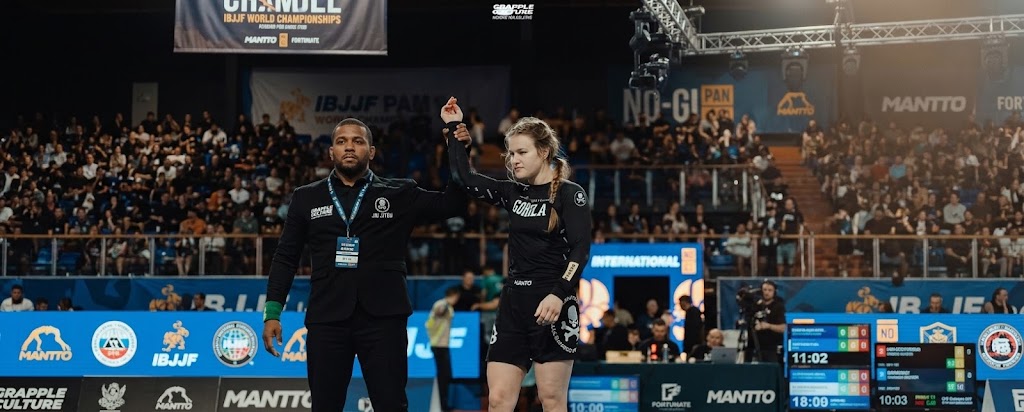
A breakdown of Martyna Kapuscinska's six submission victories at the 2026 IBJJF European No-Gi Championship, including her opponents, confirmed finishing techniques, and double-gold achievement.
Table of contents
Martyna Kapuscinska delivered one of the standout performances at the 2026 IBJJF European No-Gi Championship, winning six matches by submission and taking home two gold medals. Representing Academia Gorila, she won both the women's medium-heavyweight division and the open class at the championship in Lido di Ostia, Italy.
Her performance stood out not only because of the number of victories but also because she finished every match. Across the two divisions, she used a variety of submission attacks, including a rear-naked choke, an Aoki lock, a straight ankle lock, and two heel hooks.
Kapuscinska's achievement was part of a successful tournament for Academia Gorila. Her teammate Pawel Jaworski also won two divisions, submitting all eight of his opponents. Together, their performances helped the academy secure the adult men's and women's team titles.
Here is a closer look at Kapuscinska's six victories, her opponents, the confirmed finishing techniques, and what her performance can teach No-Gi athletes.

1. Quick Answer: How Did Martyna Kapuscinska Win Six Matches?
Martyna Kapuscinska went 6-0 at the 2026 IBJJF European No-Gi Championship, submitting all six opponents. She won gold in both the women's medium-heavyweight division and the open class.
Her documented finishes included:
Rear-naked choke against Valentina Javiera Larrondo Peña.
Aoki lock against Nia Blackman.
Straight ankle lock against Injana Goodman.
Inside heel hook against Sandra Triebel.
Outside heel hook against Salla Simola.
The available published match records confirm her submission victory over Viktoria Rejzek but do not identify the exact finishing technique. It is important not to assign a technique to that match without reliable confirmation.
2. Martyna Kapuscinska's Results at the 2026 IBJJF No-Gi Euros
The 2026 IBJJF European No-Gi Championship took place from October 28 to November 1 at PalaPellicone in Lido di Ostia, Italy. The event brought together competitors across multiple weight divisions and the open class.
Kapuscinska competed in two women's divisions: medium-heavyweight and open class. She won both, finishing the championship with a perfect six-win record.
| Division | Opponent | Confirmed result |
|---|---|---|
| Open class | Viktoria Rejzek | Submission win; technique not confirmed |
| Open class | Valentina Javiera Larrondo Peña | Rear-naked choke |
| Open class | Nia Blackman | Aoki lock |
| Open class final | Injana Goodman | Straight ankle lock |
| Medium-heavyweight | Sandra Triebel | Inside heel hook |
| Medium-heavyweight final | Salla Simola | Outside heel hook |
The results highlight the variety of attacks Kapuscinska used throughout the tournament. Her confirmed finishes included both upper-body and lower-body submissions rather than relying on a single finishing technique.
The two divisions also presented different competitive challenges. In the medium-heavyweight division, she competed against athletes within her weight category. The open class, meanwhile, allowed competitors from different weight categories to face one another.
Winning both titles meant progressing through two separate brackets and successfully facing every opponent along the way.

3. Breaking Down Kapuscinska's Six Matches
3.1 Viktoria Rejzek: A Submission Win in the Open Class
Kapuscinska began her open-class campaign with a submission victory over Viktoria Rejzek.
The available match records confirm the result, but they do not establish the exact finishing technique. Without a reliable record of the finish, it would be misleading to name a specific submission.
This opening victory was important because it allowed Kapuscinska to advance through the bracket and continue her pursuit of the open-class title.
At a major championship, every match presents a new opponent, a different tactical challenge, and another opportunity for the match to change direction. Advancing with a submission win gave her a strong start to the division.

3.2 Valentina Javiera Larrondo Peña: Rear-Naked Choke
Kapuscinska continued her open-class run with a rear-naked choke victory over Valentina Javiera Larrondo Peña.
The rear-naked choke is a well-known finishing technique in Brazilian Jiu-Jitsu. It is commonly applied after an athlete secures back control and establishes a strong position around the opponent's upper body.
The position is just as important as the final grip. The attacking athlete must control the opponent's movement, maintain back control, and limit escape opportunities before completing the choke.
In No-Gi competition, athletes cannot rely on traditional Gi grips. Instead, they use body positioning, head control, hooks, and hand fighting to establish and maintain control.
Kapuscinska's rear-naked choke was one of the documented finishes in her six-match performance.
3.3 Nia Blackman: Aoki Lock
One of the notable results in Kapuscinska's open-class campaign was her submission victory over Nia Blackman by Aoki lock.
The Aoki lock is a lower-body submission that attacks the foot and ankle through rotational pressure. It is associated with leg-lock exchanges, where precise positioning and control are essential to applying the technique.
Leg attacks have become an important part of modern No-Gi grappling. Athletes need to understand how to apply these submissions, recognize dangerous positions, and respond to defensive movements.
The victory over Blackman advanced Kapuscinska to the open-class final. She had secured another submission win against a different opponent and moved one step closer to the title.
3.4 Injana Goodman: Straight Ankle Lock in the Open-Class Final
Kapuscinska completed her open-class campaign by submitting Injana Goodman with a straight ankle lock.
The straight ankle lock is a lower-body submission that applies pressure around the ankle and lower leg. It can be effective when the attacking athlete controls the opponent's leg, maintains the correct body position, and prevents the opponent from creating space.
Its effectiveness depends on several details, including leg control, hip positioning, upper-body connection, and the angle of pressure. Simply holding the foot is not enough; the attacker must maintain control of the position.
The victory gave Kapuscinska the open-class gold medal. It was also her fourth submission win in the open-class bracket.
Winning the open class added another major achievement to her tournament. She had progressed through the bracket and secured the title, but her medium-heavyweight campaign was still to come.

3.5 Sandra Triebel: Inside Heel Hook
In the medium-heavyweight division, Kapuscinska defeated Sandra Triebel by inside heel hook.
The inside heel hook is a rotational lower-body submission that targets the knee. It involves controlling the opponent's leg and heel to create rotational pressure.
Unlike a straight ankle lock, which focuses on the ankle, a heel hook applies rotational force through the lower leg. Correct positioning and controlled application are therefore essential.
Heel hooks are an important part of advanced No-Gi leg-lock systems. Athletes need to understand the relevant leg entanglements, recognize defensive reactions, and avoid exposing their own legs while attacking.
This victory moved Kapuscinska into the medium-heavyweight final, where she faced Salla Simola.
3.6 Salla Simola: Outside Heel Hook in the Medium-Heavyweight Final
Kapuscinska finished her medium-heavyweight campaign with an outside heel hook victory over Salla Simola.
Simola was a notable opponent in the division. She had previously won the 2024 No-Gi World Championship, making the final an important test for Kapuscinska as she pursued her second gold medal.
The outside heel hook is another rotational leg-lock attack, but it differs from the inside variation in the direction of the attack and the positioning used to control the opponent's leg.
Both techniques require an understanding of leg entanglements, control, and defensive reactions. They are related submissions, but they are not interchangeable.
By submitting Simola, Kapuscinska secured the medium-heavyweight title and completed her six-for-six submission record at the championship.
4. Why Six Submissions at One Championship Matter
Winning a championship is difficult. Winning two divisions at the same event adds another level of challenge. Finishing every match by submission makes Kapuscinska's result even more notable.
Her performance highlights three important aspects of competitive No-Gi grappling.
4.1 She Used Different Submission Systems
The documented finishes included both upper-body and lower-body attacks.
The rear-naked choke is an upper-body submission, while the Aoki lock, straight ankle lock, and heel hooks target the lower body. This variety makes her results especially interesting for athletes studying different finishing systems.
However, the published results confirm the finishing techniques, not every movement or setup that led to them. It is better to distinguish between documented match results and assumptions about the strategy behind each finish.
4.2 She Won Across Two Divisions
Kapuscinska did not win just one bracket. She secured gold in both medium-heavyweight and the open class.
The open class presents a different challenge because competitors can come from different weight categories. Athletes may face differences in size, strength, reach, and preferred grappling style.
Her two titles therefore represent success across two separate divisions rather than a single uninterrupted bracket.
4.3 She Finished Every Recorded Match
BJJ Heroes reported that Kapuscinska submitted all six opponents at the championship. That gave her a 100% submission rate across her six victories.
A submission finish ends a match without requiring the winner to be determined by points or advantages. It also demonstrates the ability to convert a competitive position into a decisive result.
Her performance was part of a wider achievement for Academia Gorila. Teammate Pawel Jaworski also won two divisions and submitted all eight of his opponents. The academy finished first in both the adult men's and women's team standings.
5. What No-Gi Athletes Can Learn From These Results
Kapuscinska's tournament is a useful example of why No-Gi athletes need a well-rounded game. The published results do not reveal every detail of her match strategy, but her confirmed finishes highlight several areas worth studying.
Develop both upper-body and lower-body attacks. A grappler who understands back control, chokes, and leg locks has different ways to threaten an opponent. Training should include the entries, positional control, and defensive reactions associated with each submission.
Understand leg-lock positions. The Aoki lock, straight ankle lock, and heel hooks involve lower-body control, but they do not work in exactly the same way. Athletes should learn how these attacks differ and how to recognize and defend dangerous positions.
Build control before pursuing the finish. Submissions generally depend on controlling the opponent's movement and limiting escape opportunities. Rushing an attack without securing the position can create openings for counters.
Prepare for different opponent styles. Competing in two divisions can mean facing athletes with different physical attributes and approaches. Adaptability is an important part of tournament preparation.
For athletes who want to understand the broader foundations of grappling positions and transitions, Elite Sports has a guide to BJJ grappling and how it works.
6. No-Gi Gear for Training and Competition
No-Gi training requires clothing that allows athletes to move freely without relying on a traditional Gi. Rash guards and No-Gi shorts are common choices for grappling because they are designed for movement and close-contact training.
A rash guard provides a close-fitting layer that moves with the athlete. No-Gi shorts are designed to support movement during standing exchanges, guard work, and ground grappling.
Athletes preparing for competition should also check the event's uniform requirements before competing. Rules can specify acceptable clothing, colors, and equipment, so athletes should not assume that every training outfit is competition legal.
You can explore the Elite Sports No-Gi BJJ gear collection for training apparel.
For individual pieces, browse the No-Gi rash guards collection and the BJJ No-Gi shorts collection.
You can also read the IBJJF No-Gi uniform requirements guide before preparing for an IBJJF event. Always check the current rules for the specific competition and division in which you plan to compete.
7. Frequently Asked Questions
How many matches did Martyna Kapuscinska win at the 2026 IBJJF No-Gi Euros?
Martyna Kapuscinska won six matches at the 2026 IBJJF European No-Gi Championship. She submitted all six opponents and went 6-0 across the women's medium-heavyweight and open-class divisions.
Which titles did Martyna Kapuscinska win?
She won gold in the women's medium-heavyweight division and the women's open class.
Who did Martyna Kapuscinska defeat in the open class?
Her recorded open-class opponents included Viktoria Rejzek, Valentina Javiera Larrondo Peña, Nia Blackman, and Injana Goodman. She defeated Goodman in the final with a straight ankle lock.
Which submission did Kapuscinska use against Nia Blackman?
Kapuscinska defeated Nia Blackman with an Aoki lock in the open-class bracket.
Which submission did Kapuscinska use against Salla Simola?
She defeated Salla Simola with an outside heel hook in the medium-heavyweight final.
Did Martyna Kapuscinska submit every opponent?
Yes. Published tournament coverage reported that she finished all six of her matches by submission, giving her a 100% submission rate at the championship.
8. Final Thoughts
Martyna Kapuscinska's performance at the 2026 IBJJF European No-Gi Championship was a standout achievement: two gold medals, six victories, and six submission finishes.
Her documented wins included a mix of upper-body and lower-body attacks, ranging from the rear-naked choke to the Aoki lock and heel hooks. More importantly, she completed the tournament successfully in both medium-heavyweight and the open class.
For No-Gi athletes, her performance is a reminder of the value of submission variety, positional control, and preparation for different opponents. Her six-match run offers a strong example of high-level competition without suggesting that every match followed the same pattern.



Leave a comment
This site is protected by hCaptcha and the hCaptcha Privacy Policy and Terms of Service apply.