

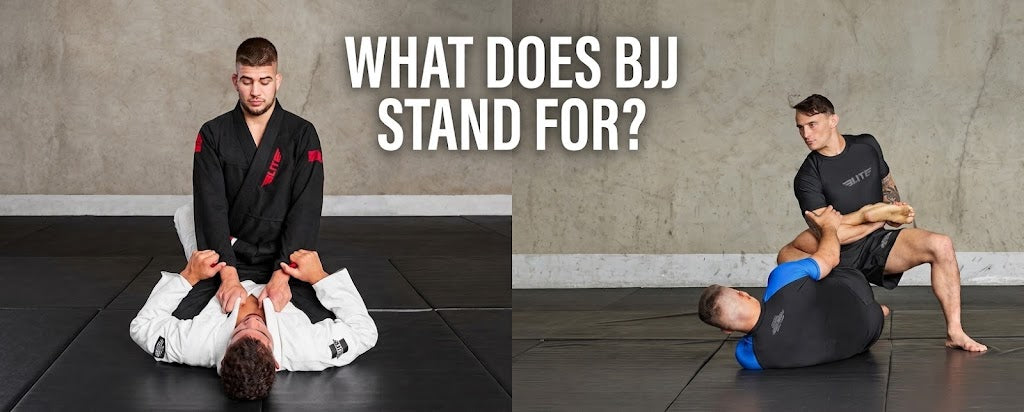
BJJ grappling refers to Brazilian Jiu Jitsu viewed through the broader discipline of grappling: using control, positioning, leverage, transitions, sweeps, and submissions to manage an opponent without relying on strikes. Grappling is the broader category; BJJ is one specific discipline within it, alongside wrestling, judo, and sambo. This page explains that relationship, then goes further than most explanations do: it walks through what actually happens, step by step, during a live exchange, and how BJJ's approach to that process compares with the other disciplines it's grouped with.
That question drives the structure below. You'll get the grappling hierarchy first, then a framework for reading any live exchange, then the positions, submissions, and training methods that framework depends on, and finally a decision path based on where you're actually starting from.
In this post, we'll show you where BJJ fits among other grappling arts, break down the step-by-step framework behind every live roll, walk through the major positions and submission categories, compare gi vs. no gi and BJJ vs. wrestling, and help you figure out what to train first depending on your goals.
Table of contents
1. What "Grappling" Actually Means
Grappling is defined by what it primarily uses: control, positioning, takedowns, clinching, transitions, and submissions. It isn't simply "the opposite of striking." That framing is common but too thin to be useful, since plenty of grappling exchanges (a scramble for a takedown, a fight for underhooks in the clinch) are explosive and high effort, not gentle by contrast to striking. What actually defines grappling is the objective: control an opponent's body and position rather than cause impact.
Wrestling, judo, sambo, and Brazilian Jiu Jitsu are all grappling disciplines. They share that same toolkit but weigh it differently and compete under different rules, which is the source of most of the confusion between them.
2. The Grappling Hierarchy
The cleanest way to hold these terms apart, stated directly:
- Grappling is the broad category. Every discipline below belongs to it.
- BJJ is one specific grappling discipline within that category, built around ground control and submission from a range of positions, including inferior ones.
- Wrestling, judo, and sambo are other specific grappling disciplines, each with its own rules, scoring priorities, and technical emphasis.
Submission grappling is not another discipline sitting next to these. It's a competition format or category, used when a ruleset allows submissions as a way to win. BJJ competition is one form of submission grappling. So are many no gi tournaments (ADCC among them) that pull technique from wrestling, judo, sambo, and BJJ without being BJJ specifically. Submission grappling is also not another name for catch wrestling; catch wrestling is its own historical discipline with its own submission set, and modern submission grappling draws from it without being synonymous with it.
Every BJJ match is grappling. Not every grappling match is BJJ. A wrestling match is grappling but isn't BJJ, because wrestling's ruleset doesn't reward submissions the way BJJ's does. What makes BJJ distinctive isn't that it's the only grappling discipline with strategy; they all have it. It's the specific weight BJJ puts on ground position as the foundation for everything else.

3. The BJJ Grappling Framework
Here's the mental model this page is built around, and the piece most explanations of BJJ skip. It isn't a rigid sequence a grappler ticks through once; a skilled grappler moves back and forth between these stages repeatedly within a single exchange, as the opponent reacts and the situation changes:
Engage → Control → Improve Position → Create Reaction → Attack → Defend → Escape or Reverse → Re-engage
- Engage: Two grapplers close distance and make contact, whether standing in a clinch or on the ground from a guard entry.
- Control: Before anything else happens, someone establishes a grip, frame, or base that limits the other person's options.
- Improve position: From that initial control, the grappler works toward a more dominant position: passing a guard, advancing from side control to mount, or taking the back.
- Create reaction: A dominant position alone doesn't finish anything. The attacker applies pressure or a threat that forces the opponent to react, which is what actually opens up an attack. This is the step most beginners don't see, because it looks like nothing is happening right before a submission suddenly appears.
- Attack: The attacker exploits the reaction, going for a submission or a sweep.
- Defend: The opponent defends the specific attack, usually by giving up something (position, a grip, an angle) to protect the more urgent thing (a joint, their breathing).
- Escape or reverse: Successful defense often creates an opening to escape the position entirely or reverse it.
- Re-engage: The exchange resets into a new phase of engagement, and the cycle starts again from wherever it lands.
This is a way of reading a live roll, not a checklist of moves to complete in order. A skilled grappler moves between these stages repeatedly as the opponent reacts, sometimes cycling back through control and improve position several times before an attack actually lands. Submissions are the visible finish, but create reaction is the stage that separates practitioners who can only apply techniques their partner allows from ones who can make an opening happen against real resistance.
3.1. Core Principles Behind the Framework
Each step above depends on a small set of underlying principles, which is why the same idea keeps showing up across different techniques:
- Leverage: Moving or controlling someone stronger than you through mechanics rather than matching their strength.
- Base and posture: A stable stance and strong spinal alignment, which is what makes the control step possible in the first place.
- Frames: Using bones, not muscle, to hold space, which is what makes the defend and escape steps possible against a heavier opponent.
- Grip fighting and weight distribution: The ongoing contest that determines who controls the engage and control steps.
- Timing: Recognizing the exact moment a create-reaction opportunity has opened.
- Position before submission: Holding a dominant position is worth more, over time, than rushing a low-percentage attack from a weak one.
4. The Major Positions
Position determines who's ahead in the framework above and what's available to them at the improve position and attack steps.
- Closed guard: Bottom player's legs locked around the top player's torso; genuinely competitive, not purely defensive.
- Open guard: Legs used to control distance and off-balance the top player without locking closed; many variants (De La Riva, spider guard, X guard).
- Half guard: Bottom player traps one of the top player's legs; a transitional position workable for both sweeps and submissions.
- Side control: Top player perpendicular to the bottom player, strong control, limited offense for the bottom player.
- Mount: Top player astride the bottom player's torso; one of the most dominant positions for submission access.
- Back control: Top player behind the bottom player with hooks in; widely considered one of the most dominant positions in BJJ.
- Turtle: Bottom player curled on hands and knees, one step from giving up back control.
- North-south: Top player chest to chest, facing the opposite direction from the bottom player.
- Standing or neutral: Where engage and grip fighting happen before any ground position is established.
5. Submissions: Chokes, Joint Locks, and Compressions
A submission only works in relation to the framework above: it depends on control creating isolation, and isolation creating a genuine attack, not on the technique alone. Submissions fall into three broad categories:
- Chokes: Restrict blood flow or airflow at the neck. Rear naked choke, triangle choke, guillotine.
- Joint locks: Hyperextend or rotate a joint past its range, most often the elbow, shoulder, wrist, ankle, or knee. Armbar, kimura, kneebar.
- Compression locks: Apply pressure against muscle or bone rather than isolating a joint's range. Bicep slicer, calf slicer.
This page won't walk through step-by-step submission mechanics; that level of detail is better learned under a coach who can correct grip and angle live. What matters here is the relationship: position creates control, control creates isolation, isolation makes a submission attempt viable, and the defender's whole job is breaking that chain before it completes — or tapping the moment it does, since tapping is the safety system that makes training joint locks and chokes on a training partner possible at all.
6. BJJ and Wrestling
Wrestling and BJJ overlap heavily, and cross-training between them is common in both directions.
What wrestling adds to a BJJ practitioner's engage and improve-position steps: takedown ability, clinch control, scrambling instinct, top pressure, and explosiveness — areas many BJJ-only practitioners are undertrained in, especially if they learned to pull guard rather than take opponents down.
BJJ adds what wrestling's scoring doesn't reward the same way: submissions, guard play from the bottom, submission defense, and sustained ground control once a match is on the mat.
Wrestling experience can give BJJ newcomers useful advantages in base, pressure, takedowns, and scrambling, although they still need to develop guard and submission skills. Neither discipline replaces the other; a well-rounded grappler eventually trains both.

7. BJJ and MMA
Adding strikes changes the framework above at almost every step, which is why sport BJJ technique doesn't transfer to MMA without adjustment. A closed guard that's fully viable in sport BJJ becomes riskier once the top player can strike downward from it, since control now has to account for strike prevention, not just position. Attack and create-reaction both shift toward positions that also limit exposure to strikes, like control against the cage.
MMA grappling draws from BJJ, wrestling, and judo at once: wrestling and judo for takedowns and cage clinch work, BJJ for ground control and submission threats, and elements of all three for scrambling back to the feet. BJJ alone isn't sufficient preparation for MMA grappling, and neither is wrestling alone.
8. Gi vs. No Gi
The difference is deeper than wearing a uniform or not. The gi adds fabric, and fabric means grips: collar, sleeve, and pant leg grips create control options and submission setups that don't exist without it, which is why gi grappling tends to reward a slower, more methodical pace built around breaking an opponent's grips.
No gi removes fabric grips entirely. Control shifts to underhooks, overhooks, wrist and ankle control, and body positioning instead. Without cloth or a belt to slow an escape, scrambles happen faster. No gi isn't simply BJJ with the uniform removed; it changes what's available at almost every step of the framework above, from engage through attack.
Many practitioners train both: gi work sharpens grip fighting and control, no gi work sharpens scrambling and pace. For a full breakdown of which to start with, see Elite Sports' guide on training gi or no gi as a beginner.
9. Equipment, Briefly
What's actually needed comes down to a short list, driven by the gi and no gi split above rather than by everything available to buy. Gi training needs a gi. No gi training needs a rash guard and grappling shorts, cut to move with hip work rather than restrict it.
Beyond that: basic hygiene supplies (most academies are strict about this), a mouthguard once sparring intensity increases, and, for solo training, a grappling dummy.
10. BJJ Grappling Dummies
A BJJ grappling dummy is a human-shaped, weighted training bag built to be gripped, controlled, and moved through positions the way a training partner would, without needing another person present. This is one of the most useful and most misunderstood pieces of BJJ equipment, so it's worth being precise about both sides.
What it's genuinely useful for:
- Repetition of movement patterns and specific transitions (guard pass sequences, mount to back, submission entries)
- Building physical memory of where hands and hips go in a given position
- Getting extra reps outside class hours without needing a partner's schedule
Weight matters more than overall size when choosing one: sizing a dummy to about half to three-quarters of your own body weight generally makes it easier to move through positions correctly.
What it cannot do, and this matters more than the list above: it doesn't resist, react, frame against you, scramble, change strategy, get tired, or create a genuine reaction step the way a live opponent does. Every one of those is central to what makes grappling difficult and valuable. A dummy is a repetition tool, not a resistance substitute. It feeds the improve-position and attack steps of the framework, but it can't test the defend or escape-and-reverse steps against real pressure. For weight, fill, and specific drills, see Elite Sports' guide to training BJJ with a grappling dummy.

10.1. Solo Practice
Solo work and live rolling teach different things, and neither substitutes for the other.
What solo training covers: movement drills (shrimping, technical stand-ups, bridging), dummy-based positional rehearsal, shadow drilling of sequences, and supporting mobility or strength work.
What requires a partner: grip fighting against real resistance, the create-reaction and defend steps of the framework, and everything involved in timing an escape against someone actively trying to stop it.
Solo practice works best as a supplement that sharpens what gets tested in class. For more detail, see what solo grappling actually covers.
11. Choosing Your Path
Where to focus depends on the actual situation, not a generic checklist:
- New to grappling entirely → Start with academy training under a coach. The framework and positions above will make far more sense once you've felt them live, even chaotically, than from reading alone.
- Deciding between gi and no gi → The real question is whether you want to build grip fighting first (gi) or scrambling and pace first (no gi). Most academies let you sample both before committing.
- Training alone between classes → Movement drills and a grappling dummy extend your reps, but they feed the improve-position step only. Live rolling is still what tests everything else.
- Training with MMA in mind → Add wrestling for takedowns and clinch work early, since sport BJJ alone leaves that part of the framework underdeveloped for a striking environment.
12. Your First Class, Briefly
A typical first class follows a simple shape: warm up, then learn a basic movement or position, then drill it with a partner, then possibly some controlled live training depending on the academy and your experience level, then a short review to clean up what didn't work. No two academies run it identically, but that general shape holds across most.
13. Training Culture
Good BJJ culture centers on respect, safety, and consistency, not toughness for its own sake. Expected norms: clean gis and short nails, tapping early rather than late, communicating with training partners about intensity and injuries, and controlled behavior with newer or smaller partners. Refusing to tap or training through real injury isn't a sign of good culture; it's a common way people get hurt and stop training altogether.
14. Self Defense: What BJJ Can and Can't Promise
BJJ is widely used as a self-defense foundation because it gives a smaller person control options against a larger one, and because many physical altercations end up in a clinch or on the ground. But sport BJJ and self-defense are not the same training context. Sport BJJ is a one-on-one match, on a mat, under a known ruleset, with a referee and no weapons. Real confrontations can involve multiple people, weapons, uneven ground, and no rules — none of which sport training directly addresses.
BJJ does not guarantee a favorable outcome, and size, numbers, and weapons still matter in a real confrontation; no amount of technique makes someone invulnerable. What grappling training reasonably offers is experience with control, positional awareness, and physical resistance, which can be useful in a one-on-one, unarmed confrontation, without guaranteeing a favorable outcome.
15. History, Briefly
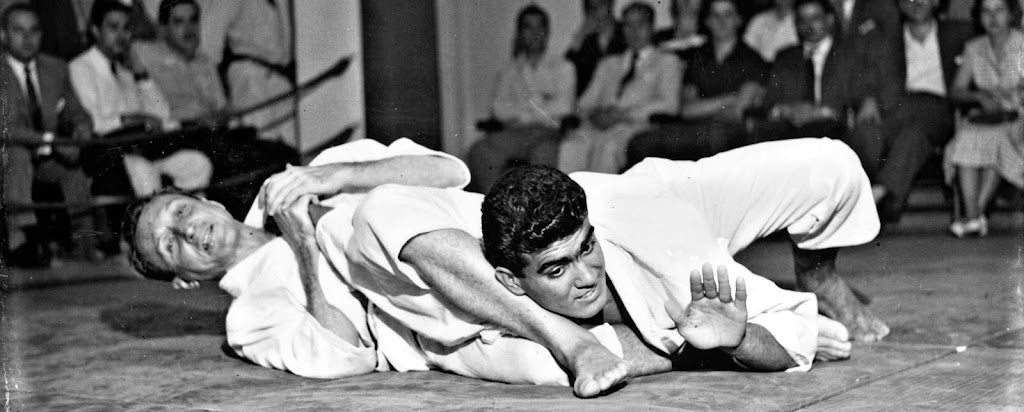
BJJ traces back to Japanese jujutsu and judo, brought to Brazil in the early twentieth century and developed over decades of practical testing, most associated with the Gracie family though involving many contributors beyond it. The art's visibility grew substantially through early MMA competition, where its ground game proved effective against strikers unfamiliar with grappling. For the fuller account, see Elite Sports' history of Brazilian Jiu Jitsu.
16. Competition: Two Different Formats
BJJ competition doesn't run under one universal ruleset, and the two formats most people encounter work differently enough to be worth separating rather than grouping.
| Format | Uniform | Scoring Style | Notes |
|---|---|---|---|
| IBJJF-style points competition | Gi and no gi divisions | Positional scoring, split by weight and belt/skill level | Matches can end by submission at any time regardless of score. See the IBJJF's own rulebook for exact point values. |
| ADCC-style submission grappling | No gi | Built to reward aggression and submission attempts more heavily than points-based formats | Rules have changed between editions in the past — check the organization's current published rules before relying on specifics. |
Always check the specific rules of an event before assuming they match either format described here in general terms.
16. FAQs
A few direct answers to common questions; the sections above cover the full explanation.
Is BJJ the same as grappling?
No. Grappling is the broad category; BJJ is one specific discipline within it.
Is submission grappling the same as catch wrestling?
No. Catch wrestling is its own historical discipline; submission grappling is a competition format that several disciplines, including BJJ, compete under.
Can a grappling dummy replace a training partner?
No. It provides repetition, not resistance, reaction, or scrambling.
What's the real difference between gi and no gi?
The gi adds fabric grips that shift control toward grip fighting; no gi shifts control toward underhooks, overhooks, and body positioning.
Should I start with wrestling or BJJ for MMA?
Neither alone is sufficient; most MMA-focused grapplers train both, since each covers different steps of a live exchange.



Leave a comment
This site is protected by hCaptcha and the hCaptcha Privacy Policy and Terms of Service apply.