
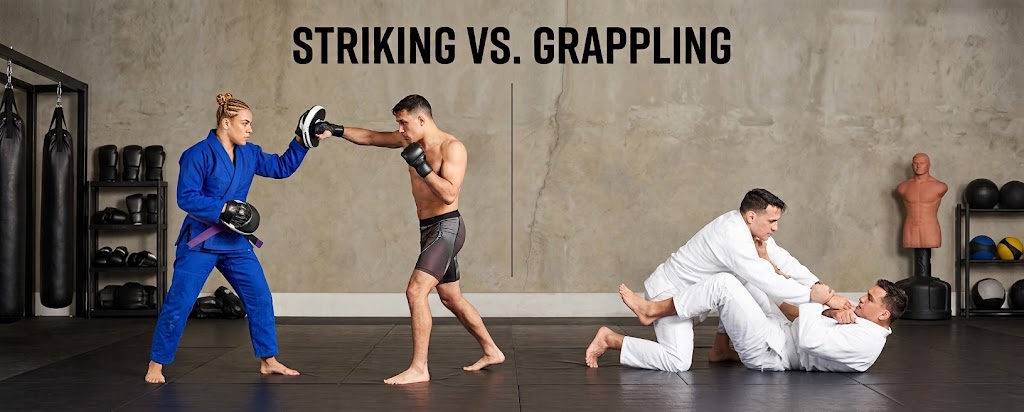
In the striking vs grappling debate, striking is fighting at a distance with punches, kicks, elbows and knees (boxing, Muay Thai, kickboxing). Grappling is fighting at close range by controlling the body with takedowns, throws, holds and submissions (Brazilian Jiu-Jitsu, wrestling, judo). Neither is "better" in every situation. In MMA, grappling usually controls where the fight happens while striking decides fights quickly. For beginners, most adults get more usable self-defense from grappling early on and more fitness and coordination from striking. Serious fighters learn both.
Table of contents
1. Key Takeaways
- Striking = range, timing, speed, knockouts. Grappling = control, leverage, position, submissions.
- Modern MMA is a hybrid. Strikers need takedown defense; grapplers need to survive on the feet.
- Grappling can be trained at full intensity with far less head trauma, which is why many adults train it longer.
- For self-defense, the best answer is a grappling base plus basic striking.
- Grappling gear (a gi or a rash guard and shorts) is inexpensive to start with.
2. Striking vs Grappling at a Glance
| Factor | Striking | Grappling |
|---|---|---|
| Main range | Long to mid range | Close range and the ground |
| Core techniques | Punches, kicks, elbows, knees | Takedowns, throws, chokes, joint locks, positional control |
| Popular arts | Boxing, Muay Thai, kickboxing, karate, taekwondo | Brazilian Jiu-Jitsu, wrestling, judo, sambo, submission grappling |
| Way to win | Knockout, TKO, points | Submission, control, points |
| Energy system | Explosive bursts | Sustained strength, grip endurance, cardio |
| Typical injuries | Cuts, fractures, concussion risk | Joint strains, fingers, knees, skin |
| Sparring intensity | Hard to do at full power often | Can be done at full resistance regularly |
| Size advantage | Reach and power help | Technique and leverage help smaller people |
2.1. What Is Striking?
Striking covers every art built around hitting and not getting hit. The goal is to control distance, land clean, and defend with footwork, head movement and guard. Common striking arts include:
- Boxing: punching, head movement and footwork.
- Muay Thai: punches, kicks, elbows, knees and the clinch, often called the "art of eight limbs."
- Kickboxing: punches and kicks with a strong emphasis on range.
- Karate and taekwondo: precision, timing and kicking.
Strengths: striking can end a fight at almost any moment, teaches excellent distance control, and builds cardio, coordination and confidence. A single clean strike can change a fight. Weaknesses: a pure striker who cannot defend takedowns loses most of their toolbox once on their back, and repeated head contact carries long-term risk.

2.2. What Is Grappling?
Grappling covers any art built around holding, moving or controlling another person's body. It answers the question, "what happens once there is no distance left?" Common grappling arts include:
- Brazilian Jiu-Jitsu (BJJ): ground control, guard, chokes and joint locks. Read our beginner guide to gi vs no-gi BJJ.
- Wrestling: takedowns, top control and relentless pressure.
- Judo: throws, trips and mat control.
- Sambo and submission grappling: a blend of throws, leg locks and submissions.
Strengths: grappling lets a fighter set the pace, conserve energy and neutralize a dangerous striker. Leverage lets a smaller person control a bigger, stronger opponent. Weaknesses: it is demanding on grips, knees and fingers, and pure grapplers can struggle if they cannot close the distance safely.

3. Key terms every beginner should know
- Takedown: bringing a standing opponent to the ground.
- Sprawl: a defensive move that drives your hips back to stop a takedown.
- Clinch: a tie-up at close range where fighters control each other's head, arms or body.
- Guard: a defensive position on your back that uses your legs to control an opponent.
- Submission: a choke or joint lock that makes an opponent tap.
- Ground and pound: striking an opponent from a dominant position on the ground.
4. Striking vs Grappling in MMA: Which Wins?
Historically, grappling arts made a huge impact in mixed martial arts. Royce Gracie's wins at the first UFC events in the 1990s showed the world that a striking-only base had a serious hole. Since then, fighters have blended everything, and today MMA is neither a grappling sport nor a striking sport.
- Grappling-heavy champions such as Khabib Nurmagomedov, Islam Makhachev and Kamaru Usman reached the top by controlling where the fight takes place.
- Elite strikers such as Israel Adesanya, Alex Pereira and Leon Edwards proved that great striking paired with strong takedown defense can beat elite grapplers.
The bridge between the two is what decides most fights: takedown defense and the clinch. If the striker keeps it standing, striking dominates. If the grappler closes the distance and gets the fight down, grappling dominates. A common view among coaches is that a grappler with weak striking usually finds more success in MMA than a striker with weak grappling, especially below the pro level.
4.1. When striking wins
- The fight stays at range and the striker has strong footwork.
- The grappler has poor cardio or telegraphs takedowns.
- A single clean shot lands. Striking offers a comeback chance that grappling rarely does.
4.2. When grappling wins
- The grappler closes distance safely and pins the opponent against the cage or mat.
- The striker is tired or gets taken down repeatedly.
- There is a large size or strength gap and technique must equalize it.


5. Does Size Matter? Weight Classes, Strength and Leverage
Size and strength help in both, but in different ways. In striking, reach, speed and power give bigger, faster fighters a real edge, and that is one reason organized striking sports use weight classes. In grappling, leverage and technique can let a smaller person control a stronger, heavier opponent, which is why arts like Brazilian Jiu-Jitsu are so popular with smaller athletes. That does not mean size is irrelevant. A large size gap still matters, and technique only closes it when the skill difference is big enough. If you are smaller than most training partners, grappling is a confidence-building place to start.
6. Striking vs Grappling for Self-Defense
Real confrontations are chaotic, and most begin with grabbing, pushing and clinching before anything else. That is why many instructors recommend a grappling foundation: it teaches you to control a person, protect yourself, and stand back up. Striking is best when you need to create space and get away. Neither is enough alone.
- Best for close-range control: grappling (BJJ, wrestling, judo).
- Best for creating space and escaping: basic striking (boxing, Muay Thai).
- Reality check: against multiple attackers or weapons, staying off the ground and escaping matters more than winning. Training both, plus awareness, is the smartest plan.
Wondering how clothing changes things? Our breakdown of gi vs no-gi BJJ explains how jackets, T-shirts and slippery fabrics affect control.
7. Striking vs grappling for women's self-defense
Women are often physically smaller than a potential attacker, so leverage-based skills matter. Grappling teaches you to escape holds, get out from underneath someone, and control a bigger person. Basic striking adds the ability to create space, and simple strikes to vulnerable targets can give you time to escape. Many women's self-defense programs combine both. Find a gym with a supportive coach and training partners of different sizes, and choose gear that fits properly, such as a women's BJJ gi.
8. Which Should You Learn First: Striking or Grappling?
It depends on your goal.
- Self-defense in the first year: start with grappling, then add striking.
- Fitness, coordination and stress relief: start with striking.
- Competing in MMA: train both from the beginning, with a strong wrestling or BJJ base.
- Over 40 or avoiding head contact: grappling is often easier to sustain long term.
- Kids: grappling is a popular starting point because it teaches control and safety. Browse kids BJJ gis when you are ready.
The best art is the one you will actually keep training. Consistency beats style.

9. Training and Fitness: What to Expect
Striking classes are cardio-heavy: bag work, pad drills, footwork, conditioning and light sparring. Grappling classes are technique- and resistance-based: drilling positions, live rolling, and long stretches of grip and core work. Both build strength and mental toughness, and you do not need to be in shape to start either one.
10. Injury Risk: Striking vs Grappling
Striking raises the risk of cuts, fractures and concussions. Grappling raises the risk of strained joints, sore fingers, knees and mat burns. You can lower risk in both by choosing a good coach, tapping early, warming up properly, and wearing well-fitted gear.
11. The Gear You Need to Start Grappling
Getting started in grappling is simple and affordable. You need one of two setups:
- Gi training: a durable gi and a belt. Our Core White BJJ Gi is a popular lightweight pick for beginners, and you can compare more in our best BJJ gis for beginners guide. Learn how to tie your BJJ belt so it stays secure and what BJJ belt stripes mean.
- No-gi training: a short sleeve no-gi rash guard and BJJ no-gi shorts. Shop all BJJ rash guards.
Training in hot weather? See which BJJ gis are best for summer. Want to drill throws and transitions solo? A grappling dummy is a great way to practice between classes.
Looking for the right fit? Browse men's BJJ gis or the full BJJ gi collection.
12. Frequently Asked Questions
What is the main difference between striking and grappling?
Striking uses punches, kicks, elbows and knees to fight at a distance. Grappling uses takedowns, holds, chokes and joint locks to control an opponent at close range and on the ground.
Which is better, striking or grappling?
Neither wins in every case. Grappling is often more reliable for control and for smaller athletes, while striking is faster at ending a fight. Most experts recommend learning both.
Is grappling better than striking in a street fight?
Grappling gives you control and a way to neutralize a single attacker, but striking helps you create space and escape. A blend, plus the goal of getting away safely, is the best approach.
Which should a beginner learn first?
If your goal is self-defense, start with grappling such as BJJ or wrestling. If your goal is fitness and coordination, start with boxing or Muay Thai. If you want to compete in MMA, train both.
Is BJJ a striking or grappling art?
Brazilian Jiu-Jitsu is a grappling art. It focuses on takedowns, positional control and submissions, and does not include striking in standard training or competition.
Can a grappler beat a striker?
Yes, if the grappler closes distance and gets the fight to the ground. A striker with strong takedown defense can also beat a grappler. The fight is decided by who controls the range.
Is grappling safer than striking?
Grappling generally involves less head trauma and can be trained at full resistance more often, but it causes more joint and finger strain. Both are safe with good coaching and sensible sparring.
Does size matter more in striking or grappling?
Size helps in both, but leverage and technique let smaller people compete in grappling more often than in striking, where reach and power play a larger role.
Is grappling or striking better for women's self-defense?
A combination works best. Grappling helps a smaller person escape holds and control a larger one, and basic striking helps create space to get away.
Do you need to be fit to start grappling or striking?
No. Both improve fitness as you train. Start at a beginner's pace and build up.
What is the best gear for beginners?
For gi BJJ, a lightweight, preshrunk gi and belt. For no-gi, a compression rash guard and grappling shorts. See our full BJJ gear collection.
13. Final Verdict
Striking gives you range, speed and finishing power. Grappling gives you control, leverage and a way to stay in the fight. The strongest martial artists blend the two, so pick the one that fits your goal today and add the other as you grow. When you are ready to start grappling, shop Elite Sports BJJ gis and get on the mats.



Leave a comment
This site is protected by hCaptcha and the hCaptcha Privacy Policy and Terms of Service apply.