
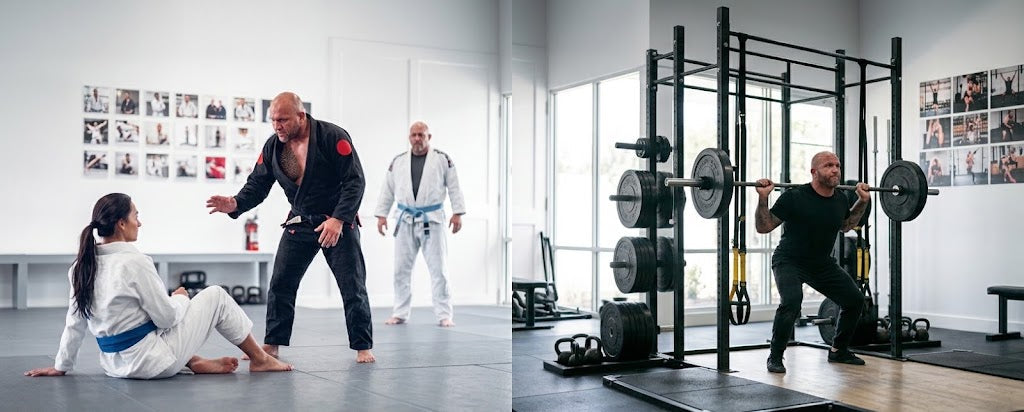
In short: You can do CrossFit and Jiu-Jitsu together if your total training load stays manageable. A good starting point is 2–3 BJJ sessions plus 1–2 CrossFit sessions a week, with your priority sport getting your freshest days. CrossFit can build strength, power and conditioning, but it cannot replace mat time, because technique and timing come only from rolling. Watch your sleep, food and fatigue, and cut back if your BJJ starts to slip.
Can You Do CrossFit and Jiu-Jitsu Together?
Yes, you can do CrossFit and Jiu-Jitsu together. The two sports build overlapping qualities like strength, power and conditioning, so many athletes combine them successfully. What matters is your total training load. For most recreational athletes, a good starting point is 2–3 BJJ sessions plus 1–2 CrossFit sessions per week, with your priority sport getting your freshest days. CrossFit can support your grappling, but it cannot replace mat time, because technique, timing and decision-making against a resisting partner are learned only by rolling.
Key Takeaways
- CrossFit for BJJ works best as supporting training, not a replacement for classes and live rounds.
- Decide which sport is your priority and protect the quality of those sessions.
- A sensible starting point is 2–3 BJJ days and 1–2 CrossFit days per week, adjusted for recovery.
- If you train both on one day, put the more important session first or make the other one lighter.
- Constant soreness, weak grips and flat rolling usually mean too much total load, not too little.
- Sleep, food and rest days are part of the program, not extras.
First, Decide Which Sport Comes First
Before you plan a single week, ask yourself one honest question: which one am I really trying to get better at?
If it is Jiu-Jitsu, your schedule should protect the quality of your BJJ sessions. CrossFit then fills gaps, like general strength or work capacity, without eating so much recovery that your technical training suffers. If CrossFit is your main sport, flip that. If you enjoy both recreationally, you have more freedom, but you still have a limit.
There is no universal schedule, because work, sleep, age, nutrition, training history and competition goals all change how much you can handle. Here is a rule that holds up almost everywhere: the sport you most want to improve gets your best energy and your most consistent training time.
Table of contents
1. Why Do CrossFit and BJJ Work Well Together?
On the surface, they look nothing alike. CrossFit blends weightlifting, gymnastics and conditioning. BJJ is a grappling sport built on leverage, position and live resistance. But the physical demands overlap more than most people expect.
| Physical quality | CrossFit | BJJ |
|---|---|---|
| General strength | High | Important |
| Muscular endurance | High | Important |
| Power | Frequently trained | Important |
| Aerobic conditioning | Frequently trained | Important |
| Anaerobic conditioning | Frequently trained | Important |
| Coordination | Important | Essential |
| Grip strength | Often involved | Highly relevant |
| Mobility | Depends on programming | Important |
| Technical skill | Exercise-specific | Sport-specific |
| Opponent decision-making | Limited | Essential |
BJJ is an intermittent sport: you move between low-intensity positional work and short, explosive bursts. Strength, power, and both aerobic and anaerobic fitness all feed into that. CrossFit trains a similar mix, though how much of each depends heavily on the workout. That overlap is why strength and conditioning is a logical partner for Jiu-Jitsu.
But physical preparation and technical preparation are not the same thing, and that difference is the heart of this whole topic.
2. Is CrossFit Good for BJJ? What the Research Says
CrossFit can be a useful addition to BJJ when it improves a quality you actually lack and does not leave you too tired to train well. Someone who is weak in general strength may benefit a lot. Someone who already rolls five days a week probably does not need three more hard metcons on top.
The research is encouraging but needs careful reading. A 2026 randomized trial published in the Journal of Clinical Medicine followed 44 competitive male BJJ athletes for eight weeks. One group added a structured circuit program (resistance, plyometric, gymnastic and BJJ-related exercises) to its normal training, while the other followed a standard BJJ cycle. The circuit group improved on several motor fitness measures, especially strength endurance (read the study). The catch: that program was designed for grapplers and was not CrossFit itself, so it shows that structured conditioning can complement BJJ, not that CrossFit automatically makes you better.
On the CrossFit side, a 2026 systematic review of 19 studies found that CrossFit training improved maximal oxygen uptake, strength, muscle size and muscular endurance, while also creating significant physiological stress (read the review). That stress is the important part for you. It is the price of the fitness gains, and you pay it out of the same recovery account your BJJ draws from.
It also helps to see how real athletes do it. Jason Khalipa, the 2008 CrossFit Games champion, took up BJJ in 2016 and won his division at the US Open that year. Even when he is not preparing for CrossFit competition, he keeps BJJ in his week two to three days at a time, according to his biography. He did not swap one for the other. He scheduled both.

3. What Can CrossFit Add to Your BJJ?
3.1. General strength
Strength helps you produce and resist force: bridging, standing up in base, takedown entries, passing, keeping frames and controlling positions. It should never replace technique, because a well-timed movement beats muscling through everything. But strength gives your technique more to work with. If you want to go deeper on this, read our guide to the benefits of strength and conditioning in BJJ.
3.2. Power
BJJ is not only a slow grind. Exploding out from the bottom, creating space, shooting a takedown and winning a scramble all need fast force production. Some CrossFit movements can develop that, though how well it transfers depends on the exercise and programming. Our BJJ workout for explosive power shows how to build it without wrecking your recovery.
3.3. Conditioning
A match can swing from patient positional work to an all-out scramble in seconds. Good conditioning helps you recover between those bursts. Still, the most specific conditioning for BJJ is BJJ. Your body has to learn to work and recover while gripping, squeezing and being squeezed. For other options, see our list of the best conditioning exercises for BJJ trainees.
3.4. Muscular endurance
Holding frames, underhooks, body locks, top pressure or a guard for a full round takes muscles that keep working under fatigue. General muscular endurance helps you tolerate that workload.
3.5. Grip and pulling strength
Pull-ups, rows and carries build upper-body pulling strength, which is useful in the gi where you fight for sleeves, collars, lapels and pants. Be careful with volume, though. If your classes already hammer your grip, extra grip work counts toward the same weekly total.
4. What CrossFit Cannot Teach You
A workout can make you fitter, but it cannot teach you to:
- pass the guard of a skilled opponent
- escape side control
- defend a triangle or recognize an armbar setup
- win an underhook battle or keep your guard from being passed
- chain submissions and read how a partner reacts
Those skills come only from practicing Jiu-Jitsu. CrossFit builds the physical tools you bring to the mat, and BJJ teaches you how to use them. That is why swapping BJJ classes for extra conditioning is rarely a good trade if your goal is to become a better grappler.

5. How Many Days a Week Should You Do CrossFit and BJJ?
There is no single right answer, but here is a practical starting framework for a recreational athlete:
| Your situation | BJJ | CrossFit |
|---|---|---|
| Beginner to both | 2 sessions | 1 session |
| BJJ is the priority | 3 sessions | 1–2 sessions |
| Both matter equally | 2–3 sessions | 2–3 sessions |
| Competition camp for BJJ | 4+ sessions | 0–1 lighter session |
Treat this as a starting point, not a prescription. Someone with years of training may handle more, and a newcomer may need less. The right number is the one that lets you train consistently, recover between sessions, keep your technique sharp, keep progressing and avoid piling up fatigue week after week. If you want a deeper look at BJJ frequency on its own, read how many days per week you should train BJJ.
5.1. A sample BJJ-focused week
Say Alex wants BJJ to be the main focus but enjoys CrossFit too. A reasonable first week could look like this:
| Day | Training |
|---|---|
| Monday | BJJ |
| Tuesday | CrossFit (moderate) |
| Wednesday | BJJ |
| Thursday | Rest or light mobility |
| Friday | BJJ |
| Saturday | Optional light CrossFit or open mat |
| Sunday | Rest |
Not every session needs to be maximal. If Friday includes hard, competition-style rolling, Saturday's CrossFit should be lighter or skipped. Plan around how hard the sessions actually are, not just how many there are. A simple way to do that is the hard and easy approach: alternate stress where you can, so you do not turn the whole week into one long recovery problem. You do not need seven hard days to have a productive seven-day week.


6. Should You Do CrossFit Before or After BJJ?
You can train both on the same day, for example CrossFit in the morning and BJJ in the evening, or the reverse. A few hours between sessions gives you time to eat, hydrate and recover. But two sessions still cost more than one, so be realistic.
The simplest rule: make the most important session the highest-quality session.
6.1. CrossFit before BJJ
A hard CrossFit workout beforehand can leave you with tired legs, a fatigued grip, less explosiveness and less focus for live rounds. If the CrossFit session is deliberately light, that may not matter. If it is a brutal metcon right before an important class, it matters a lot.
6.2. CrossFit after BJJ
Doing CrossFit after BJJ protects the quality of your technical practice. You may have less left for the workout, but that is fine if BJJ is your priority. Supplemental training does not need to be maximal to be useful.
6.3. The same-day rule in practice
For a BJJ-focused athlete, high-quality BJJ plus moderate CrossFit usually beats exhausting CrossFit plus sloppy BJJ. This matters most on days with new technique, competition prep or hard positional sparring. Some people perform well with conditioning first, and others see technique fall apart. Pay attention to how you actually perform and let that guide you.
7. What Exercises Support a BJJ Athlete?
There is no single best CrossFit workout for BJJ. Pick movements based on the quality you want to build.
| Exercise | What it helps with |
|---|---|
| Squats | Lower-body strength for base, bridging and standing up |
| Deadlifts | Posterior chain strength and overall force production |
| Pull-ups and rows | Upper-body pulling strength and endurance |
| Carries | Grip, trunk stability and whole-body tension |
| Kettlebell swings | Hip power and conditioning when done correctly |
| Olympic lifts | Speed and power, but only after you learn the technique properly |
| Push-ups, dips, gymnastics work | General strength and body control |
For full workouts and progressions, our full-body strength and conditioning workout for BJJ and the guide on how to balance BJJ and weightlifting go into much more detail, so this article can stay focused on how CrossFit fits into your week.
7.1. Do you need CrossFit-specific exercises at all?
Not necessarily. A better question is: what is currently limiting my training?
- If strength is the limit, a controlled strength program may help more than another high-volume conditioning class.
- If aerobic fitness is the limit, steady aerobic work may make more sense.
- If you are constantly exhausted while rolling, the fix may not be more conditioning. Look at pacing, technical efficiency, sleep, nutrition and total volume first.
8. Can CrossFit Improve Your BJJ Cardio?
It can contribute to general conditioning, but with a caveat. CrossFit workouts vary enormously. A short heavy session is a very different challenge from a long, high-volume metcon, and neither reproduces the stop-start, gripping, squeezing nature of grappling. For more ideas on building your engine, see our guide to a BJJ workout to improve stamina.
8.1. Why fit CrossFit athletes still gas out in their first BJJ classes
If you come from CrossFit, you might be very fit and still feel wrecked after a few rounds. That does not mean your cardio is bad. Grappling asks for things a workout does not:
- holding awkward positions while you breathe
- squeezing and relaxing over and over
- gripping, pushing and pulling against a live person
- making decisions under pressure
- reacting to someone who does not follow a plan
A workout tells you what movement comes next. An opponent does not. That difference is why general fitness never fully replaces sport-specific conditioning.
9. Can CrossFit Make You Worse at BJJ?
Not directly. The real risk is fatigue that carries over into your mat time.
Imagine you have an important BJJ class Wednesday evening, but Wednesday morning you did a tough session with heavy legs, high-rep pulling and a long conditioning finisher. By evening you are still carrying that fatigue. Once in a while, no big deal. Several times a week, and your BJJ quality will suffer. You might notice:
- slower reactions and poorer technique
- a weak grip
- less willingness to scramble
- trouble concentrating
- lower rolling intensity
At that point the problem is not that CrossFit is bad for BJJ. It is that your total load no longer supports your main goal.
9.1. How do you know if you are doing too much?
One brutal workout does not mean you are overtraining. Look for patterns, such as:
- declining performance despite consistent training
- persistent soreness or unusual fatigue
- poor sleep or loss of motivation
- repeated minor injuries
- workouts that feel harder without any change in load
The answer is not always complete rest. Often it is simply reducing intensity, volume or the number of hard days. If you want to know what real overtraining looks like, read what happens if you overtrain in Brazilian Jiu-Jitsu.
10. Recovery: Sleep, Food, Hydration and Rest
The more you combine, the more recovery becomes your real training plan.
- Sleep supports recovery, learning and performance. Our guide on why sleep matters for the BJJ player explains how to make it a habit.
- Nutrition needs to match your workload. If you jump from three sessions a week to seven without eating more, recovery will slip. See our top foods for recovery after BJJ training.
- Hydration matters because both sports cause heavy sweat losses, especially in warm rooms. Treat it as part of preparation.
- Rest days are when your body adapts to the work you have already done. For more ideas, check the top methods for fast BJJ muscle recovery.
11. What About BJJ Competition Preparation?
Your priorities should shift as a tournament gets closer. In a normal training block you may have room for supplemental conditioning. As competition nears, specific work matters more: competition-style rounds, positional sparring, match pacing, rules, weight management, technical weak spots and recovery between rounds.
A hard CrossFit session that leaves you sore for two days has little value if it keeps you from doing quality competition-specific BJJ. This is where CrossFit can quietly flip from a useful tool to plain extra fatigue. A sensible move is to reduce it, keep one lighter session for maintenance, and put the energy on the mats.
12. CrossFit for Gi and No-Gi Jiu-Jitsu
The same principles apply either way, but the demands differ a little.
Gi BJJ adds gripping demands from sleeves, collars, lapels and pants, so watch your grip volume when you add pulling or grip-heavy CrossFit work. A durable, well-fitted gi like our Core White BJJ Gi keeps training comfortable while your body handles that load.
No-gi BJJ removes clothing grips, which makes underhooks, wrist control, head position, body locks and leg control more important. A short-sleeve BJJ rash guard and no-gi shorts are also handy for CrossFit sessions, since they wick sweat and stay in place. Not sure which to train? Our beginner guide covers whether to train gi or no-gi.
In both cases, CrossFit remains general strength and conditioning, not a replacement for technical grappling.

13. CrossFit and Jiu-Jitsu for Beginners and Athletes Crossing Over
13.1. If you are new to both
Start small, for example two BJJ sessions and one CrossFit session per week. After a few weeks, check in with yourself: Are you recovering? Is your BJJ improving? Are you enjoying it? Is your sleep normal? Do you still have energy outside the gym? If yes, add gradually. If not, more workouts are probably not the answer.
13.2. If you already do CrossFit and are starting BJJ
Your fitness will help you adapt, but do not assume it transfers to grappling. Focus on learning technique, breathing, relaxing under pressure, understanding positions and tapping early. Trying to win every round on strength and conditioning slows your learning.
13.3. If you already do BJJ and are starting CrossFit
You may have great mat fitness and still be new to barbell technique, Olympic lifts, gymnastics and high-volume pacing. Start with manageable loads, learn the movements and resist turning your first month into a competition. Ease in, because unfamiliar high-volume work is a common way to end up sore and sidelined.
13.4. Two examples of how this plays out
These are illustrative scenarios to show the idea.
Alex (BJJ-focused) trains BJJ four days a week and adds CrossFit three days. After a few weeks, Alex's grip is fading, rolling feels flat and soreness never goes away. The fix is trimming CrossFit, not because it is bad, but because the total workload is too high for current recovery.
Jordan (recreational) trains BJJ twice a week and CrossFit twice a week, sleeps well, eats enough, takes rest days and is progressing in both. There is no reason to change a thing just because someone else trains differently.
Your training should fit you, not the other way around. For more on tailoring it to your life, see our guide on BJJ training frequency.
14. CrossFit and BJJ: Common Mistakes to Avoid
- Making every session high intensity. Hard training has a place, but hard every day does not.
- Replacing BJJ with conditioning. If skill is the goal, you still need to practice the skill.
- Ignoring fatigue because "more fitness is better." Fatigue is not proof of a productive session.
- Copying a professional's schedule. Their recovery resources, coaching and training history are not yours.
- Adding CrossFit without removing anything. Three extra hard sessions on top of five training days changes your load dramatically.
- Chasing numbers over technique. Movement quality matters in both sports.
- Forgetting that BJJ is already conditioning. Hard rolling is training stress and should count toward your weekly total.
15. How to Find the Right Balance
Instead of asking, "How much more can I handle?" try asking, "What training gives me the most useful adaptation without costing me the rest of my week?" That shift changes a lot.
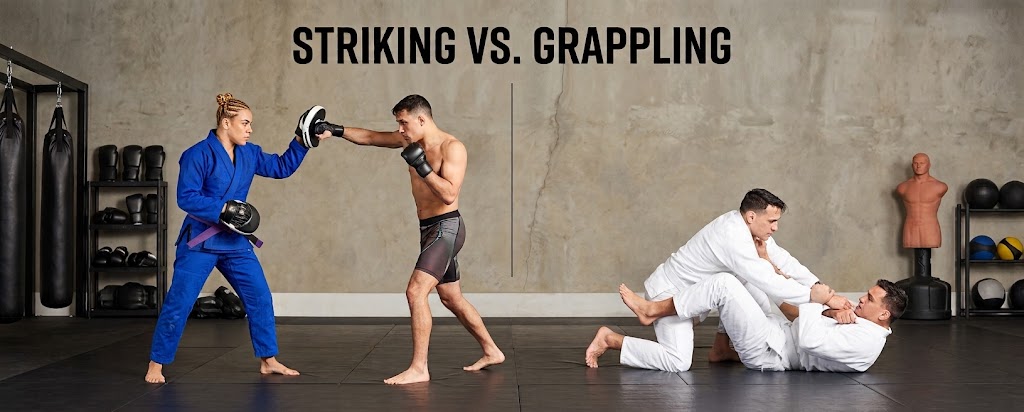
If your BJJ is improving, recovery is good and you enjoy CrossFit, there is no need to overcomplicate things. If your rolling is getting worse, soreness never leaves and every week feels like recovery from the last, the answer is probably less training, not more. Curious how other combat disciplines fit together? Read our breakdown of striking vs grappling.
16. Frequently Asked Questions About CrossFit and Jiu-Jitsu
Can you do CrossFit and Jiu-Jitsu together?
Yes. CrossFit and Jiu-Jitsu can be combined when your total training load is manageable and you have enough recovery between hard sessions. Decide which sport is your priority and protect those sessions.
Is CrossFit good for BJJ?
It can be. CrossFit can build general strength, power, muscular endurance and conditioning that support grappling. It works best as a complement to mat time, not a replacement for it.
How many times a week should I do CrossFit if I train BJJ?
There is no universal number, but one to two CrossFit sessions alongside two to three BJJ sessions is a reasonable starting point for most recreational athletes. Adjust based on how you recover and whether your BJJ keeps improving.
Should I do CrossFit before or after BJJ?
If BJJ is your priority, do the more important session when you are freshest, which usually means BJJ first or a lighter CrossFit session beforehand. Avoid a hard metcon right before an important class.
Can I do CrossFit and BJJ on the same day?
Yes, many athletes do. Leave a few hours between sessions, keep one of them lighter and put your priority sport at your best-energy time.
Does CrossFit improve BJJ cardio?
It can improve general conditioning, but BJJ cardio is specific to grappling. Long rounds of gripping, squeezing and changing pace are best trained by rolling itself, with CrossFit as a supplement.
Can CrossFit make me stronger for BJJ?
It can build general strength and power. Just remember that strength supports technique and does not replace it, and that a program built specifically for grapplers may transfer better than general CrossFit workouts.
Can CrossFit replace BJJ conditioning?
No. CrossFit contributes to general fitness, but only grappling trains you to work, recover and make decisions against a resisting partner. Treat it as an addition to your BJJ conditioning.
Is CrossFit better than weightlifting for BJJ?
Neither is universally better. CrossFit mixes lifting, gymnastics and conditioning, while traditional lifting is more targeted. The right choice depends on your weak points and how much BJJ you already do.
Which is harder, BJJ or CrossFit?
They are hard in different ways. CrossFit is mostly a physical challenge you can scale to your level. BJJ adds technique, live resistance and a steep early learning curve. Jason Khalipa, a CrossFit champion who moved into BJJ, has said that BJJ is the harder one to start.
Can beginners combine CrossFit and BJJ?
Yes, but start with fewer sessions and build up. Beginning with two BJJ classes and one CrossFit class a week lets you see how your body responds before adding more.
Does CrossFit help gi and no-gi BJJ?
It can help both by adding general strength and conditioning. Gi and no-gi have different gripping demands, so keep CrossFit supplemental to the style you train most.
What are the signs I am overtraining with CrossFit and BJJ?
Look for a pattern of declining performance, constant soreness, poor sleep, unusual fatigue, lost motivation and repeated minor injuries. If several show up together, reduce intensity or volume before adding more.
How should I adjust CrossFit before a BJJ competition?
As a tournament approaches, shift energy toward competition-specific BJJ and cut CrossFit to lighter, shorter sessions or pause it. Protect recovery so you can do quality rounds.
17. Final Takeaway
You do not have to choose between being a CrossFit athlete and a Jiu-Jitsu practitioner. You just need to know what each is giving you. CrossFit builds physical qualities that support your training. BJJ builds the grappling skill that makes you a better grappler. The combination works best when the two support each other instead of fighting over your recovery.
If BJJ is your priority, protect your mat time, use CrossFit strategically, watch your fatigue, and give yourself the food, sleep and rest to adapt. The goal is not to finish every week exhausted. It is to walk in next week stronger, better conditioned, recovered and better at Jiu-Jitsu.



Leave a comment
This site is protected by hCaptcha and the hCaptcha Privacy Policy and Terms of Service apply.