
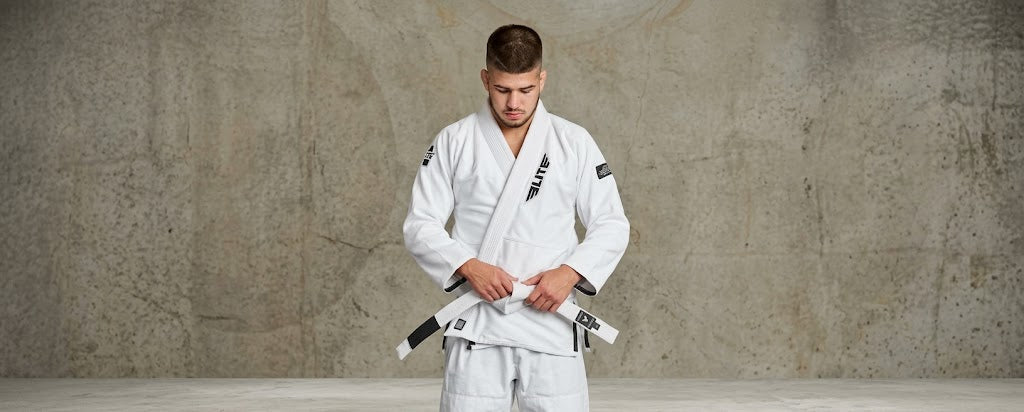
Learn how to tie a BJJ belt securely so it stays in place during rolling. This guide explains the correct square knot step by step, how tight a BJJ belt should be, common mistakes that cause it to come undone, and what to do when your belt keeps loosening. It also covers belt fit, material, kids’ BJJ belts, and practical tips for keeping your belt secure throughout training.
Table of contents
A correctly tied BJJ belt sits flat against the stomach in a square knot, holds through a full class without loosening, and uses both ends of equal length so it doesn't trail or flop during a roll. Most beginners either tie a slip knot that comes undone in the first five minutes of live training, or tie it so tightly it digs in when they bend forward. The fix is a specific sequence, not extra force. Getting the knot right matters just as much as getting the gi jacket itself to fit correctly, since a loose belt over a well-fitted gi still comes undone in a scramble.
This guide walks through that sequence step by step, covers the mistakes that cause a rank belt to come undone mid-roll, and answers the questions new students ask most often about belt fit and care.
1. Why Tying Your Belt Correctly Matters
A belt is not just a rank marker. It helps keep the gi jacket closed during grappling, so a poorly tied belt can affect training, not just appearance.
A belt that comes loose mid-roll forces a stoppage to retie it, breaks the flow of a live round, and can expose more of the jacket than IBJJF and most gym rules allow. A belt tied too tight digs into the stomach during forward folds like guard passes and hip escapes, which becomes uncomfortable well before the round ends. Getting the knot right the first time removes both problems and is one of the first practical skills most instructors expect a new student to pick up in the first few classes.
2. What You Need Before You Start
A standard adult jiu-jitsu belt is roughly one and a half to two inches wide and long enough to wrap around the waist twice with both ends hanging evenly once tied. Most belts, like our adult jiu-jitsu belts, use a cotton-polyester blend. This fabric tends to soften and hold a knot better with wear, while a stiffer, newer belt can take a few weeks of use before it knots as reliably.
Put your BJJ gi on and close the jacket before tying the belt. Trying to tie the belt first and then closing the jacket over it usually results in an uneven, loose finish.
3. Step-by-Step: Tying the Standard Gi Belt Knot

4. Common Mistakes When Tying a Gi Belt
- Tying a slip knot instead of a square knot. A slip knot looks similar at first glance but pulls open under tension instead of tightening, which is exactly what happens during a scramble.
- Starting with uneven belt lengths. If you don't center the belt before the first wrap, one end runs out of length by the final tuck, forcing an awkward, weaker finish.
- Tying the belt over a jacket you haven't fully closed. This traps extra slack in the knot and makes it far more likely to loosen during movement.
- Over-tightening instead of re-tying. A belt that will not stay snug usually has a knot problem, not a tightness problem. Pulling harder rarely fixes a badly formed knot.
5. How Tight Should Your Belt Actually Be
BJJ belt should sit snugly enough that the jacket stays closed through normal movement, but with enough room to fit two fingers flat between the belt and the stomach. Too loose, and the jacket gaps open during scrambles. Too tight, and forward folding motions like guard passing or hip escapes become genuinely uncomfortable within the first few minutes.
6. What to Do If Your Belt Keeps Coming Undone
If a grappling belt tied with the correct knot still loosens repeatedly during rolling, the most common causes are a belt that has gone stiff and glossy from age, a knot tied slightly too loose to start, or a jacket that runs long enough that extra fabric bunches under the belt and works it loose. Retying with a firmer initial tightening pass, or replacing a belt that has clearly aged out, usually resolves it.
7. Frequently Asked Questions
What is the correct knot for a BJJ belt?
A square knot tied so both ends cross evenly and lie flat against the stomach, not a slip knot or a simple overhand knot.
Why does my belt keep coming untied?
Most often because you tied it as a slip knot rather than a true square knot, because you didn't fully close the jacket before tying, or because the belt itself has aged and lost its grip.
How tight should a jiu-jitsu belt be?
Snug enough to keep the jacket closed through normal movement, with roughly two fingers of room between the belt and the stomach.
Do all belt materials tie the same way?
The knot technique is the same, but stiffer or newer belts can be harder to knot securely until they soften with use, while a well-worn-in belt tends to hold a knot more reliably from the start.
Is there a different way to tie a kids' jiu-jitsu belt?
The knot itself is identical. The main difference is length: a belt made for kids is shorter, so centering it accurately in step 1 matters even more to avoid running out of belt during the final tuck.



Leave a comment
This site is protected by hCaptcha and the hCaptcha Privacy Policy and Terms of Service apply.