

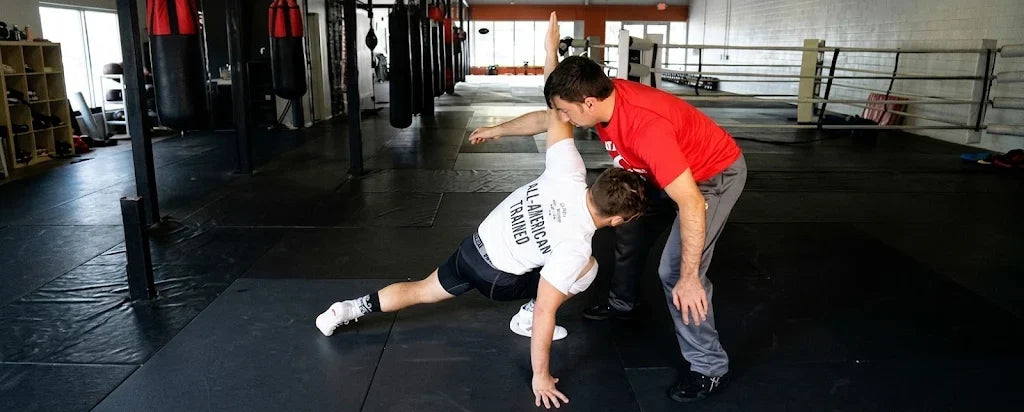
The superduck looks flashy, but it is a duck under with a fake in front of it. This guide builds it in three stages: the basic duck under, the looser-tie duck under, then the superduck. You get the footwork, the arm windmill and the finish, plus common mistakes, defense, safe drilling and how the move fits into no-gi BJJ, wrestling and MMA.
Table of contents
1. Quick Answer
A superduck is a duck under takedown set up with a fake. You step out as if shooting a low single leg, plant your hand, step back to the opposite side, and windmill your far arm past their arm. Your head and shoulder then drive through, and you finish behind them with a grip on their hips.
2. What Is a Superduck?
The superduck is a variation of the duck under, one of the most established takedowns in wrestling. In a standard duck under, you change levels, slip your head under your opponent’s arm and come out behind them. The superduck adds a fake low attack and a quick arm windmill.
It also looks harder than it is. If you can already do a clean duck under, you have most of the footwork. The rest is timing and a convincing fake.
The duck under suits grappling well because it carries a low risk of getting submitted or re-attacked and has a good chance of ending at the back. That is why it shows up in no-gi grappling and wrestling-heavy BJJ. If you want more ways to reach the back from standing, our guide to getting back control from the standing position in BJJ covers the arm drag and duck under too.

3. Build the Foundation First
Don’t start with the superduck. The two duck unders below use the same footwork, so learn them first.


3.1 Hand position
Your thumbs change the feel of the exchange. With your thumbs together, your grip is more offensive, which is what you want when you attack. With your thumbs separated and alongside your index fingers, your grip is more defensive and blocks your opponent’s grips.
3.2 Duck under 1: the basic misdirection
- Start with double inside ties, one hand inside each of your opponent’s arms.
- Step toward the side of your lead leg and lift their arm slightly as you step. This is the misdirection, and it draws their attention to that side.
- Step to the other side as you roll your head underneath their arm.
- Your hand goes to their back pocket (the hip area), and you duck behind them.
Drill this until the two steps blend into one motion.

3.3 Duck under 2: from a looser tie
The footwork stays the same. Only the entry changes.
- Reach with your rear hand and palm their face. Avoid reaching with your lead hand, since it is the one most exposed to their shots and attacks.
- They will often respond by grabbing your wrist.
- Use the same misdirection step to the side.
- Shoot your other hand to their waist, take the back pocket and pull them down and around.
Their reaction becomes your opening, and the superduck builds on the same idea.
4. How to Do a Superduck, Step by Step
The superduck uses the same stance and footwork. It is athletic and timing-based, and it looks choppy when practiced slowly. It gets smoother as you add speed.
- Take your stance and make contact in a tie or hand fight.
- Jab step to the side of your lead leg, as in the duck unders.
- Fake a low attack. Drop your hand as if you were going for a low single leg.
- Plant your hand, keeping your base under you.
- Step back to the other side.
- Windmill your other arm past their arm to beat it out of the way.
- Drive your head and shoulder through and come out behind them, with a hand on the back pocket.
- Finish on top, with control of their hips or waist.
A quick way to remember it: fake low, plant, switch sides, windmill, hips.

5. Why the Superduck Works
The fake gives your opponent something to react to. When they respond to the low threat, their arms and weight can shift, and the windmill then clears the arm that was guarding that side. This is the logic behind most good setups: show one thing, take another.
It is also a close relative of the low-level fake used in single leg attacks. If you want to understand what happens when the low threat turns into a real shot, our guide to the guillotine choke vs the single leg takedown shows how the two exchanges feed each other.


6. Common Mistakes and How to Fix Them
- Bending at the waist instead of dropping your hips. You stall under the arm and make it easy for your opponent to sprawl or crossface. Bend your knees and keep your hips under you.
- A fake that is too small. If it doesn’t look like a real attack, nothing reacts to it. Commit to the first step.
- Letting go of control too early. Keep your grip until your head is through.
- Reaching with your lead hand. It is the hand most exposed to shots, so use the rear hand.
- Rushing the windmill. The arm should clear their arm, not just swing past it.
- Finishing face to face. If you end in front of your opponent, you changed levels but did not get behind them. Keep turning until your chest is at their back.
7. How to Defend a Superduck
These are general principles for dealing with any duck under:
- Keep your hips back and your hands active so your arms are not dragged out of position.
- React to the head and shoulders, not the low hand. The fake is designed to pull your attention down.
- Reset the hand fight early with a snap down or a sprawl before your opponent’s head is through.
- Square your hips if you feel their head driving under your arm.


8. Superduck in BJJ, No-Gi and MMA
The duck under is considered more no-gi-friendly, because the friction of a gi sleeve makes it harder to slide under an arm. In the gi, the grips on your lapel and sleeve change the entry, so you usually need to clear the grip first.
If you train in the gi, make sure it moves well. Our BJJ gi collection has options for every size and level.
In MMA the duck under shows up in cage wrestling and clinch exchanges. For how BJJ adapts to that environment, see BJJ for MMA.
For the wider picture, these guides place the move among other standing options:
9. How to Practice Safely
- Go slow and cooperative first, then add speed and resistance.
- Warm up your neck, shoulders and knees. The move involves a quick level change and rotation.
- Agree on intensity with your partner. The superduck is explosive.
- Train on proper mats and stop if anything pinches in your neck or knee.
- Ask a coach to check your head position, since that is where most mistakes happen.
10. What to Wear for Superduck Drills
For no-gi drilling, you want gear that stays in place and does not catch on sleeves. A fitted no-gi BJJ rash guard does that. Elite Sports rash guards are made from a polyester and spandex blend with flatlock seams, in sizes S to 3XL.
Long sleeves cover your arms to the wrist, which means more protection from mat burn and a bit more grip when everyone is sweaty. Short sleeves run cooler and leave your arms free. If you want to try both, the standard black long sleeve rash guard and the standard black short sleeve rash guard are good starting points.
Pair a rash guard with no-gi BJJ shorts or no-gi spat pants. If you plan to compete, check the rules first, and see our guide to IBJJF mandatory no-gi uniform requirements.
11. Frequently Asked Questions
What is a superduck in wrestling?
It is a duck under takedown with a fake. You show a low attack, step to the opposite side, windmill the far arm, and come out behind your opponent.
Is the superduck a good takedown for BJJ?
Yes, particularly in no-gi. It leads toward the back without committing to a leg.
What is the difference between a duck under and a superduck?
A duck under is a level change and a slip under the arm. A superduck adds a low fake and an arm windmill, so it needs more timing and athleticism.
Is the superduck hard to learn?
It is easier if you build up to it. Learn the basic duck under first, then the looser-tie version, then add the fake and windmill.
Does the superduck work in the gi?
It is harder in the gi because sleeve and lapel friction gets in the way. You usually need to clear the grip first.
Is the superduck safe to practice?
It is safe when you drill it progressively with a partner and respect speed. Poor head position is the main risk, so ask a coach to check it.
What if the superduck fails?
Keep your hips under you and reset to a hand fight or another takedown. The same stance leads into a standard single or double leg.
12. Final Thoughts
The superduck looks like a highlight-reel move, but it is a simple chain: fake low, plant, switch sides, windmill, hips. Learn the two duck unders first, drill the footwork slowly, and add speed once the steps link together.



Leave a comment
This site is protected by hCaptcha and the hCaptcha Privacy Policy and Terms of Service apply.