
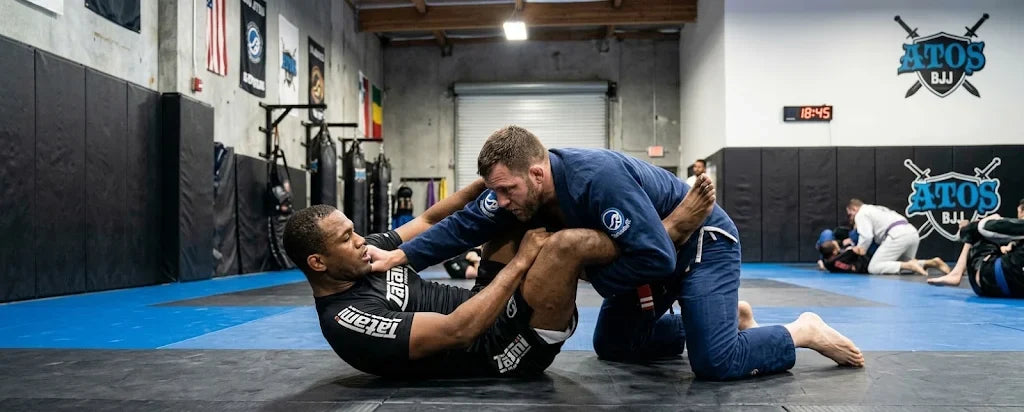
BJJ for MMA combines Brazilian Jiu-Jitsu with wrestling, striking defense, and cage control. Fighters must adapt submissions, guard positions, takedowns, and escapes to account for punches and ground-and-pound. Effective MMA grappling requires controlling an opponent while protecting yourself, creating offensive opportunities, and recognizing when to transition or stand up.
Table of contents
Brazilian Jiu-Jitsu is one of the most important grappling disciplines in mixed martial arts. However, there is a major difference between using BJJ in a traditional grappling match and applying it against an opponent who can punch, wrestle, and fight back under MMA rules.
A position that feels comfortable during a regular BJJ roll can become dangerous when ground-and-pound is involved. A submission attempt can expose a fighter to strikes. Even recovering guard requires a different level of awareness when an opponent is actively trying to attack.
BJJ for MMA requires a different mindset: control the opponent, protect yourself from damage, and recognize when to attack, defend, or escape.
The biggest adjustments involve takedown setups, front-headlock control, guard positioning, cage wrestling, and the ability to move between different grappling positions without exposing yourself to unnecessary damage.
Here are the most important lessons every grappler should understand.

1. Quick Answer: Why Is Real Jiu-Jitsu in the UFC Different?
BJJ for MMA combines traditional Brazilian Jiu-Jitsu with wrestling, striking defense, cage control, and MMA-specific positional training. Unlike a traditional BJJ match, an MMA fighter must account for punches and other legal strikes while grappling. This changes how athletes approach guard, takedowns, submissions, escapes, and ground control.
2. Why MMA Grappling Requires a Different Approach
Traditional Brazilian Jiu-Jitsu focuses on controlling an opponent, improving position, escaping unfavorable situations, and creating submission opportunities.
MMA includes those same grappling skills, but fighters must also consider striking.
For example, a BJJ practitioner might use closed guard to control an opponent and work toward a triangle choke or sweep. In MMA, the opponent on top can create striking opportunities by improving posture and distance.
The bottom fighter must now manage two problems: controlling the opponent and defending against strikes.
The same principle applies to the top fighter. Passing guard is useful, but maintaining balance, avoiding submissions, and creating effective offense are also important.
The techniques may be familiar, but the risks and priorities change when strikes are introduced.
This is why BJJ for MMA requires athletes to adapt their usual grappling strategies instead of relying on traditional competition habits without modification.
For foundational information, read Elite Sports' BJJ grappling guide.
3. Why Front-Headlock Control and Guillotine Chokes Matter
One of the most important grappling situations in MMA occurs when an opponent attempts a takedown and exposes their head and neck.
This can create an opportunity for a front-headlock position and a guillotine choke.
A front headlock allows a fighter to control the opponent's head and upper body. Depending on the position, it can lead to a guillotine attempt, a positional transition, or another form of control.
However, the position requires proper timing.
A fighter who attempts a guillotine without controlling the opponent's posture and position can lose the advantage or end up underneath them.


4. Why the guillotine is useful
The guillotine can be particularly relevant when an opponent shoots for a takedown with their head positioned incorrectly.
A grappler needs to understand:
How to control the opponent's head and neck.
How to maintain a stable position.
When to attack and when to prioritize control.
How to avoid losing position during a failed submission attempt.
How to transition when the opponent defends.
A submission is only useful when the position allows you to control the opponent and apply it effectively.
For MMA athletes, front-headlock control should be developed alongside wrestling defense rather than treated as a replacement for it.

5. Why You Cannot Simply Shoot for a Takedown in MMA
One of the biggest mistakes a grappler can make is attempting predictable takedowns without setting them up.
In traditional BJJ, a grappler may be comfortable entering directly into a takedown exchange. In MMA, an opponent can use strikes to control distance and punish predictable entries.
A fighter needs to understand range, timing, and reactions before attempting to close the distance.
Instead of repeatedly shooting from too far away, an athlete can use feints and striking setups to create openings.
For example, a fighter might:
Use feints to make an opponent react.
Encourage the opponent to move forward.
Make an opponent commit to a punch from outside effective range.
Change levels after creating a reaction.
Connect striking setups with wrestling entries.
A takedown becomes much harder when the opponent knows exactly when you are going to shoot.
This is why BJJ for MMA cannot be developed through ground grappling alone. A fighter needs to understand striking distance and how to enter safely.
The goal is not to throw random punches before attempting a takedown. It is to create an opening that makes the wrestling entry harder to anticipate.
6. Why MMA Grappling Is Simplified and Intensified
MMA grappling can involve fewer practical options in a particular situation than a traditional BJJ match, but those options must be applied decisively.
Traditional BJJ offers a wide range of guard positions, transitions, and submission setups. MMA changes which options are practical because the opponent can strike.
The same position can have a completely different purpose depending on whether strikes are allowed.
This becomes especially clear when examining mount, closed guard, and half guard.


6.1 Mount: Why protecting yourself changes the escape
In traditional BJJ, a person underneath mount may use their hands to control the opponent's hips or knees, create space, and work toward an escape.
In MMA, pushing the opponent away can create an opportunity for ground-and-pound.
When an opponent can punch, holding them close may be safer than allowing them to posture up and generate striking distance.
The trap-and-bridge escape can also be useful. By bridging, the bottom fighter forces the opponent to post an arm. The next step is to trap that arm and attempt to reverse the position.
Timing is important. If the opponent has already established posture and started striking, the escape becomes more difficult.
In MMA mount defense, controlling the opponent's ability to create striking space is a major priority.

6.2 Closed guard: Why it remains useful in MMA
Closed guard is often treated differently in MMA because the bottom fighter can use it to control posture and limit the opponent's movement.
Rather than simply accepting damage, the bottom fighter can work to control an arm, limit posture, and create submission opportunities.
Useful options include:
Controlling an arm to limit the opponent's posture.
Creating triangle and armbar opportunities when openings appear.
Using legal strikes when the rules and position allow them.
Creating submission threats to open opportunities to stand up.
Closed guard is not automatically a safe position, but it can be useful when the bottom fighter actively controls the opponent.
The purpose of closed guard in MMA is not simply to hold someone between your legs. It is to limit their offense and create an effective attack or escape.
6.3 Top half guard: An important MMA position
Top half guard can be valuable in MMA because the top fighter can control an opponent's trapped leg while maintaining pressure.
In traditional BJJ, some competitors may avoid locking their own legs around an opponent because it can appear that they are trapping themselves in guard.
MMA introduces a different consideration: controlling the opponent's leg can limit their ability to escape, recover position, or stand up.
The bottom fighter may struggle to create the movement needed to recover guard or improve position.
Top half guard can help limit an opponent's movement and make it harder for them to return to their feet.
This does not mean every half-guard position is automatically dominant. Control, balance, pressure, and the opponent's available escapes still matter.


7. Why Staying in Turtle Can Be Dangerous
Turtle can be a useful defensive position in traditional BJJ. It allows a grappler to protect themselves, prevent certain attacks, and work toward recovering guard or standing.
MMA adds another problem: strikes.
A fighter who remains in turtle too long can expose themselves to punches and other attacks.
The priority should be to hand-fight and work toward standing, or create enough movement to recover a more useful position.
A fighter needs to recognize when to:
Protect the head.
Control the opponent's hands.
Create space.
Recover guard.
Work toward standing.
Avoid giving the opponent unrestricted striking opportunities.
In MMA, turtle should be treated as a position to transition out of, not somewhere to remain comfortably.
The best response depends on the opponent's position and the available escape route.
8. Why Getting Back to Your Feet Matters So Much
A major difference between traditional BJJ and MMA is how fighters think about escaping.
In a BJJ match, recovering guard can be a successful way to improve a position. In MMA, standing up can sometimes be the more important objective.
A fighter may need to escape an opponent's top pressure before ground-and-pound creates more problems.
A controlled get-up involves:
Protecting yourself from strikes.
Creating space without exposing yourself.
Establishing a stable base.
Using hand fighting to prevent the opponent from maintaining control.
Returning to a standing position when the opportunity appears.
However, standing up without controlling the opponent can expose the back or allow another takedown.
A successful MMA escape is not just getting out of a bad position. It is reaching a position where you can defend yourself and continue fighting.
This is why MMA grappling practice should include repeated positional escapes and technical stand-ups.


9. Cage Wrestling Can Change the Entire Exchange
The cage introduces another challenge that traditional BJJ practitioners may not experience regularly.
When an opponent presses you against the fence, your movement becomes restricted. The attacker can connect their hands, control your hips, and use pressure to maintain the position.
Defending against this pressure requires more than strength.
Important skills include:
Pummeling for inside position.
Raising the elbows to help free the hips.
Preventing the opponent from connecting their hands.
Breaking connected grips when they are established.
Finding opportunities to turn away from the fence.
Using single-leg or double-leg entries when appropriate.
Working toward a better position through controlled movement.
The attacker also needs to maintain pressure without losing balance or allowing an escape.
Cage wrestling requires position, hand fighting, hip movement, and the ability to recognize opportunities before the opponent establishes control.
For anyone training BJJ for MMA, practicing against a wall or cage under qualified supervision can help develop skills that ordinary open-mat rounds do not fully reproduce.
10. Why Damage and Position Must Work Together
MMA grappling is not only about takedowns and submissions.
A fighter must understand how to connect positional control with offense.
Controlling an opponent does not always mean you are winning the exchange. The fighter must recognize when to create damage, when to improve position, and when to pursue a submission.
Striking from close range, including short punches and legal knees in appropriate positions, can create additional offensive opportunities.
However, a fighter who focuses only on striking may lose positional control. A fighter who only looks for submissions may miss safer opportunities to improve position.
Effective MMA grappling connects control with offense instead of treating them as separate skills.
This balance is an important part of adapting BJJ for MMA.
11. What Happens When BJJ Is Tested Against MMA Resistance?
Technique demonstrations can explain what a fighter should do. Applying those techniques against an experienced MMA opponent is a different challenge.
During controlled MMA sparring, a grappler must deal with striking distance, takedown defense, positional transitions, and fatigue at the same time.
Several problems become clear:
Entering without a proper setup makes takedowns difficult.
Striking threats affect takedown timing.
Reaching the ground does not guarantee top position.
A successful position can change quickly through a scramble.
An experienced opponent can recognize familiar attacks and counter them.
The lesson is that knowing what to do and being able to do it against resistance are two different things.
A technique that works during drilling still needs to survive timing, pressure, resistance, and fatigue.
This is why BJJ for MMA requires regular practice in realistic but appropriately controlled training situations.
12. Why Consistent Practice Matters More Than Memorizing Techniques
MMA athletes need to develop the ability to make decisions quickly.
They must recognize when to strike, when to wrestle, when to defend a takedown, when to pursue a submission, and when to stand up.
That awareness develops through repeated practice.
A well-rounded training program can include:
Wrestling and takedown defense: Practicing entries, sprawls, clinch positions, and takedown finishes.
Front-headlock training: Developing head control, guillotine awareness, and defensive transitions.
Positional grappling: Starting from mount, half guard, side control, and back control to develop specific reactions.
Wall wrestling: Learning to attack and defend against the cage.
Submission offense and defense: Practicing chokes, joint locks, escapes, and transitions.
Controlled MMA sparring: Introducing appropriate striking scenarios under qualified coaching.
Conditioning: Developing the ability to repeat explosive efforts while maintaining technical awareness.
The objective is not to turn every BJJ session into hard MMA sparring. Technical drilling, controlled resistance, and positional training all have a place.
Good MMA grappling training develops the ability to make decisions under pressure, not simply memorize techniques.
Athletes can also benefit from appropriate strength and conditioning work. Elite Sports explains this further in its guide to the benefits of strength and conditioning in BJJ.
13. Training Equipment for No-Gi and MMA Grappling
MMA-focused grappling involves constant movement, clinching, wrestling, and positional transitions. Training clothing should allow athletes to move comfortably without becoming a distraction.
A properly fitted rash guard helps keep clothing secure during no-gi grappling. Grappling shorts should allow unrestricted hip movement and suit the requirements of the training environment.
Explore Elite Sports' BJJ No-Gi Gear collection, including No-Gi BJJ rash guards and BJJ No-Gi shorts.
Physical preparation also matters. Grappling exchanges can involve repeated explosive efforts, sustained pressure, and demanding scrambles.
Always develop MMA-specific techniques under qualified coaching and use appropriate protective equipment.
14. Frequently Asked Questions
Is BJJ effective in the UFC?
Yes. Brazilian Jiu-Jitsu provides submissions, positional control, escapes, and defensive grappling skills used in MMA. Fighters must adapt those skills to striking, wrestling, and cage positioning.
Why is BJJ for MMA different from traditional BJJ?
MMA allows strikes, so fighters must account for punches and other legal attacks while grappling. This changes how they use guard, escape mount, approach submissions, and control opponents.
Why are guillotines important in MMA?
Guillotines can punish opponents who expose their necks during takedown attempts. However, the position and timing must be correct to avoid losing control or ending up underneath the opponent.
Is closed guard useful in MMA?
Yes. Closed guard can help the bottom fighter control posture, limit striking opportunities, and create submission attacks. Its effectiveness depends on maintaining control and responding to the opponent's actions.
Why is top half guard useful in MMA?
Top half guard can help a fighter control an opponent's trapped leg, limit their movement, and make it harder for them to stand up. The position still requires proper pressure and balance.
Is turtle a good position in MMA?
Turtle can be a temporary defensive position, but staying there too long can expose a fighter to strikes. Hand fighting and transitioning toward a safer position are important.
How do MMA fighters set up takedowns?
They can use range awareness, feints, striking reactions, and changes of level to create opportunities. Predictable takedown attempts are generally easier to anticipate and defend.
Does cage wrestling matter in MMA?
Yes. The cage affects movement, balance, and takedown defense. Fighters need to understand hand fighting, inside position, hip movement, and ways to escape or attack against the fence.
Do MMA fighters train No-Gi BJJ?
No-gi grappling is relevant to MMA because it develops submission skills, body control, and wrestling-related transitions without relying on traditional gi grips. Training methods vary between fighters and teams.
15. Final Thoughts: BJJ for MMA Is About Adapting
Brazilian Jiu-Jitsu has an important place in MMA, but its application changes when strikes become part of the fight.
A fighter must understand how to control an opponent, defend against ground-and-pound, establish takedowns, work against the cage, and return to their feet when necessary.
The strongest MMA grapplers do not abandon their BJJ fundamentals. They adapt them to a different competitive environment.
Real Jiu-Jitsu for the UFC is terrifying because every exchange demands more than technique. It demands timing, awareness, adaptability, and the ability to keep making decisions under pressure.



Leave a comment
This site is protected by hCaptcha and the hCaptcha Privacy Policy and Terms of Service apply.