
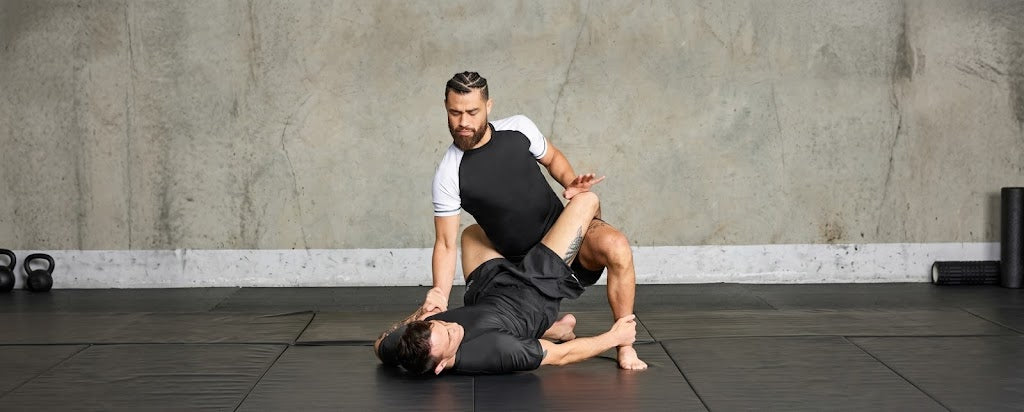
In short: The best BJJ rash guard should fit snugly without restricting movement, manage sweat, and stay in place during training. Choose long sleeves for more arm coverage or short sleeves for a lighter feel, and check your gym’s requirements before selecting a design. If you compete under IBJJF no-gi rules, confirm that your rash guard meets the current uniform requirements for fit, coverage, and rank colors. Pair it with compliant no-gi shorts or spats, check the size chart before ordering, and wash your rash guard after every session to keep your training gear clean and ready to use.
What Are BJJ Rash Guards, and Which One Should You Buy?
BJJ rash guards are tight-fitting athletic tops, usually a polyester and spandex blend, worn for no-gi training, under the gi, or in MMA and grappling. They protect your skin from mat burn, reduce skin-to-skin contact, wick sweat and leave opponents very little fabric to grab. For most beginners, a compression rash guard in black or white, in short or long sleeves, is the best first buy. If you plan to compete under IBJJF rules, buy a ranked rash guard: black, white or black and white with at least 10% of your belt color, or a rash guard that is 100% your belt color.

Key Takeaways
- A rash guard is essential for no-gi and a smart layer under the gi, but its job and fit change by use.
- For IBJJF no-gi, the shirt must be skin tight, cover the torso to the shorts' waistband and show your rank color. Sleeveless is not allowed.
- In IBJJF gi events, men may not wear a shirt under the jacket, while women are required to wear one.
- Fit matters more than brand. A good rash guard should not ride up when you bridge, shrimp or scramble.
- A complete no-gi kit also includes shorts or spats that follow the same color rules.
- Wash it after every session and air dry it. A clean rash guard is a hygiene tool, not just clothing.
Table of contents
1. What a BJJ Rash Guard Is and How It Works
A rash guard, sometimes called a rashie, is a stretchy, snug top designed to stay in place while you move. Surf versions exist too, but BJJ and MMA versions are built for grappling: thinner, stretchier and made to survive constant friction and sweat. Most are made from synthetic fabric, typically a blend of polyester and spandex.
A few features separate a rash guard built for the mats from a generic athletic shirt:
- Compression fit. The shirt clings to your body, so there is little loose fabric for an opponent to grip.
- Flatlock seams. These sit flatter against the skin and are designed to reduce chafing and help the garment hold together.
- Moisture-wicking fabric. It moves sweat away from the skin so you stay more comfortable round after round.
- An anti-slip hem or waistband. This helps the shirt stay down when you bridge, shrimp and scramble.
- Four-way stretch. The shirt moves with you instead of restricting your arms or hips.
For example, our Standard short sleeve rash guard uses an 87% polyester and 13% spandex blend, flatlock seams and an anti-slip design, according to its product page. If you want the reasons behind each feature, our guide on why rash guards are essential for BJJ hygiene explains how they protect your skin and your training partners.
2. Choose by How You Train: Gi, No-Gi, MMA and Competition
The best rash guard for you depends on what you are doing in it. Start here.
| Your training | What the rash guard does | What to look for |
|---|---|---|
| Gi training | Protects skin from collar and gi friction and keeps the inside of the gi cleaner | Thin, breathable fabric, comfortable collar, short or long sleeve |
| No-gi training | Is your main top. It handles sweat, friction and grips | Compression fit, flatlock seams, anti-slip hem, quick drying |
| MMA and mixed grappling | Gives mobility and low drag during scrambles and wall work | Durable stitching, secure hem, stretch in all directions |
| IBJJF no-gi competition | Is part of your uniform | Ranked colors, skin tight, long enough to cover the waistband |
| Kids | Protects skin and covers for sensitive areas | Correct kids sizing, comfortable seams, easy washing |
If you are still deciding between the two formats, read gi BJJ or no-gi BJJ: the differences and pros and cons, and our beginner guide on whether to train gi or no-gi. For what to wear under a gi specifically, see what to wear under your BJJ gi and rash guard vs tee shirt.
3. Ranked Rash Guards and IBJJF Rules
If you only train for fun, you can wear almost any color your gym allows. If you compete under IBJJF rules, the rules are strict, and an incorrect shirt can stop you at the uniform check. A ranked rash guard is one that shows your belt color so referees can identify your rank.

3.1. What IBJJF no-gi requires
Summaries of the IBJJF no-gi uniform rules agree on the key points:
- Skin tight. The shirt must be elastic and cling to the body. Loose T-shirts are not allowed.
- Long enough. It must cover the torso to the waistband of your shorts.
- Allowed colors. Black, white or black and white, with at least 10% of your rank (belt) color. A shirt that is 100% your rank color is also allowed.
- Sleeves. Short or long sleeves are both fine. Sleeveless is not.
- Logos and designs. Branding is allowed, but it should not hide your rank color or dominate the shirt. Keep it modest.
| Belt | Base color | Rank color requirement |
|---|---|---|
| White | Black, white or black and white | White is your rank color |
| Blue | Black, white or black and white | At least 10% blue, or a 100% blue shirt |
| Purple | Black, white or black and white | At least 10% purple, or a 100% purple shirt |
| Brown | Black, white or black and white | At least 10% brown, or a 100% brown shirt |
| Black | Black, white or black and white | Black is your rank color |
Always confirm against the current IBJJF rulebook and your event's notes before you buy or compete. Rules and shade requirements can change, and referees make the final call. Purple is a common trouble spot, because a shirt that looks purple to you may not match the required shade.
3.2. Gi competition: men and women have different rules
In IBJJF gi divisions, summaries say that men may not wear a shirt under the jacket, while women are required to wear a fitted top under it. Check the current rules for allowed colors. Local tournaments and other organizations are often more relaxed, so read your event's rules.
3.3. What our rash guards offer for competition
Elite Sports lists its Standard men's rash guards as built to meet IBJJF no-gi requirements. They come with a black base and rank-color accents. The collection includes white, blue, purple, brown and black options, plus gray and red for training. Gray and red are not standard adult IBJJF rank colors, so choose white, blue, purple, brown or black if you plan to compete. See the full men's BJJ rash guard collection, or browse the women's and kids' collections. For a deeper look at the full no-gi uniform, read our IBJJF no-gi uniform requirements and the essential rules for no-gi BJJ.
4. MMA Rash Guard vs BJJ Rash Guard
People often use the terms interchangeably, and many rash guards work for both. There are some differences in emphasis.
| Feature | BJJ rash guard | MMA rash guard |
|---|---|---|
| Main use | Grappling, rolling, tournaments | Cage grappling, scrambles, training camps |
| Fit | Skin tight, often rank-colored for competition | Snug, built to stay put during striking and wrestling |
| Construction | Flatlock seams, anti-slip hem | Often reinforced stitching and a grip panel at the hem |
| Rules | IBJJF has color rules | Promotions and gyms set their own |
| Fabric | Polyester and spandex | Polyester and spandex, sometimes with more spandex |
If you split time between BJJ and MMA, a compression rash guard with flatlock seams and a secure hem usually covers both. Our Standard rash guards are designed for BJJ, MMA and other martial arts, according to their product pages. If you train both styles, our article on striking vs grappling explains how they connect.
5. Fit and Sizing: How a BJJ Rash Guard Should Fit
A rash guard that fits poorly is the most common reason people dislike them. Use this simple fit test.
- Snug, not painful. It should feel like a second skin, with no pinching at the shoulders, armpits or neck.
- Hem below the waist. The bottom should rest a little below your waistband and stay there when you raise your arms.
- Sleeves in the right place. Short sleeves should cover the upper arm. Long sleeves should end at the wrist, not past it.
- Move test. Bridge, shrimp and reach overhead. If it rides up, binds or restricts your hips and shoulders, try another size.
- Check the size chart. Use the chart for your gender and age group. If your height and weight point to different sizes, our size guidance says to follow your weight. One customer review also suggests sizing up if you are between sizes.
Compression is usually the better choice for most training, but some people prefer a slightly looser feel. We compare both in compression rash guard vs loose fit for BJJ rolls. For IBJJF competition, remember that the shirt must be skin tight.


6. Long Sleeve or Short Sleeve Rash Guard for BJJ?
| Choose | If you want | Consider |
|---|---|---|
| Long sleeve | More arm and elbow protection from mat burn, extra coverage | Slightly warmer in hot rooms |
| Short sleeve | More airflow, easier in summer, a lighter feel | More exposed skin for friction |
Both are allowed in IBJJF no-gi events. Many practitioners own one of each and choose by climate and room temperature. For the full comparison, including whether long sleeves run too hot, see long sleeve vs short sleeve rash guards for BJJ, and for hot, sweaty sessions try our guide to the best no-gi rash guard for sweat wicking and quick drying and the breathable rash guards for long sessions.
7. Colors, Black Rash Guards and Designs
A black rash guard is a safe choice in most places. It is allowed as a base color in IBJJF no-gi events, pairs with any shorts, and is easy to keep looking sharp. If you are a beginner who does not compete, color is mostly a style decision, but check your gym's dress code.
If you want a rash guard that looks cool and stays legal for competition, keep these rules in mind:
- Keep the base black, white or black and white.
- Make sure your rank color is clearly visible and meets the minimum coverage.
- Avoid bright or neon panels that do not match your rank.
- Keep logos and graphics modest so they do not hide the rank color.
Not competing? You can choose any color or design your gym allows, such as gray or red. Our top BJJ rash guards guide highlights more styles.

8. Build a Full No-Gi Kit: Rash Guard, Shorts and Spats
A rash guard is only half of a no-gi uniform. If you plan to compete, your bottoms need to follow the rules too, and matching your gear makes it easier to pass a uniform check.
- Shorts. IBJJF summaries say board shorts must have no pockets (or pockets stitched shut), no metal or plastic, and reach at least halfway down the thigh but not past the knee. Colors should be black, white, black and white, and/or your rank color.
- Spats or compression pants. These are allowed for competition and are commonly worn under shorts. Women can compete in shorts, compression shorts or spats. Spats worn under shorts should follow the color rules.
- Undergarments. IBJJF requires brief-type undergarments in both gi and no-gi events.
Browse our BJJ no-gi shorts and kids' shorts, or see the whole no-gi gear collection. Our Black Jack blue no-gi shorts are a natural match for a blue rash guard.
8.1. Three simple kit ideas
| Kit | Includes | Best for |
|---|---|---|
| Starter kit | One compression rash guard, no-gi shorts | New students trying no-gi |
| Daily trainer | Two or three rash guards, shorts and spats | Training several times a week without constant laundry |
| Competition kit | Ranked rash guard, compliant shorts, backup shirt | IBJJF tournaments |
If you train often, buying in multiples makes sense. We offer a pack of three black short sleeve rash guards and a pack of three black long sleeve rash guards, and our flash sale page lists current discounts if you are watching for a BJJ rashguard sale.
9. Care and Hygiene Essentials
Rash guards protect your skin only if they are clean. A damp, unwashed shirt is a good place for bacteria and fungus to grow.
- Wash after every session. Do not leave a wet rash guard in a closed gym bag.
- Use mild detergent. Skip harsh chemicals and fabric softener, which can reduce stretch and wicking.
- Turn it inside out before washing and use a cool setting.
- Air dry. Heat is one of the fastest ways to wear out stretch fabric.
- Cover cuts and wounds and shower after training.
Our guides on how to wash a BJJ rash guard and 5 pro care tips to extend its life cover the details, and how to avoid skin infections in BJJ explains what to watch for on your skin.
10. How to Buy BJJ Rash Guards: A Quick Checklist
- Decide where you will wear it: gi, no-gi, MMA or competition.
- Pick sleeves based on climate and how much arm coverage you want.
- Check the colors against your rank if you compete in IBJJF events.
- Choose compression fit, and check the size chart for your group.
- Look for flatlock seams and an anti-slip hem.
- Check the fabric for stretch and moisture wicking.
- Buy more than one if you train several times a week.
- Match your shorts or spats to the same rules.
- Read the return and warranty details before you order.
Want a head start? Our BJJ rash guard buyer's guide and complete guide to gi and no-gi rash guards are good companions to this article. If you are building a full kit, you may also want a Core White BJJ gi for gi classes.
11. Common Mistakes When Choosing a BJJ Rash Guard
- Buying by color alone. Make sure the fit, fabric and seams suit grappling.
- Choosing a size that is too big. A loose rash guard rides up and gives opponents something to grab.
- Ignoring rank rules before a tournament. Check the colors before you pay for registration.
- Assuming gray or red is legal. These are fine for training but are not standard adult IBJJF rank colors.
- Wearing a shirt under the gi in IBJJF men's gi divisions. It can get you flagged at uniform check.
- Skipping the backup shirt. Bring a second compliant rash guard to tournaments.
- Machine drying every time. Heat shortens the life of stretch fabric.
12. Frequently Asked Questions About BJJ Rash Guards
What is a BJJ rash guard?
A BJJ rash guard is a tight-fitting, stretchy shirt, usually made from polyester and spandex, worn for no-gi training, under a gi, or in MMA. It protects the skin from mat burn, reduces skin contact and wicks sweat.
Do you need a rash guard for BJJ?
For no-gi, yes, in practice. Most gyms and every IBJJF no-gi event expect one. For gi training it is optional but recommended for skin protection and hygiene.
What does a ranked rash guard mean?
A ranked rash guard shows your belt color so referees can identify your rank. Under IBJJF no-gi rules, it must be black, white or black and white with at least 10% of your rank color, or 100% your rank color.
Can you wear a rash guard under a gi?
Yes in training. In IBJJF gi competition, men may not wear a shirt under the jacket, and women are required to wear a fitted top. Rules at other events vary, so check yours.
Should a BJJ rash guard be tight or loose?
Tight, but comfortable. It should feel snug, stay in place when you move and not restrict your shoulders or hips. IBJJF no-gi competition requires a skin-tight shirt.
How should a rash guard fit?
The hem should rest slightly below the waist, sleeves should end in the right place, and the shirt should not ride up when you bridge, shrimp or reach overhead. Check the size chart, and use your weight if your height points to a different size.
Are long sleeve or short sleeve rash guards better for BJJ?
Neither is universally better. Long sleeves give more arm protection, and short sleeves offer more airflow. Both are allowed in IBJJF no-gi events.
What color rash guard should I buy for BJJ?
For training, any color your gym allows. For IBJJF competition, choose black, white or black and white with your rank color, or a 100% rank-color shirt. Black and white are the safest base colors.
Is a rash guard the same as a compression shirt?
They overlap. A BJJ rash guard is a compression-style shirt designed for grappling, with features like flatlock seams and an anti-slip hem. Check that any shirt meets the rules for your event.
What is the difference between an MMA rash guard and a BJJ rash guard?
Many work for both. MMA versions often emphasize durable stitching and a secure hem, while BJJ versions for competition follow IBJJF color rules. A compression rash guard with flatlock seams usually suits both.
How often should I wash my BJJ rash guard?
After every training session. Use mild detergent, a cool wash and air drying to protect the fabric and keep your skin healthy.
How many rash guards do I need?
If you train two or three times a week, two to three rash guards let you rotate without washing every night. Competitors should also bring a spare.
Can women and kids wear the same rash guards?
Women and kids should choose rash guards sized for their group. Elite Sports offers separate women's and kids' collections with their own size charts.
What is a BJJ rashie?
"Rashie" is a casual term for a rash guard, used by many grapplers and in some countries more than others.
13. Final Verdict
The right BJJ rash guard depends on how you train. For gi classes, a thin, comfortable layer is enough. For no-gi, you want compression, flatlock seams and an anti-slip hem. For IBJJF competition, add your rank color and check the rules. Whatever you pick, check the fit, wash it after every session and match your shorts or spats to the same rules.
Ready to shop? Start with our BJJ rash guard collection, add no-gi shorts, and call us at 1-855-793-3281 if you need help choosing a size.




Leave a comment
This site is protected by hCaptcha and the hCaptcha Privacy Policy and Terms of Service apply.