
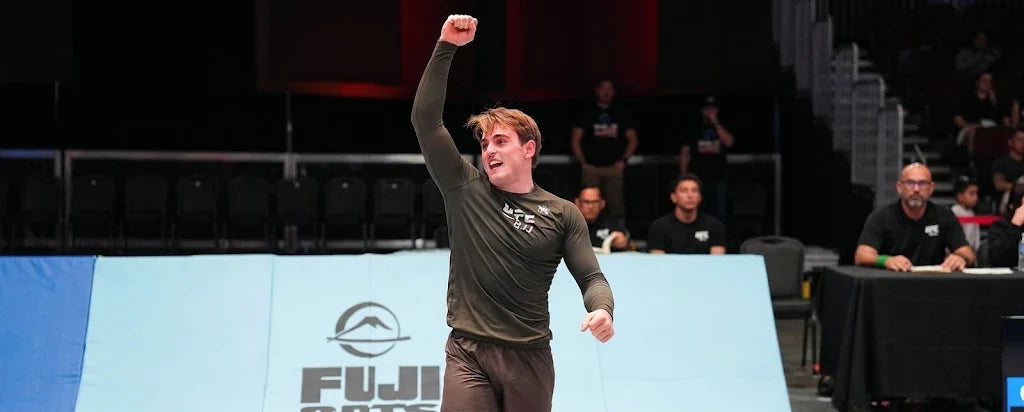
Quick answer: Andrew Tackett is one of the most difficult no-gi grapplers to slow down because he connects wrestling, guard play, counterattacks, positional transitions and submissions. When someone blocks his first attack, he often finds the next one before the opponent can settle. He was 5–0 in UFC BJJ as of November 17, 2026, but he is not undefeated across all grappling competitions. His real lesson is not “move faster.” It is recognize the next useful position sooner.
Table of contents
Imagine stopping a takedown. Your opponent's hands are off your legs, you're starting to regain your stance, and for a split second you think you've escaped. Against Andrew Tackett, that moment of relief may be the beginning of a new problem.
He might change his angle, reconnect to the hips or turn a defensive exchange into another attack. Watching him can feel like watching someone compete with the fast-forward button pressed. But describing Tackett as simply aggressive misses the interesting part: he appears to know where the exchange can go next, and he is willing to change plans before the position gets stuck.
That is why his game deserves a closer look. The useful question is not whether an ordinary student can copy an elite athlete's conditioning. It is whether they can borrow his decision-making.

1. First, how good is Andrew Tackett right now?
Tackett is the reigning UFC BJJ welterweight champion as of November 17, 2026. UFC's November fight-card announcement lists him at 5–0 in UFC BJJ, with a title defense against Chris Wojcik scheduled for December 3. That is his UFC BJJ record, not an unbeaten career record.
A few matches show both his strengths and the limits of calling anyone “unbeatable”:
Match |
Verified result |
What it tells us |
Kade Ruotolo, 2024 Craig Jones Invitational semifinal |
Tackett lost by split decision |
Elite opponents can match his pace and win close exchanges. |
Vagner Rocha, UFC BJJ 7, April 2026 |
Tackett won by unanimous decision |
Persistent defense can prevent a submission, even against the champion. |
Jonnatas Gracie, UFC BJJ 10, August 2026 |
Tackett won by face-crank submission, Round 1, 1:44 |
A defended attack can quickly become a back attack and a finish. |
His match with Ruotolo is still useful to study because neither athlete seemed content to hold a quiet position for long. Rocha offered a different problem: he forced Tackett to work through all three rounds. And against Gracie, the decisive sequence was brief enough to underline how fast positional choices can become a submission threat.
The bigger question here is what his actual style teaches, rather than retelling his life story or listing every tournament result.
1.1 His most dangerous attack might be the second one
Most grapplers have a favorite opening. Maybe it's a double leg, a knee-cut pass or a leg entry. The trouble starts when that opening fails and they keep trying the same thing from a worse angle.
Tackett's game is a reminder that an opponent's defense often reveals the next opening. A sprawl can expose a chance to reconnect higher on the body. A frame that stops one passing route may open space on the opposite side. A leg attack can turn into a scramble or a counterattack if the defender regains a safe position first.
There is a documented example of this adaptability. At UFC BJJ 4 in December 2025, Elijah Dorsey attacked Tackett's leg, but Tackett countered with an inside heel hook and won in the first round. That is an elite-level exchange, not a beginner drill. The transferable idea is simpler: defense is not always the end of offense.
Try this in class: when your initial attack is stopped, notice what the defender had to move to stop it. Did they post a hand, rotate their hips, square their shoulders or retreat their leg? That change may point to a second attack. You do not have to force it. Sometimes disengaging safely and resetting is the best decision.

1.2 He rarely gives an opponent time to make a good position permanent
There is a difference between nearly passing someone's guard and holding them in side control. There is also a difference between catching a leg and completing a takedown. Those small gaps are where a reactive grappler has room to work.
Tackett is effective at making those unsettled moments matter. Rather than treating every disadvantage as a finished position, he looks for ways to improve his hip angle, recover inside position, turn toward an underhook or return to wrestling.
That does not mean you should spin to your knees whenever someone passes. If an opponent has secured head-and-arm control or is threatening your back, turning without protecting your neck and shoulders can make things worse. The lesson is to recognize the transition *before* the opponent finishes stabilizing it.
When someone's pass is nearly complete, ask yourself: Do I still have enough space for a frame? Can I regain a knee line? Is the underhook genuinely available, or would reaching for it expose my back? The answer depends on the position. For a deeper treatment of keeping usable frames and leg position, read our guide to the layers of BJJ guard retention.


1.3 He changes direction instead of trying to win the same battle twice
Have you ever spent a whole round trying to pass toward one hip while your partner keeps replacing the same knee shield? It feels busy, but nothing changes.
A better approach is to pressure until your partner commits to the defense, then change the angle. In practical terms, that may mean switching passing sides, moving between a body connection and an outside angle, or abandoning a low-percentage attack before you become extended and vulnerable.
What looks like endless motion from the outside can actually be a sequence of small decisions: pressure, read, redirect, settle. Tackett's adaptability makes those decisions appear unusually quick. It also helps explain why his game includes more than one mode—wrestling on the feet, attacks from guard, leg entanglements and passing from the top.
The key is to change with a purpose. Random movement is not the same as a productive scramble. If you change direction without controlling distance, posture or your opponent's hips, you may only give them a better angle.

1.4 The back is an important destination, but his submissions are not one-dimensional
Back control is a powerful reward for winning a scramble. Once you get behind an opponent's shoulders and establish a secure connection, their ability to face you and defend changes dramatically. That is why you often see high-level scramblers treating the back as a destination rather than merely trying to land on top.
But it would be inaccurate to say Tackett wins only with rear-naked chokes. His UFC BJJ title defenses show real variety. He submitted Renato Canuto with a D'Arce choke in 2025 and Elijah Dorsey with a heel hook later that year. His 2026 finish against Jonnatas Gracie was officially recorded as a face crank, after he attacked from the back. Those are different finishing mechanics.
What connects them is his ability to move from the exchange in front of him toward a threat that the opponent has to respect. If a back take isn't available, he does not need to pretend that it is. For the mechanics of staying connected once you actually take the back, our separate guide explains maintaining back control in BJJ.
1.5 His pace is impressive, but awareness is the lesson you can copy
Yes, Tackett competes at an extraordinary tempo. But none of us can determine his exact energy expenditure or conditioning from watching a match. He is clearly highly trained; the more useful coaching point is that unnecessary hesitation and repeated failed attacks also consume energy.
Good movement has a destination. Instead of thinking, “I must scramble harder,” think, “What is the next safe improvement?” Get a frame back. Recover inside elbow position. Turn your hips toward a usable angle. Secure the top position once you have it. If your opening disappears, recognize it and move on.
Sometimes the efficient answer is to slow down and stabilize, particularly when you are defending a submission. Tackett's pace is a useful example of how quickly an expert can process options—not a demand that every white belt roll at maximum speed.
2. The evidence that keeps the hype honest
It is tempting to call a champion unstoppable after a spectacular finish. The results tell a more interesting story.
At the 2024 Craig Jones Invitational, Kade Ruotolo edged Tackett by split decision. In April 2026, Vagner Rocha took him the distance before losing a unanimous decision at UFC BJJ 7. Neither result makes Tackett less impressive. They show that composure, defensive awareness and the ability to disrupt his preferred pace are meaningful challenges to his game.
This matters when evaluating the “most dangerous” label. There is no single official world ranking that can settle a question spanning different organizations, rulesets and weight classes. Tackett belongs in the conversation because of his championship results and versatile attacks. Declaring him definitively the best would go beyond what those results establish.
3. Is Andrew Tackett an example of modern American jiu-jitsu?
In one sense, yes: his style reflects the increasing blend of wrestling, submissions and positional movement visible in contemporary no-gi grappling. Wrestling's strong place in US school and college sports gives many American athletes a familiar route into takedowns and scrambles.
But the blend is not uniquely American, and “American jiu-jitsu” is not a single standardized competition ruleset. Grapplers around the world combine wrestling, judo, leg locks and BJJ. What Tackett illustrates particularly well is a complete set of options, not a national monopoly on those skills.
If you are trying to add more wrestling to your BJJ, start with connection and balance rather than copying the fastest takedown in a highlight clip. Our guide to wrestling takedown strategies for BJJ covers the fundamentals separately.
4. Four realistic training lessons to take into your next class
You do not need an elite athlete's speed to practice the choices behind a fast game. Work at controlled intensity with a coach and a willing partner, and agree on the starting position before each round.
- Chain one attack to one safe alternative. Start from a light standing clinch. If your first controlled entry is defended, practice reconnecting to a different grip or angle rather than driving through a bad position. Reset before balance or head position becomes unsafe.
- Practice the direction change. From seated guard versus a standing passer, let the top player work one angle, meet a controlled frame and change direction. The goal is reading the defense—not explosively throwing the legs aside.
- Recognize the early pass. Start with a passer nearly past the knees, but without settled head-and-shoulder control. The bottom player chooses between recovering a knee, framing or making a coached underhook-to-wrestle-up transition. Stop if the back or neck becomes exposed.
- Finish the scramble with control. Begin from a safe turtle or front-headlock scenario. The attacking partner tries to establish a stable top or back-control position, and the defender tries to face them or recover guard. No neck cranks or unsupervised leg-lock finishes.
The success metric is not how frantic the round feels. After each repetition, ask: Did I notice the available position? Did I stay safe? Did I settle when I earned control? If the answer is yes, the drill worked.
5. What if you train in a gi instead of no-gi?
The same principles of timing, hip position and choosing a second attack can transfer to gi training. However, collars, sleeves and pant grips change how long someone can hold you in place, so you cannot simply copy every no-gi scramble. Our gi vs no-gi BJJ guide explains those differences. If your academy trains in a uniform, browse the Elite Sports BJJ gi collection to compare the available fits before choosing one.
For no-gi training, a comfortable BJJ rash guard and no-gi shorts are practical basics for repeated movement drills. Gear helps you train comfortably; it does not replace technical instruction.
6. What should you watch in Tackett's next match?
As of November 17, 2026, Tackett is scheduled to defend his UFC BJJ welterweight title against Chris Wojcik on December 3. Our UFC BJJ 14 event preview has the announced card and viewing details.
Instead of counting every takedown attempt, watch the second decision in each exchange. What does Tackett do when his first entry is blocked? Does he move around the defense, counter an attack or choose to reset? And can his opponent force him to stay in defense long enough to break that rhythm? Those questions reveal more about the match than the highlight reel alone.
7. Frequently asked questions
Is Andrew Tackett undefeated?
No. He lost to Kade Ruotolo by split decision in the 2024 Craig Jones Invitational semifinals. His 5–0 UFC BJJ record is specific to that promotion as of November 17, 2026; it is not an undefeated lifetime record.
Is Andrew Tackett a UFC BJJ champion?
Yes. He is the reigning UFC BJJ welterweight champion as of November 17, 2026, with a defense against Chris Wojcik scheduled for December 3. Results and title status should be updated after that event.
What makes Andrew Tackett's grappling style unusual?
He is comfortable linking standing wrestling, guard attacks, scrambles, top control and submissions. The distinguishing feature is often how rapidly he recognizes the next attack after the first option is defended.
Does Andrew Tackett only use rear-naked chokes?
No. Verified UFC BJJ finishes include a D'Arce choke against Renato Canuto, a heel hook against Elijah Dorsey and a face crank against Jonnatas Gracie. His back attacks matter, but he does not depend on one submission.
What is a scramble in BJJ?
A scramble is an unsettled exchange in which both athletes are moving to establish or recover control. It can happen after a takedown, sweep attempt, guard pass or escape. Good scrambling involves balance and positional awareness, not just speed.
Can a beginner learn from Tackett's style?
Yes, by practicing one controlled transition at a time. Learn safe frames, head and hip positioning, simple wrestling connections and when to reset. Do not imitate high-risk submissions or explosive counters without qualified supervision.
What is a wrestle-up from guard?
A wrestle-up occurs when the bottom grappler uses an opening—often involving an underhook, leg connection or posting position—to rise toward a standing or top grappling exchange. It is one option, not the right response to every guard pass.
Is Andrew Tackett the best no-gi grappler in the world?
That is an opinion rather than an established fact. The answer depends on weight class, competition format, opponent strength and the period being compared. His UFC BJJ title run makes him a major contender in the discussion, while his loss to Ruotolo shows why an absolute claim needs care.
8. The bigger lesson: don't confuse a blocked move with a finished exchange
The reason Andrew Tackett is so interesting is not that he never gets stopped. He does. It is what he tries to do *after* he gets stopped. His game asks an uncomfortable question of every opponent: Can you defend the next position, too?
For the rest of us, that is a useful way to think about improving at BJJ. Build one dependable attack, a safe response when it fails and a position you can actually control at the end. Learn to recognize the transition instead of fighting yesterday's battle. You may never move at Tackett's pace, but you can become much harder to settle—and much easier to coach.



Leave a comment
This site is protected by hCaptcha and the hCaptcha Privacy Policy and Terms of Service apply.