
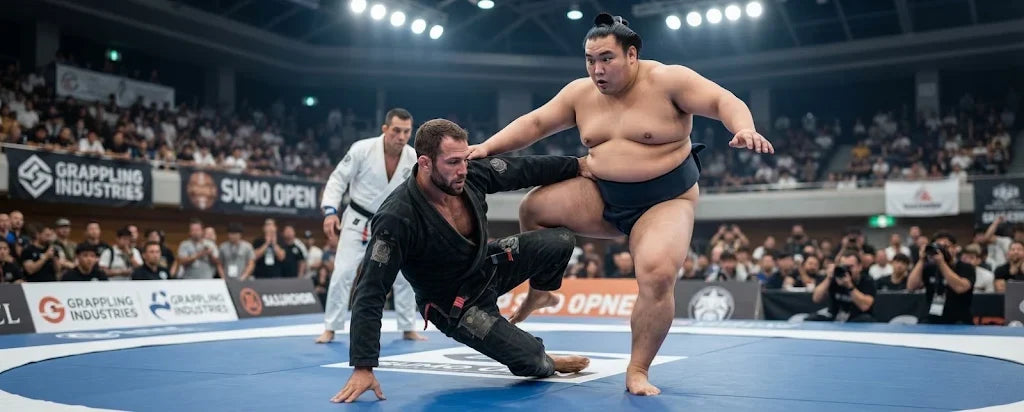
BJJ experience can help in sumo through balance breaking, foot trips and clinch awareness. But a sumo ring changes the winning conditions: ring-outs or the first non-foot ground contact normally end the bout, subject to specific refereeing exceptions. The story follows a black belt who reported 29 bouts and three gold medals at his first amateur event.
Table of contents
Quick answer: Yes, Brazilian jiu-jitsu experience can help in sumo. Balance breaking, foot trips, body positioning and the ability to stay calm in a clinch all have value. But BJJ and sumo reward different decisions: a hand on the ground during a bout or a step outside the ring can mean defeat. In one athlete's account of his first amateur sumo tournament, a 212-pound BJJ black belt entered four divisions, wrestled 29 bouts and finished with three gold medals. His biggest lesson came from the losses as much as the wins.

1. One practice session, then 29 matches
What happens when a black belt who knows how to grapple walks into a sport he barely knows?
In this case, there was almost no time to prepare. The athlete said he had less than a week's notice and managed one sumo training session before competing. He weighed in at 212 pounds, entered middleweight and then added light heavyweight, heavyweight and open weight. Some opponents were much larger. His wife, also a BJJ black belt, joined the event.
He expected a fun experiment, not an easy afternoon. The tournament, as he described it, used double-elimination brackets: lose once and you might have a route back; lose again and your run could be over. Across four divisions, he reported 29 matches and three gold medals. The counts and results in this article come from his account rather than an independently checked official bracket.
Twenty-nine bouts make for a remarkable day. But the more revealing question is what his years in BJJ actually did for him once the rules changed.
2. The first win: A familiar foot trip in an unfamiliar ring
Early in the day, he described winning with ko-soto-gari, the judo name for a minor outer reap. Rather than relying on a new sumo trick, he used a familiar grappling principle: move the opponent's weight, take away a supporting step and make them lose balance.
That principle belongs to no single martial art. Judo and wrestling use trips and throws, BJJ athletes practice their own stand-up entries, and sumo has legitimate trips and throws alongside its better-known pushes. What changes is the finish. In a BJJ match, a takedown often leads to guard work or positional control. In sumo, an off-balance step, a fall or a ring-out can end the entire bout.
The first win showed why grappling experience can transfer. His next losses showed exactly where it stops transferring.


3. The hand that touched down—and changed the match
In a light-heavyweight bout, the black belt said he lost because his hand touched the surface. Think about how ordinary that reflex is for a grappler. If your balance goes, your hand may shoot toward the mat to stop the fall.
In many BJJ exchanges, posting a hand can help you defend a sweep or recover position. After a sumo bout has started, that same touch will normally cost the match if it is the first non-foot contact with the ground. The other basic way to lose is to be forced outside the ring.
There's a small but important rule detail: the hand-touch rule does not mean sumo wrestlers never put their hands down. Under International Sumo Federation refereeing regulations, the tachiai (start) requires the competitors' hands to touch down behind the starting lines. The ordinary ground-contact loss applies once the bout is underway, subject to specific judging exceptions.
That is the kind of detail a highlight clip may not teach. It also explains why a seasoned grappler can look comfortable in the clinch yet be surprised by a result.

4. The comeback: Why losing early did not end the story
The tournament's double-elimination format turned early losses into second chances. According to the athlete, he repeatedly found himself fighting back through the losers' side of a bracket, then meeting opponents again when a title was on the line.
There is an overlooked skill here: changing an approach between matches. An opponent who drove through his first entry might be vulnerable to a different angle the next time. A loss could reveal which pressure worked, where he was off balance and when he needed to circle instead of pushing straight ahead.
That doesn't mean a comeback was inevitable. It means competition experience—the nerves, the reset and the willingness to try again—mattered alongside technique. His family was part of the day, too: he warmed up with his daughter, and his wife said she had accidentally been entered into an all-gender open-weight bracket. Late in the event, he described a sore back, a swollen lip and aches almost everywhere. The next bout still had to be wrestled.
5. Three BJJ skills that traveled well—and two habits that did not
5.1 Balance breaking worked
A grappler feels when an opponent is leaning, bracing or committing weight to a foot. That awareness can create a trip or force an awkward recovery step. In a small ring, one step can be decisive. The tournament account described success from off-balancing and forward pressure, not from a long submission sequence.
5.2 Upper-body control helped, but the rules set limits
As the event went on, the athlete talked about working around opponents' neck and upper-body positions. In BJJ and no-gi wrestling, controlling posture with legal head-and-arm ties can help direct movement. In amateur sumo, however, taking hold of an opponent's throat is prohibited under the international rulebook. A legal upper-body tie is not permission to seize or choke the throat.
The useful lesson is about posture, pressure and timing—not copying every grip someone describes during a tournament. If you want the BJJ version of that idea, Elite Sports explains how posture changes grappling exchanges.
5.3 Remaining composed through rematches helped
A black belt has usually spent years dealing with live resistance. That doesn't make anyone immune to nerves, but it can help an athlete stay engaged after a bad exchange. This competitor's repeated rematches showed why reviewing a mistake and making a small adjustment can matter more than trying harder in exactly the same way.

5.4 Posting to save a position did not transfer
The hand-touch loss was a perfect example. A response that protects a BJJ position may hand the sumo match to your opponent. When the win condition changes, good instincts need new boundaries.
5.5 Ground-fighting plans had nowhere to go
There is no ordinary guard-passing or submission phase after a sumo takedown. Dropping to guard—a normal tactical choice in some BJJ rulesets—would usually end a sumo bout by ground contact. That makes standing balance, footwork and ring awareness essential rather than optional.
6. Did someone step out first? The dead-body rule explained
One of the day's most confusing exchanges ended in a disputed decision. In the athlete's account, a wrestler appeared to step outside before the other landed, yet officials explained a result using the shinitai principle, often translated as the dead-body rule.
Under International Sumo Federation regulations, shinitai describes a competitor who has already lost balance and is irretrievably falling. If the opponent who delivered the decisive action briefly puts a protective hand down (kabaite) or steps outside first (kabaiashi), officials may still award that opponent the win. The rule is more specific than simply asking whose hand or foot made contact first.
That does not mean the rule explains every close call, or that we can overturn a referee's judgment from a narrated account. It means a replay that focuses on the first visible touch may miss the question the judges were actually deciding.
7. What about the opponents who were much bigger?
A 212-pound competitor entering heavyweight and open weight has a real size challenge. Weight, strength, stance, reach, timing and sumo-specific experience all influence a clinch. Good angles can help a smaller athlete, but an opponent with a strong base can also stop a trip or push through it.
Winning some bouts against heavier people does not prove size is irrelevant or that BJJ beats sumo. It shows a narrower and more useful point: grappling fundamentals can create opportunities even when the athlete is new to a particular rule set.
8. Three safe lessons BJJ athletes can take back to class
You do not need to enter a sumo tournament to use the insights. In a suitable training space, with a qualified instructor and willing partner:
- Start some rounds on your feet. Practice establishing posture and inside position before you think about a takedown. Use controlled resistance rather than surprise collisions.
- Create a step before finishing. Explore how a small push-pull or change of angle makes your partner shift weight. Work slowly enough to protect knees and ankles, and learn appropriate breakfalls.
- Practice recovering position near a marked boundary. Use a safe line on the mat to recognize when you're moving straight backward. Practice circling out without running into walls or other athletes.
These drills support BJJ stand-up practice; they are not a substitute for sumo coaching. For a deeper BJJ-specific progression, see Elite Sports' wrestling takedown strategies for BJJ practitioners.
9. Does gi training help with the same skills?
Some of the concepts carry into both gi and no-gi BJJ: staying balanced, controlling distance and recognizing an opponent's pressure. The gripping methods differ. In gi classes, jackets and sleeves offer legal fabric grips; in no-gi, athletes rely more on direct ties, underhooks and body control. Sumo adds its own gripping rules and its own competitive uniform, the mawashi.
If you're training those clothing-grip fundamentals in jiu-jitsu, a properly fitting BJJ gi belongs in that practice. Men choosing a gi specifically for regular classes can compare available fits in the men's BJJ gi collection. Neither purchase is a shortcut to sumo success; training and instruction are what develop the skill.
If you want more detail on how cloth grips alter regular jiu-jitsu exchanges, read Elite Sports' guide to how the BJJ gi changes training. The lesson here remains the same: useful habits must still fit the rules of the sport you're doing.
10. Frequently asked questions
Can a BJJ black belt beat a sumo wrestler?
Yes, it can happen, particularly in amateur competition, but it depends on the athletes, size, experience and rules. This account is not a controlled test of which martial art is superior.
Why does touching the ground make you lose in sumo?
During a bout, a wrestler normally loses if a body part other than the soles of the feet touches the ground first. The rules also recognize specific exceptions for already-decided falls. Hands touching down during the tachiai are part of starting, not an ordinary in-bout loss.
Are foot trips allowed in sumo?
Sumo includes trips and throws as well as pushes. A move still has to follow the applicable sumo rules, including restrictions on prohibited grips and strikes. This competitor called one of his early finishes ko-soto-gari.
Does a lighter BJJ athlete have a chance against a heavier opponent?
There may be an opportunity through timing, angles and balance breaking, but greater mass and sumo experience can be substantial advantages. No tournament story guarantees the outcome of a different matchup.
What is the dead-body rule in sumo?
The shinitai principle recognizes when a wrestler is already irretrievably falling. A protective hand touch or step outside by the opponent who completed the decisive action does not necessarily reverse the result.
Is pulling guard a good strategy in sumo?
No. Deliberately sitting to play guard would ordinarily put a non-foot body part on the surface and lose the match. Sumo does not continue into ground grappling in the way BJJ does.
11. The real result of the experiment
Three reported gold medals make a striking headline. But the most memorable part of this tournament account is the contrast between two moments: a familiar foot trip that worked immediately and an equally familiar hand post that ended a bout.
That is what cross-training exposes. Experience gives you a head start; a different rulebook shows you where the head start ends. For anyone who grapples, the lesson is to understand what your sport rewards—and stay curious about what another sport can teach you.



Leave a comment
This site is protected by hCaptcha and the hCaptcha Privacy Policy and Terms of Service apply.