
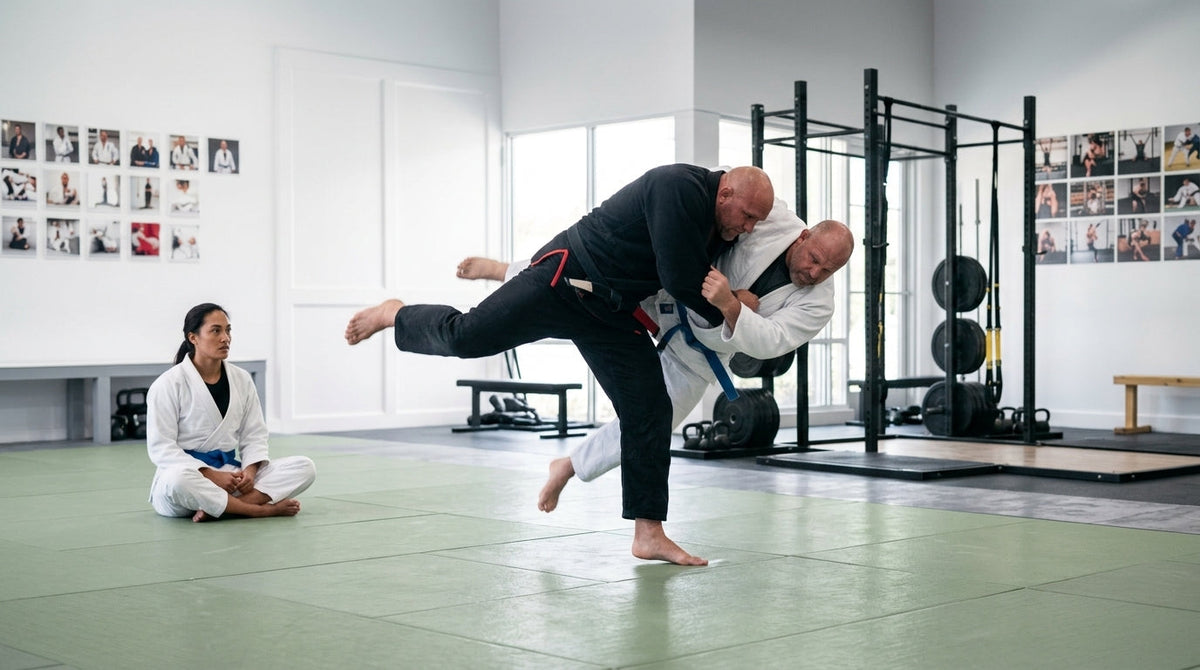
Judo throw names follow a clear system once you know the five families: Te Waza, Koshi Waza, Ashi Waza, Ma Sutemi Waza and Yoko Sutemi Waza. This guide lists all 68 official Kodokan throws, explains what the Japanese words mean, and answers common questions about judo basics, takedowns, kicks and BJJ.
Judo throw names look intimidating at first, but they follow a clear system. Kodokan judo recognizes 68 official throws, and the International Judo Federation (IJF) uses the same classification. It sorts every throw into five families: Te Waza (hand techniques), Koshi Waza (hip techniques), Ashi Waza (foot and leg techniques), Ma Sutemi Waza (rear sacrifice techniques) and Yoko Sutemi Waza (side sacrifice techniques).
This guide gives you the full judo throws list by family, decodes the Japanese words inside each name, and covers the basics every beginner needs. It also answers the questions people search most, from whether judo has kicks to which takedown counts as the most basic. Whether you come from BJJ, wrestling or your first day on the mats, you can use it as a reference.
Table of contents
1. The five judo throw families at a glance
Judo splits its throwing techniques (Nage Waza) into standing techniques (Tachi Waza) and sacrifice techniques (Sutemi Waza). Those two groups break down into five families:
- Te Waza (hand techniques): 16 throws. Examples: Seoi Nage, Tai Otoshi, Kata Guruma.
- Koshi Waza (hip techniques): 10 throws. Examples: O Goshi, Uki Goshi, Harai Goshi.
- Ashi Waza (foot and leg techniques): 21 throws. Examples: O Soto Gari, O Uchi Gari, Uchi Mata.
- Ma Sutemi Waza (rear sacrifice techniques): 5 throws. Examples: Tomoe Nage, Sumi Gaeshi, Ura Nage.
- Yoko Sutemi Waza (side sacrifice techniques): 16 throws. Examples: Yoko Otoshi, Tani Otoshi, Yoko Guruma.
Add those counts together and you get the 68 official Kodokan throws.

2. How to read judo throw names
Most Japanese throw names describe either the body part doing the work or the action of the throw. Learn a dozen word parts and you can decode much of the list:
- Nage: throw
- Goshi (Koshi when it stands alone): hip
- Gari: reap
- Harai or Barai: sweep
- Otoshi: drop
- Guruma: wheel
- Gaeshi: reversal or counter
- Gake: hook
- Makikomi: wrap around throw
- O and Ko: major (large) and minor (small)
- Uchi and Soto: inner and outer
So O Soto Gari reads as "major outer reap" and Ko Uchi Gari reads as "minor inner reap." Spellings vary between sources. You will see Ouchi Gari and O Uchi Gari, or De Ashi Barai and De Ashi Harai, and each pair names the same technique.
3. What is a judo throw?
A judo throw is a technique from Nage Waza that takes an opponent from standing to the mat with control. Strength alone does not make it work. Every throw rests on three stages:
- Kuzushi: breaking or disrupting the opponent's balance.
- Tsukuri: fitting your body, grips and feet into position for the technique.
- Kake: executing the throw.
The IJF treats these three stages as the foundation of judo technique, and they apply to every throw in this guide. That explains why a skilled judoka makes a throw look effortless. The visible part takes a fraction of a second, but grip, footwork, direction, timing and the opponent's reaction all decide whether it lands. Judo clubs train the entry again and again without finishing the throw, a drill called uchikomi, because a clean entry is where most throws are won or lost.
4. The best judo throws and what they do
No official ranking of the best judo throws exists, and the right choice depends on your size, grips and instructor. The throws below show up most often in beginner syllabi and in competition, so they make a sensible starting point.
4.1. Te Waza examples
Seoi Nage (shoulder throw). You turn in under your opponent, load them onto your back and rotate them over your shoulder. Ippon Seoi Nage is a one arm version of the same idea. It ranks among the most recognized judo throws.
Tai Otoshi (body drop). You step across, extend a leg as a block and pull your opponent's upper body over it. Hands and upper body drive the throw, which is why it belongs to Te Waza instead of the hip family.
4.2. Koshi Waza examples
O Goshi (major hip throw). You pull your opponent's weight over your hip, control the upper body and rotate to finish. Many clubs teach it early because it shows hip positioning in its simplest form.
Harai Goshi (sweeping hip throw). You load your opponent onto your hip and add a sweeping leg action to carry them over.
Koshi Guruma (hip wheel). You wrap an arm around your opponent's head and wheel them over your hip. It looks similar to O Goshi but works through a different grip and rotation.
4.3. Ashi Waza examples
O Soto Gari (major outer reap). You drive your opponent's upper body backward while your leg reaps their leg from the outside. It is one of the foundational judo throws.
O Uchi Gari (major inner reap). You reap from the inside instead, usually against an opponent who stands with their feet apart. It teaches clearly that the setup matters as much as the leg action.
Uchi Mata (inner thigh throw). You lift through the inside of your opponent's thigh while pulling them forward. It appears often in high level competition.
De Ashi Barai (forward foot sweep). You sweep your opponent's advancing foot just as they load weight on it. Timing does the work here, not force. Despite its delicate look, it sits in the first group of the traditional Gokyo syllabus, so beginners meet it early.
Sasae Tsurikomi Ashi (propping drawing ankle throw). You block your opponent's foot or ankle with the sole of your foot while your hands pull them over it.
Hiza Guruma (knee wheel). You place a foot against your opponent's knee and wheel them over it as you break their balance.
4.4 Ma Sutemi Waza examples
Tomoe Nage (circle throw). You fall backward on purpose, plant a foot on your opponent and send them over your head.
Sumi Gaeshi (corner reversal). You drop back at an angle and use a leg to lift your opponent across your body.
Ura Nage (rear throw). You lift your opponent and fall backward to throw them behind you. It resembles a suplex, but judo classifies it as a sacrifice throw.
4.5. Yoko Sutemi Waza examples
Yoko Otoshi (side drop). You drop to your side and take your opponent over with you.
Tani Otoshi (valley drop). You fall to the side and back while a hooked leg takes your opponent over. Some rulesets restrict it, so check the rules where you train.
Sacrifice throws put your own body on the mat, which makes them risky for beginners. Learn them with a qualified instructor and a willing, trained partner.
5. Complete judo throws list by family
A judo throws chart works better when you group names by family instead of memorizing one long list. These lists follow the IJF and Kodokan classification.
5.1. Te Waza: hand techniques (16)
- Seoi Nage
- Ippon Seoi Nage
- Seoi Otoshi
- Tai Otoshi
- Kata Guruma
- Sukui Nage
- Obi Otoshi
- Uki Otoshi
- Sumi Otoshi
- Yama Arashi
- Obi Tori Gaeshi
- Morote Gari
- Kuchiki Taoshi
- Kibisu Gaeshi
- Uchi Mata Sukashi
- Ko Uchi Gaeshi
5.2. Koshi Waza: hip techniques (10)
- Uki Goshi
- O Goshi
- Koshi Guruma
- Tsurikomi Goshi
- Sode Tsurikomi Goshi
- Harai Goshi
- Tsuri Goshi
- Hane Goshi
- Utsuri Goshi
- Ushiro Goshi
5.3. Ashi Waza: foot and leg techniques (21)
- De Ashi Barai
- Hiza Guruma
- Sasae Tsurikomi Ashi
- O Soto Gari
- O Uchi Gari
- Ko Soto Gari
- Ko Uchi Gari
- Okuri Ashi Harai
- Uchi Mata
- Ko Soto Gake
- Ashi Guruma
- Harai Tsurikomi Ashi
- O Guruma
- O Soto Guruma
- O Soto Otoshi
- Tsubame Gaeshi
- O Soto Gaeshi
- O Uchi Gaeshi
- Hane Goshi Gaeshi
- Harai Goshi Gaeshi
- Uchi Mata Gaeshi
5.4. Ma Sutemi Waza: rear sacrifice techniques (5)
- Tomoe Nage
- Sumi Gaeshi
- Hikikomi Gaeshi
- Tawara Gaeshi
- Ura Nage
5.5. Yoko Sutemi Waza: side sacrifice techniques (16)
- Yoko Otoshi
- Tani Otoshi
- Hane Makikomi
- Soto Makikomi
- Uchi Makikomi
- Uki Waza
- Yoko Wakare
- Yoko Guruma
- Yoko Gake
- Daki Wakare
- O Soto Makikomi
- Uchi Mata Makikomi
- Harai Makikomi
- Ko Uchi Makikomi
- Kani Basami
- Kawazu Gake
This is a reference list of recognized techniques, not a promise that each one is legal in every competition, age division or club. Rules change, so check the governing organization for your event.

6. Judo throws banned in competition
Some recognized throws are prohibited under IJF competition rules, mainly because of injury risk or leg grabbing. The IJF and Kodokan material marks these as prohibited:
- Kata Guruma
- Morote Gari
- Kuchiki Taoshi
- Kibisu Gaeshi
- Kani Basami
- Kawazu Gake
IJF rules also penalize grabbing the opponent's legs in standing work, which rules out leg grab throws such as Sukui Nage in IJF events. A technique can stay in the Kodokan classification even when competition rules prohibit it, so a name on the list above does not mean you can use it in a match. Ask your instructor or event organizer what applies to you.
7. How many judo throws are there?
The answer depends on which list you count:
- Kodokan official list: 68 throws since April 2017, split 16, 10, 21, 5 and 16 across the five families.
- Gokyo no Waza: the traditional teaching syllabus. It dates to 1895 and took its standard form of 40 throws in five groups in the 1920 revision.
- Nage no Kata: a form of 15 throws arranged in five sets of three. It teaches the principles behind throwing, such as kuzushi, tsukuri and kake, rather than serving as a catalog of techniques.
So a "complete" judo throws list might hold 40, 67 or 68 names, depending on the source. When you compare lists online, check which syllabus each one follows.
The answer depends on which list you count:
- Kodokan official list: 68 throws since April 2017, split 16, 10, 21, 5 and 16 across the five families.
- Gokyo no Waza: the traditional teaching syllabus. It dates to 1895 and took its standard form of 40 throws in five groups in the 1920 revision.
- Nage no Kata: a form of 15 throws arranged in five sets of three. It teaches the principles behind throwing, such as kuzushi, tsukuri and kake, rather than serving as a catalog of techniques.
So a "complete" judo throws list might hold 40, 67 or 68 names, depending on the source. When you compare lists online, check which syllabus each one follows.
8. Judo basics for beginners
Memorizing dozens of Japanese names is not the best place to start. These fundamentals come first:
- Ukemi (breakfalls): you learn to fall safely before you learn to throw. Forward rolls, side falls and back falls let you take repeated throws in training.
- Kumikata (gripping): grips set distance, posture and your ability to attack. Most throws start with a sleeve grip and a collar grip.
- Kuzushi (breaking balance): you move the opponent outside their stable base.
- Tsukuri (entry and positioning): feet, hips, grips and direction come together before the throw.
- Kake (execution): you finish the technique. A throw with weak kuzushi or weak tsukuri demands extra strength, which is a sign the setup was incomplete.
Add controlled entries, steady repetition with a partner and supervised randori (free practice), and you have the early curriculum at most clubs.

9. What is the most basic judo takedown?
No single throw holds that title, and clubs differ. Two sources help narrow it down.
The Gokyo no Waza places eight throws in its first group, called Dai Ikkyo, which is the group students meet first. In order, they are:
- De Ashi Barai
- Hiza Guruma
- Sasae Tsurikomi Ashi
- Uki Goshi
- O Soto Gari
- O Goshi
- O Uchi Gari
- Seoi Nage
Within that group, O Goshi often appears first for novices, while many BJJ coaches point to O Soto Gari as the simplest takedown to hit. The second group adds Ko Soto Gari, Ko Uchi Gari, Koshi Guruma, Tsurikomi Goshi, Okuri Ashi Harai, Tai Otoshi, Harai Goshi and Uchi Mata. If you want a short beginner list, start with O Goshi, O Soto Gari, O Uchi Gari, De Ashi Barai, Sasae Tsurikomi Ashi, Seoi Nage and Tai Otoshi, then let your instructor adjust the order.


10. Judo moves and techniques beyond throws
"Judo moves" and "judo techniques" cover far more than throws. The Kodokan classification has three main groups:
- Nage Waza (throwing techniques): 68 techniques, covered above.
- Katame Waza (grappling techniques): 32 techniques, split into hold downs (Osaekomi Waza, 10), chokes and strangles (Shime Waza, 12) and joint locks (Kansetsu Waza, 10).
- Atemi Waza (striking techniques): strikes against vital points, practiced in kata and kept out of competition.
Here are examples of judo techniques names outside the throws:
- Hold downs: Kesa Gatame, Kata Gatame, Kami Shiho Gatame, Yoko Shiho Gatame, Tate Shiho Gatame
- Chokes: Hadaka Jime
- Joint locks: Ude Garami, Ude Hishigi Juji Gatame, Waki Gatame
Informally, people also use "judo moves" for foot sweeps, grips, transitions, counters and breakfalls.
11. What is a restraining maneuver in judo?
A restraining maneuver in judo is a technique that controls an opponent instead of throwing them. Two groups fit the description. Hold downs (Osaekomi Waza) pin an opponent on their back, and under IJF rules a pin held for 20 seconds scores ippon. Joint locks (Kansetsu Waza) restrain an opponent through the elbow, and competition judo allows armlocks on the elbow only.
If you found this page through a crossword, the answer to the New York Times clue "Restraining maneuver in judo" is ARMBAR, which appeared in the March 27, 2026 puzzle.
12. Judo takedown names vs throw names
"Takedown" is a general grappling word for bringing an opponent from standing to the ground. Judo uses the more precise term Nage Waza for its throws, so a judoka rarely says "takedown" in class.
The takedowns people most often describe with that word include O Goshi, Seoi Nage, O Soto Gari, O Uchi Gari, Uchi Mata, Tai Otoshi, Harai Goshi, De Ashi Barai, Sasae Tsurikomi Ashi and Tomoe Nage.
The distinction matters because wrestling and MMA takedowns do not always map onto judo throws. The wrestling double leg is a good example. Judo has a name for it, Morote Gari, and the Kodokan recognized it as an official technique in 1982, yet IJF rules prohibit it in competition because it grabs the legs.
13. The judo style of fighting
Jigoro Kano founded judo in 1882, and it has been an Olympic sport since 1964. It is a grappling art, which means two athletes fight at close range using grips, balance, throws, pins, chokes and elbow locks. Competitors do not rely on punches or kicks.
Judo fighters usually stand more upright than wrestlers and fight for grips on the jacket, then look for a moment to break balance and throw. Under IJF rules, a throw delivered with control and power, or a pin held for 20 seconds, scores ippon and ends the match. If the fight goes to the ground, the same athletes switch to groundwork (Ne Waza) for pins, chokes and elbow locks.
Brazilian Jiu Jitsu grew out of judo, and the two arts still share plenty of ground. If you want a direct side by side, read how judo and BJJ compare.
14. Does judo have kicks?
Competitive judo does not use kicks. Punching and kicking are not allowed in competition or in randori. Striking techniques (Atemi Waza) exist in the classical curriculum, but judoka practice them only in kata, which are pre arranged forms.
The confusion comes from foot techniques. Throws such as O Soto Gari, De Ashi Barai and Uchi Mata use the leg, but they reap, sweep or lift the opponent's leg to unbalance them. They do not strike. If you want to see where kicking arts and grappling arts split, read this breakdown of striking versus grappling.
15. Technique du judo: the French term
"Technique du judo" is French for "judo technique." Because judo spread through France early and widely, many searchers use the French term. French judo uses the same three groups of techniques as English language judo: techniques de projection (Nage Waza), techniques de contrôle (Katame Waza) and techniques de frappe (Atemi Waza). Breakfalls are called chutes, and Ukemi is the Japanese word for them. The Japanese names in this guide stay the same in French dojos.
16. Judo throws in Brazilian Jiu Jitsu
BJJ and judo share historical roots, so judo throws show up often in BJJ training, especially in gi grappling. Techniques that BJJ players commonly borrow include O Goshi, Uchi Mata, O Soto Gari, O Uchi Gari, Seoi Nage and Tai Otoshi. For a practical starting point, see these easy judo techniques that carry over to BJJ.
A throw does not transfer to BJJ unchanged. Rules, grips, stance, clothing and training style all shape what works, and some judo throws leave you exposed to a back take if you miss. A throw that scores ippon in judo may also leave you in a different position than you want in a BJJ match. Treat judo throws as tools to adapt, and expect to adjust them.
17. How to learn judo throws safely
Throws involve falls and rotational force, so progress in steps:
- Warm up properly.
- Learn ukemi before anything else.
- Practice basic movement and grip fundamentals.
- Drill kuzushi and controlled entries.
- Repeat techniques with a qualified partner.
- Move to supervised randori when your instructor says you are ready.
Do not try advanced sacrifice throws, high amplitude throws or unfamiliar techniques on an untrained partner. Videos help you learn terminology, but you should learn the physical technique on proper mats under a qualified instructor. An instructor can also adapt a throw to your height, weight and experience.
18. Gear for judo and BJJ training
The judogi is the traditional judo uniform, and it differs from a BJJ gi in weight and cut. If you train both arts, read using a judo gi for BJJ before you buy.
If your goal is BJJ training alongside your throws, a preshrunk gi built for BJJ training keeps its fit after washing, so the sleeves and jacket stay consistent as you drill grips.
19. Frequently asked questions
What are the main judo throw names?
The best known judo throw names include Seoi Nage, O Goshi, O Soto Gari, O Uchi Gari, Uchi Mata, Tai Otoshi, Harai Goshi, De Ashi Barai, Sasae Tsurikomi Ashi, Tomoe Nage and Ura Nage. Kodokan judo lists 68 official throws in five families.
What are the five judo throwing categories?
They are Te Waza (hand techniques), Koshi Waza (hip techniques), Ashi Waza (foot and leg techniques), Ma Sutemi Waza (rear sacrifice techniques) and Yoko Sutemi Waza (side sacrifice techniques).
How many judo throws are there?
Kodokan judo lists 68 official throws. The traditional Gokyo no Waza syllabus holds 40 throws in five groups, and Nage no Kata teaches 15. The number you see depends on which list a source counts.
What is the most famous judo throw?
No official answer exists. Seoi Nage, O Goshi, O Soto Gari and Uchi Mata are among the most recognized, but popularity varies by club, athlete and era.
What is the easiest judo throw to learn?
No throw is easiest for everyone. Instructors choose based on your experience, build and the club curriculum. O Goshi and O Soto Gari are common early picks.
What is a judo takedown?
"Takedown" is a general grappling term for taking an opponent from standing to the ground. Judo calls its formal throwing techniques Nage Waza.
What are the basic judo techniques?
Judo basics include ukemi (breakfalls), kumikata (gripping), movement, kuzushi, tsukuri, kake, basic throws and basic groundwork. Exact curricula vary by club and federation.
Does judo have kicks?
Competitive judo does not use kicks. Striking techniques exist in kata only. Foot sweeps and reaps use the leg to unbalance an opponent, not to strike.
What is a restraining maneuver in judo?
Hold downs (Osaekomi Waza) and elbow armlocks (Kansetsu Waza) restrain an opponent. The crossword answer to this clue is ARMBAR.
What does Nage Waza mean?
Nage Waza means throwing techniques. It is the Kodokan group that holds all 68 official throws.
What do Te Waza, Koshi Waza and Ashi Waza mean?
Te Waza means hand techniques, Koshi Waza means hip techniques and Ashi Waza means foot and leg techniques.
What does Sutemi Waza mean?
Sutemi Waza means sacrifice techniques, where the thrower deliberately gives up their standing position to complete the throw.
What are kuzushi, tsukuri and kake?
Kuzushi is breaking the opponent's balance. Tsukuri is fitting your body into position. Kake is executing the throw.
What is ukemi?
Ukemi means breakfalls, the techniques that let you land safely when you are thrown.
What is the difference between Gokyo and Nage no Kata?
Gokyo no Waza is a teaching syllabus of 40 throws in five groups. Nage no Kata is a form of 15 throws that demonstrates the principles behind throwing.Are judo throws used in BJJ?
Are judo throws used in BJJ?
Yes. Many BJJ players adapt judo throws, particularly in gi grappling. Rules and positional goals differ, so a throw may need adjustments.
Can I learn judo throws at home?
You can study names and watch demonstrations at home, but you should learn the physical technique on mats with a qualified instructor. Incorrect throws and falls can cause injury.
Where can I find official judo technique demonstrations?
The International Judo Federation hosts a technique database with demonstrations for recognized throws at judo.ijf.org.
20. Final takeaway
Judo throw names become easy once you stop memorizing one long list. Start with the five families: Te Waza, Koshi Waza, Ashi Waza, Ma Sutemi Waza and Yoko Sutemi Waza. Then learn the three principles that connect them: kuzushi, tsukuri and kake. From there, throws like O Goshi, Seoi Nage, O Soto Gari, Uchi Mata and Tomoe Nage read as variations on one system.
The names are only the start. The skill comes from balance, grips, movement and timing, and you build those on the mat.



Leave a comment
This site is protected by hCaptcha and the hCaptcha Privacy Policy and Terms of Service apply.