
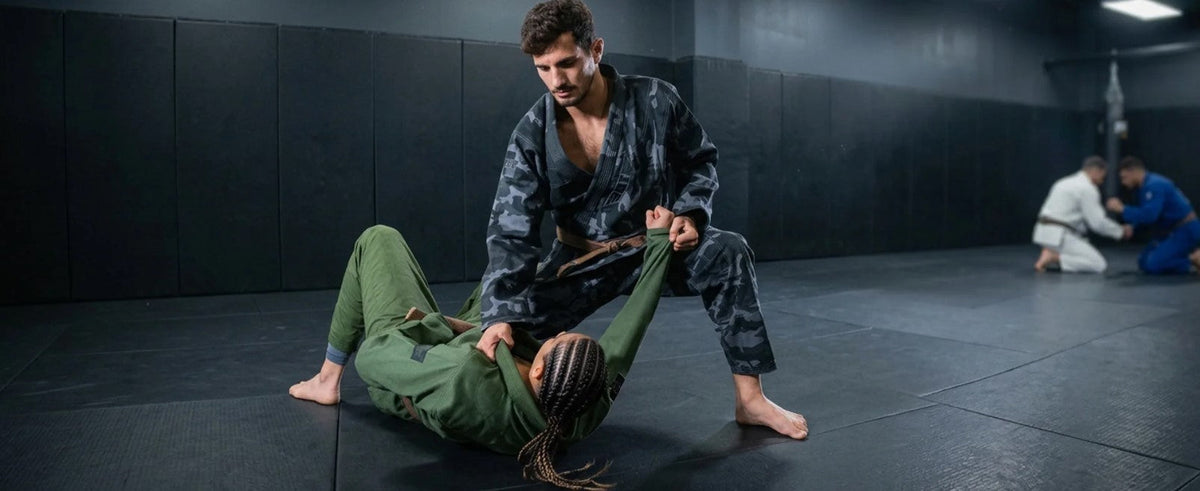
A breakdown of how the BJJ Gi changes Brazilian Jiu-Jitsu training — from grip fighting and guard passing to defense and patience — plus practical guidance on Gi construction, sizing, care, and IBJJF competition rules.
Table of contents
Quick answer: A BJJ Gi changes Brazilian Jiu-Jitsu by adding fabric grips — collar, sleeves, pants, and lapel — that both athletes can use to control posture, create angles, and set up attacks. This turns grip fighting into a core skill, slows exchanges into more methodical positional battles, and demands a different approach to guard, passing, and defense than No-Gi training does.
A BJJ Gi does more than serve as the uniform you wear during Brazilian Jiu-Jitsu training. The jacket and pants create grips, friction, resistance, and control points that can change how you move, defend, pass, and attack.
Gi training also teaches you to think differently about grips and positional control. A sleeve, collar, pant leg, or lapel can become part of a technique, giving you more ways to control your opponent — but also creating more opportunities for them to control you.
That is one reason Gi and No-Gi Jiu-Jitsu can feel like two different versions of the same sport. The fundamentals stay connected, but the available grips and reactions change how techniques are applied. If you're shopping for gear, Elite Sports' IBJJF-approved BJJ Gi collection is a good place to compare options once you know what to look for.

How Does a BJJ Gi Affect Your Training?
A BJJ Gi changes training primarily by giving both athletes additional gripping surfaces.
The collar, sleeves, pants, and sometimes the lapel can be used to control posture, restrict movement, create angles, and set up attacks. Because both athletes can use these grips, every grip you establish also gives your opponent another potential point of control. This creates a constant technical exchange.
| Training Factor | With a BJJ Gi | Without a Gi |
|---|---|---|
| Main grips | Collar, sleeve, pants, lapel | Wrists, arms, neck, body |
| Friction | Higher | Generally lower |
| Grip fighting | Major part of exchanges | Still important, but different |
| Clothing-based attacks | Possible | Not applicable |
| Movement | Often more controlled | Often more dynamic |
| Grip endurance | Highly important | Important in different ways |
| Technique selection | More grip-dependent options | More body-control focused |
Neither style is automatically better. They simply place different demands on your technique.
1. A BJJ Gi Makes Grip Fighting More Important
Grip fighting is one of the first major differences you notice when training in a Gi.
Instead of controlling only your opponent's body, you can use the fabric to create distance, break posture, prevent movement, or prepare an attack.
Common Gi grips include:
- Sleeve grips
- Collar grips
- Pant grips
- Lapel grips
- Cross-collar grips
- Two-on-one sleeve controls
- Collar-and-sleeve combinations
The important skill isn't simply learning how to grab the Gi — it's learning when to grip, where to grip, and when to let go. Holding a grip too long can fatigue your hands. Holding the wrong grip can give your opponent an easy opportunity to establish their own control.
Why Grip Fighting Matters
Good grip fighting can help you:
- Control your opponent's posture
- Limit their preferred movement
- Create angles for attacks
- Prevent them from establishing strong grips
- Set up sweeps, passes, and submissions
This makes grip fighting a strategic part of Gi Jiu-Jitsu rather than a simple strength contest.
2. The Gi Changes Guard Playing
The Gi gives guard players more ways to control an opponent.
A sleeve grip can help control an arm. A collar grip can influence posture. Pant grips can interfere with passing movement, while lapel grips can create unusual angles and controls. This means the same guard position can behave differently depending on the grips being used.
For example, a closed guard player may use collar and sleeve control to break posture before attempting an attack. A spider guard player can use sleeve grips to manage distance and create leverage.
The lesson is important: the position is only part of the problem. Your grips determine what you can do from that position.
3. Passing the Guard Requires Different Decisions
Passing a Gi guard isn't simply about moving around the legs — you also have to manage your opponent's grips.
A strong passer may first look to:
- Break sleeve control
- Control the collar
- Establish inside position
- Prevent dangerous grips
- Control the hips
- Maintain good posture
- Create passing angles
Instead of asking only "How do I get past the legs?" you also need to ask "Which grips are preventing me from passing?" That question can make your training more technical and improve your understanding of positional control.
4. The Gi Can Teach Patience
Gi training can sometimes slow exchanges down.
Strong grips can prevent immediate movement, forcing both athletes to work through several smaller positional battles before reaching a submission or dominant position. This can teach patience.
Rather than forcing a technique, you may need to:
- Establish a grip.
- Break your opponent's grip.
- Improve your position.
- Create an angle.
- Force a reaction.
- Attack when the opening appears.
This approach can help develop a more methodical style of Jiu-Jitsu.
5. A BJJ Gi Can Make Grip Endurance Important
Gi training can place significant demands on your hands and forearms. Constantly gripping sleeves and collars can make your hands fatigue, especially during long rounds.
However, grip endurance shouldn't become an excuse to rely on strength instead of technique. Good Gi training teaches you to recognize when a grip is useful and when it's costing more energy than it provides.
A useful rule: grip with purpose, not simply because you can.
6. BJJ Gi vs. No-Gi: What Changes?
The biggest difference between Gi and No-Gi training is the availability of clothing grips. Without the fabric, athletes must rely more heavily on controlling the body itself.
| Technique Area | BJJ Gi | No-Gi |
|---|---|---|
| Collar control | Available | Not available |
| Sleeve control | Available | Not available |
| Pant grips | Available | Not available |
| Lapel systems | Available | Not available |
| Wrist control | Useful | Very important |
| Body control | Important | Extremely important |
| Grip endurance | Fabric grips | Body grips |
| Friction | Generally higher | Generally lower |
| Scrambling | Can be slower | Often faster |
| Clothing-based submissions | Possible | Not possible |
The distinction doesn't mean Gi and No-Gi practitioners learn completely different Jiu-Jitsu. Many fundamental concepts transfer between both styles, including position, base, balance, leverage, frames, hip movement, weight distribution, timing, escapes, and submission mechanics. The main difference is how those concepts are applied. If you also train No-Gi, Elite Sports' No-Gi gear collection covers rash guards and shorts built for that side of training.
Does Gi Training Help No-Gi Jiu-Jitsu?
Yes — many skills developed through Gi training transfer to No-Gi, including fighting for dominant grips, controlling posture, maintaining positional pressure, creating angles, managing distance, and thinking several steps ahead.
However, a grip that works with a collar or sleeve can't simply transfer to No-Gi. The underlying concept must be adapted to body control:
- Gi: Control the collar to manage posture.
- No-Gi: Control the head, wrist, arm, or upper body to influence posture.
The specific grip changes, but the underlying objective stays similar.

7. How the Gi Changes Defensive Training
The Gi also gives the person defending additional problems to solve. If your opponent controls your collar or sleeve, they may be able to limit your movement before attacking. This means defensive training should include grip awareness.
When defending, ask:
- What grips does my opponent have?
- Which grip is the most dangerous?
- Can I break it?
- Can I improve my position before attacking?
- Am I allowing my opponent to control my posture?
This is one reason experienced Gi practitioners often pay close attention to grips before an opponent has even begun a major attack.
8. Does the Type of BJJ Gi Matter for Training?
The construction of a BJJ Gi can affect how it feels during training. Factors such as fabric weight, fit, reinforcement, stitching, and shrinkage can influence comfort and durability.
A training Gi should allow enough movement for normal techniques while being durable enough to withstand repeated gripping, pulling, washing, and mat use.
| Gi Characteristic | Why It Matters |
|---|---|
| Fit | Affects mobility and comfort |
| Fabric weight | Influences feel, durability, and heat |
| Reinforcement | Helps high-stress areas withstand training |
| Shrinkage | Can affect fit after washing |
| Stitching | Influences long-term durability |
| Pants construction | Important for movement and repeated pulling |
| Collar construction | Important because collars receive frequent grips |
There's no single construction that's perfect for every athlete. A competitor may prioritize weight and competition requirements, while a frequent recreational practitioner may prioritize durability and comfort. Elite Sports' BJJ Gi collection uses pre-shrunk pearl weave fabric specifically to keep fit consistent through repeated washes.
Lightweight vs. Heavyweight BJJ Gi
| Feature | Lightweight Gi | Heavier Gi |
|---|---|---|
| Feel | Lighter and less restrictive | More substantial |
| Heat | Usually easier to manage | Can feel warmer |
| Travel | Easier to pack | Takes more space |
| Daily training | Convenient | Durable option |
| Competition | Often preferred when weight matters | May require closer attention to tournament limits |
| Durability | Depends on construction | Often associated with more substantial fabric |
Weight alone doesn't determine quality. A well-constructed lightweight Gi can be suitable for frequent training, while a heavier Gi may appeal to athletes who prefer a more substantial feel.
9. What Should Beginners Learn About Gi Training?
Beginners don't need to memorize dozens of Gi grips immediately. Instead, focus on these fundamentals:
- Learn basic grips — Understand what sleeve and collar grips allow you to control.
- Learn to break grips — Don't allow your opponent to establish strong grips without a response.
- Protect your posture — Good posture makes many positions easier to defend.
- Avoid unnecessary strength — Use positioning and leverage instead of constantly trying to overpower your training partner.
- Learn why a grip works — Knowing the purpose of a grip is more useful than simply memorizing where to place your hands.
10. How Many BJJ Gis Do You Need?
The answer depends on how frequently you train.
| Training Frequency | Practical Gi Rotation |
|---|---|
| 1–2 sessions per week | 1–2 Gis |
| 3–4 sessions per week | 2–3 Gis |
| 5+ sessions per week | 3+ Gis can make rotation easier |
Having more than one Gi can make laundry and training logistics easier. The important point is that a Gi should be washed after training rather than repeatedly reused while dirty or damp. IBJJF competition rules also require Gis to be in acceptable condition — they cannot be wet, dirty, torn, or give off unpleasant odors, per the official IBJJF uniform requirements.
If you're outfitting a family, Elite Sports carries separate Men's BJJ Gis and Kids BJJ Gis sized specifically for each group rather than one generic cut.
11. BJJ Gi Care Can Affect Its Lifespan
How you wash and dry your Gi can affect its fit and longevity.
Basic care practices include:
- Wash the Gi after training.
- Follow the manufacturer's care instructions.
- Avoid leaving a damp Gi in a closed gym bag.
- Pay attention to shrinkage.
- Inspect stitching and high-stress areas.
- Dry it appropriately for the fabric and manufacturer's instructions.
A Gi that's cared for properly is more likely to remain comfortable and usable through repeated training.
12. What Makes a Good Training BJJ Gi?
A good training Gi should match the athlete's training schedule, fit, preferences, and intended use.
Consider:
- Fit: The Gi should allow normal movement without being excessively loose or restrictive. Check a size guide before ordering rather than sizing based on regular clothing.
- Comfort: You'll spend hours training in it, so comfort matters.
- Durability: Repeated pulling and washing place stress on the fabric and stitching.
- Weight: Consider how hot your training environment is and whether you travel frequently.
- Competition requirements: If you plan to compete, make sure the Gi meets the rules of the organization hosting the event.
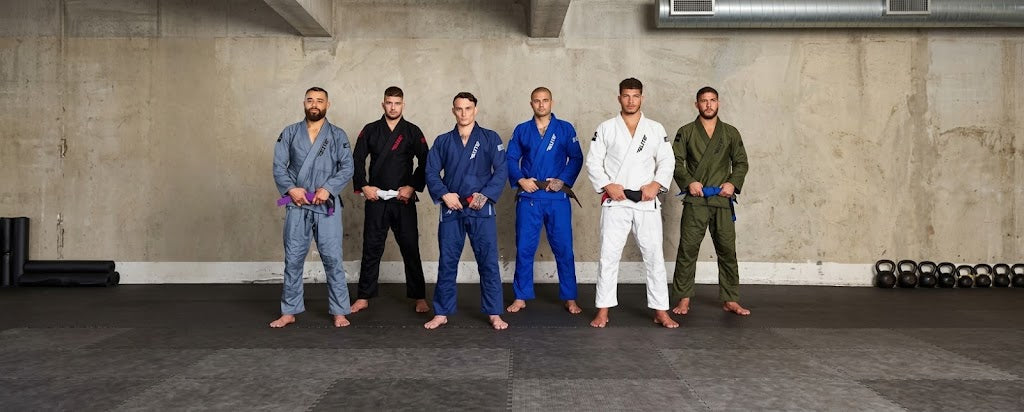
For IBJJF competition, current uniform requirements specify woven cotton or cotton-like fabric and permit white, royal blue, or black Gis, among other requirements. Always check the official IBJJF rules before competition, since regulations can change.

13. BJJ Gi Training Is About More Than the Uniform
A Gi isn't simply something you wear to class — it changes the technical environment of the match.
The fabric creates grips. Those grips influence posture. Posture affects movement. Movement creates reactions. Reactions create opportunities for attacks and escapes.
That chain is what makes Gi Jiu-Jitsu technically interesting. Instead of viewing the Gi as equipment that simply covers the body, think of it as another variable in the grappling equation.
14. Frequently Asked Questions About BJJ Gis
What is a BJJ Gi?
A BJJ Gi is the traditional uniform used for Brazilian Jiu-Jitsu training and competition. It consists primarily of a jacket, pants, and belt. The fabric also provides gripping surfaces that can be incorporated into techniques.
Does a BJJ Gi make Jiu-Jitsu harder?
It can make certain exchanges more grip-dependent. The additional grips create more possibilities for both attacking and defending, so Gi training can feel technically different from No-Gi training.
Is Gi or No-Gi better for beginners?
Neither is universally better. Gi training teaches clothing-based grip fighting and control, while No-Gi emphasizes body control and different forms of gripping. Beginners can benefit from learning either style.
Can Gi training improve No-Gi Jiu-Jitsu?
Yes. Concepts such as posture control, grip fighting, balance, leverage, distance management, and positional awareness transfer between the two styles. The specific grips, however, must be adapted.
How often should I wash my BJJ Gi?
A BJJ Gi should generally be washed after every training session. Leaving a used Gi damp in a gym bag can create unpleasant odors and hygiene problems.
What color BJJ Gi can I wear in IBJJF competition?
Current IBJJF uniform requirements permit white, royal blue, and black Gis, with additional rules governing color, patches, measurements, and condition. Always check the official IBJJF uniform page before competing.
Does a heavier BJJ Gi last longer?
Not necessarily. Fabric weight can influence durability, but construction, stitching, reinforcement, material quality, and care also affect how long a Gi lasts.
How many BJJ Gis should I own?
Your training schedule determines the practical number. Someone training once or twice a week may manage with one or two Gis, while someone training most days may benefit from having several for rotation.
15. Final Thoughts
The BJJ Gi changes more than what you wear on the mat. It changes how you grip, control posture, play guard, pass, defend, manage distance, and approach exchanges.
That's why learning Gi Jiu-Jitsu isn't simply about memorizing techniques that use a collar or sleeve — it's about understanding how clothing changes the relationship between two grapplers.
Once you start paying attention to grips and the reactions they create, the Gi becomes another tool for learning the deeper principles of Brazilian Jiu-Jitsu. When you're ready to train in one, Elite Sports' BJJ Gi collection is IBJJF-approved and built for exactly this kind of grip-based training.

Elite Sports
Elite Sports was founded in 2015 with a mission to make premium-quality, IBJJF-approved BJJ Gis accessible at a fair price. What started with a single Gi has grown into a recognized brand in Brazilian Jiu-Jitsu, with men's, women's, and kids' Gis worn by athletes in academies and tournaments worldwide. Every Elite Sports BJJ Gi is built from pre-shrunk pearl weave fabric with reinforced stitching, and ships with a free belt.



Leave a comment
This site is protected by hCaptcha and the hCaptcha Privacy Policy and Terms of Service apply.