
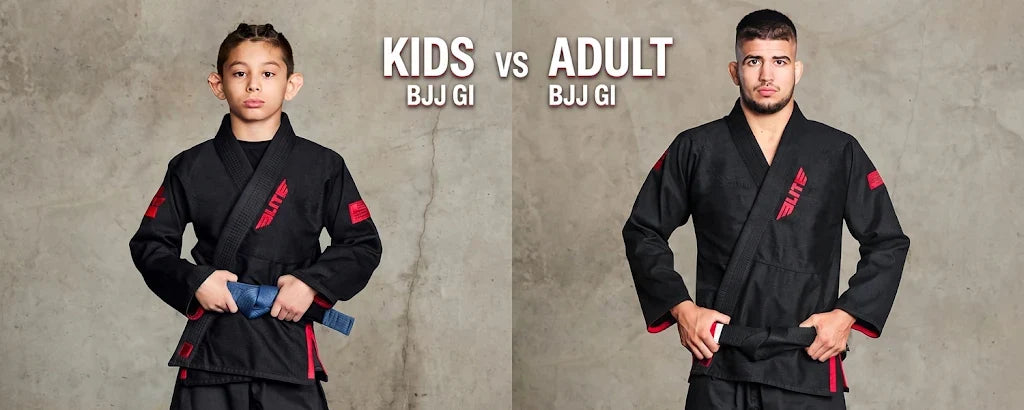
Quick answer: Move from a kids’ BJJ gi to an adult gi when the largest youth cut no longer fits comfortably—not at a particular age. Elite Sports lists youth size 3 (called C3 in some collection copy) for heights of 4 ft 11 in–5 ft 2 in and weights of 95–120 lb. Check the current adult A- and F-size charts and garment measurements; there is no automatic size conversion.
Table of contents
A teenager can outgrow a Brazilian jiu-jitsu gi in the middle of a school year—or find that the largest kids’ size is still the most comfortable option. That leaves parents with a frustrating question: is it time for an adult gi, or will an adult cut simply be too long and loose?
There is no universal age at which the switch should happen. The useful answer comes from body measurements, the garment’s cut and what happens when the athlete moves. Here is how to make that decision without guessing from the size printed on the label.

1. At a glance: kids vs adult BJJ gi
- Stay with youth sizing when the published kids’ chart still matches the athlete’s measurements and the jacket and pants allow comfortable movement.
- Compare adult sizing when the largest kids’ size is too short, too tight, or outside the published height-and-weight range.
- Do not assume that youth size 3 equals adult A1 or F0. Each size family follows a different chart and cut.
- Check competition requirements separately if the gi will be worn at a tournament; a good gym fit is not automatic event approval.


2. There is no magic birthday for switching to an adult BJJ gi
One 12-year-old may be taller than a 16-year-old. Two teens with the same height may need very different jacket widths or trouser cuts. That is why “age 13” or “high school” is not a reliable gi-size rule.
Start with the manufacturer’s chart, not with the school grade or the size of the athlete’s regular clothes. For Elite Sports, the first stop is the official BJJ gi size guide, which lists separate kids’, men’s and women’s size systems.
That separation matters. An adult-sized teen does not automatically need a men’s cut, and an F-size is not a guaranteed fit based on gender alone. Compare each cut’s proportions with the athlete’s measurements and choose the one that allows comfortable movement.
3. Where Elite Sports’ kids sizing ends
Elite Sports’ published kids size chart lists C000, 00, 0, 1, 2 and 3. The two largest youth sizes are:
| Elite Sports kids size | Published height range | Published weight range |
|---|---|---|
| 2 | 4 ft 7 in – 4 ft 11 in | 80–95 lb |
| 3 (also called C3 in collection copy) | 4 ft 11 in – 5 ft 2 in | 95–120 lb |
These are published shopping ranges, not guarantees that a particular jacket and pants will fit. A teen near the upper end of size 3 might still be comfortable in the youth cut; another teen within the same range might find the shoulders or pants restrictive. If the chart points to more than one option, compare the garment’s actual fit. You can see the available youth options in the kids’ BJJ gi collection.
On the adult side, the men’s BJJ gi collection lists A1–A5. The women’s BJJ gi collection lists F0–F4. These are different sizing systems and cuts; neither A1 nor F0 is an automatic next size after youth size 3.

4. Five signs a youth BJJ gi no longer fits
An athlete may have technically remained inside a height range even when the garment has become uncomfortable. Before ordering the next uniform, check what the current one does during basic jiu-jitsu movements:
- The sleeves are obviously too short. With arms extended and elbows moving, the jacket no longer gives the coverage expected by the academy. For a tournament, check the organizer’s actual uniform rules rather than using a home-made sleeve limit.
- The trousers ride up or bind. Squatting, stepping into a lunge and moving into guard should not create sharp pulling at the knees, seat or crotch.
- The shoulders restrict movement. Reaching, framing and raising the elbows should not feel blocked by the jacket.
- The jacket no longer overlaps comfortably. A jacket that pulls open during ordinary movement may be too small or the wrong cut, even if its sleeves seem acceptable.
- Fit problems remain after normal care. If the gi is already too short or tight, do not rely on stretching the fabric or changing washing habits to make it suitable.
A uniform that is too large creates a different problem: surplus fabric, dragging trouser hems and sleeves that reach far down the hands can interfere with movement. “Room to grow” should not mean several sizes too big.
5. How to compare youth size 3 with adult A- and F-sizes
When size 3 is borderline, use this step-by-step process rather than guessing which adult label comes next.
- Measure the teen today. Record current height and weight. If they are between ranges or have proportions that make standard sizing difficult, ask customer support for actual jacket and pant dimensions before buying.
- Start with the youth chart. If both measurements fall within size 3, keep it in consideration—but do not stop there if the current youth gi binds or rides up.
- Compare both adult charts that may fit. A-sizes and F-sizes use different cuts. Look at the published ranges and product-specific charts rather than treating either as a direct conversion from C3.
- Check length and width separately. A jacket can have enough sleeve length but still be too wide at the torso. Trousers may have an acceptable waist but excessive leg length. One size label cannot describe every proportion.
- Try the garment on clean, with tags attached. Have the teen stand, reach forward, lift both arms, squat and take a wide stance. The gi should allow free movement without excessive fabric hanging from the sleeves or legs.
- Protect your exchange options. If a new gi does not fit, review the current return and exchange policy before washing, removing tags or training in it. Return conditions and fees may apply.
If the jacket seems right but the trousers do not, read our separate guide to wearing different BJJ gi jacket and pants sizes. It covers proportion problems without forcing every athlete into a single fit rule.
6. What if a teen is between youth and adult gi sizes?
This is the awkward transition shoppers often overlook. Growth does not always move neatly from one size chart to the next. A teenager might be taller than the upper youth height range while still having a relatively narrow frame, or heavier than the youth chart suggests while remaining shorter than some adult cuts.
Do not force a choice between a kids’ gi that restricts motion and an adult gi that is clearly oversized. Instead:
- Ask for real garment measurements, especially sleeve length, jacket width, trouser outseam and waist adjustment range.
- Compare the published A- and F-cut charts and any model-specific options; the label alone does not identify the best fit.
- Check whether the academy has a loaner gi available for a short transition period.
- Consider a different model or brand if the available proportions do not work. Comfort and safe movement matter more than matching a particular label.
The best answer can be “neither of these sizes is right today.” That is more useful than buying a gi the teen cannot train comfortably in.
7. Three realistic fitting situations
These are illustrative examples, not customer measurements or guaranteed size recommendations. They show how to use the chart without turning it into a rigid age rule.

Example 1: a 5 ft 1 in teen weighing 108 lb
Both measurements fall inside Elite Sports’ published youth size 3 range. A kids’ gi remains a reasonable option to try. The final decision depends on sleeve, jacket and trouser fit. There is no need to buy an adult gi solely because this athlete is a teenager.
Example 2: a 5 ft 4 in teen weighing 113 lb
The weight falls inside the youth size 3 range, but the height is above its published upper limit. That conflict is a reason to compare adult cuts and request measurements—not a reason to automatically buy A1 or F0.
Example 3: a 4 ft 11 in teen weighing 125 lb
The height touches the start of size 3, while the weight exceeds its published range. The current youth gi may be too narrow. Compare garment dimensions and an appropriate adult cut, checking trousers as carefully as the jacket.
In each case, the chart narrows the choices; movement and garment measurements make the final decision.
8. Should a growing teenager buy a gi one size bigger?
Buying slightly ahead can seem economical, especially during a growth spurt. But an oversized BJJ gi is not automatically better value. Too much fabric can make sleeves and trousers cumbersome in training and may fail a tournament uniform inspection.
Choose a fit that works now, with reasonable movement allowance. If the teen is near the top of a published range, compare the next suitable cut before paying. Avoid guessing how much the gi will shrink or how much the athlete will grow in the next six months.
To keep the fit consistent after purchase, follow the garment’s own label and our existing guide to BJJ gi washing and care. This article focuses on the youth-to-adult transition; the care guide covers laundering in detail.
9. Does an adult gi make a teenager competition-ready?
No. Competition eligibility is not determined by whether a manufacturer calls a gi “kids” or “adult.” Organizers may inspect the actual jacket and pants for permitted color, fabric, condition and fit. Different tournaments and age divisions may have different requirements.
For IBJJF events, the published uniform requirements address permitted colors, jacket and pant measurements, construction, and condition. Check the current event guidance and the garment itself; a product description or a move to an adult size cannot guarantee that it will pass inspection.
Parents who are unsure can ask the academy coach to check the uniform well before competition day. A comfortable, clean training gi and a competition-compliant gi are related but not identical buying decisions.
10. Where to shop after you have checked the fit
Once you have identified a promising cut, compare the current sizes, colors and options across the models rather than buying solely by the label. A correct fit should take priority over choosing a particular size family.
The full BJJ gi collection lets you compare available youth and adult models in one place. If you also need to choose a weave or weight, the separate BJJ gi buying guide covers those questions in more detail.
11. Frequently asked questions
What age should a teenager move to an adult BJJ gi?
There is no universal switching age. Measure height and weight, compare the youth and adult charts, and select the cut that fits comfortably during movement.
Is a kids size C3 the same as an adult A1?
No. They belong to different size systems, and a youth size label does not convert directly to an adult A-size. Always check the brand’s current measurements.
What is the largest Elite Sports kids’ BJJ gi size?
Its published kids chart ends at size 3 (called C3 in some collection copy), listed for 4 ft 11 in–5 ft 2 in and 95–120 lb. The ranges guide shopping but do not guarantee fit.
Should a teen choose an A-size or an F-size gi?
Choose based on the available garment cut and the athlete’s actual proportions. Compare both charts where appropriate; do not select a size family solely from age or gender.
What if the jacket fits but the pants are too long?
Compare actual measurements, ask whether separate pieces or alternate cuts are available, and check the event rules before altering a competition uniform. Do not assume the entire gi must be replaced with a much bigger or smaller size.
Can a teen compete in a kids’ gi?
It depends on the organizer’s uniform requirements and how that particular gi fits. The age label alone is not enough to establish compliance. Check the event’s current rules and ask an official if uncertain.
Should I wash a new gi before checking the size?
No. Check the fit and the store’s return terms first. Washing may change the fabric and make the item ineligible for an exchange. Once you decide to keep it, follow the garment’s care label.
12. The takeaway: buy the fit, not the age label
The right time to switch from a kids’ BJJ gi to an adult gi is when the youth cut no longer fits the athlete—not when they reach a specific birthday. Measure first, compare the published charts, check real movement and confirm tournament rules where relevant. That approach prevents an expensive guess and keeps the focus where it belongs: comfortable training.



Leave a comment
This site is protected by hCaptcha and the hCaptcha Privacy Policy and Terms of Service apply.