
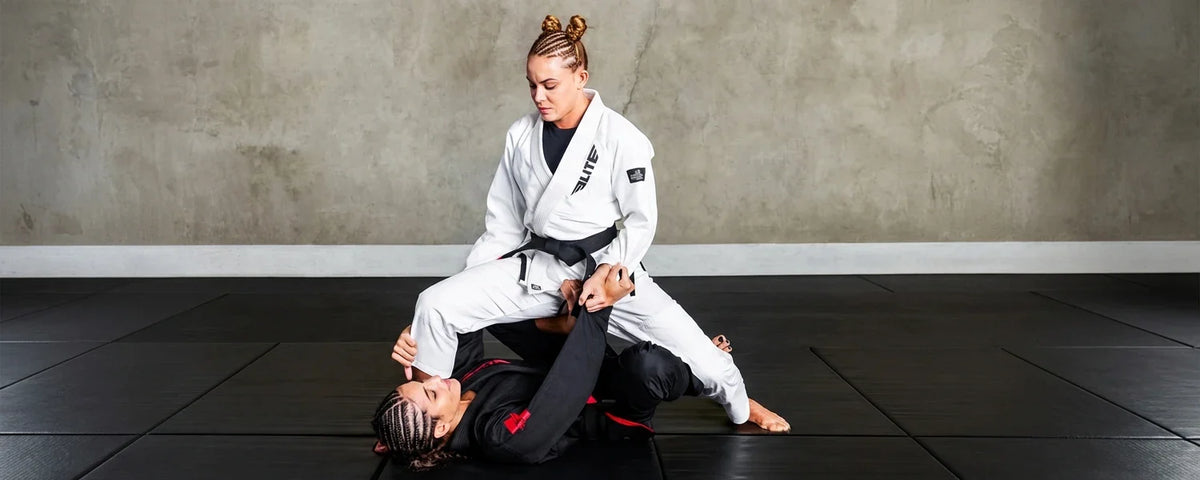
A women’s gi size chart is a starting point, not a complete fit assessment. Learn how to use Elite Sports’ F0–F4 sizing grid, compare shoulder and hip proportions, evaluate pant rise and thigh room, and choose a gi that fits both your upper and lower body.
Table of contents
A BJJ gi can fit perfectly across your shoulders while feeling tight through the hips. Another gi might give you plenty of room in the pants but leave excess fabric around your upper body. Both problems can occur even when your height and weight match the manufacturer's recommended size.
The solution is to distinguish size from cut. Size tells you where to start; cut describes how the fabric is distributed around your body. Understanding both can make choosing a women’s Brazilian Jiu-Jitsu gi much easier.
1. Quick answer: How should a women’s BJJ gi fit?
Start with the brand’s height-and-weight chart, then check the jacket and pants separately. The jacket should close comfortably and allow shoulder movement; the pants need enough seat, thigh and crotch room for seated and kneeling positions. Elite Sports uses F0–F4, but there is no universal hip-to-shoulder ratio that determines an F-size.
2. How to read the Elite Sports F0–F4 size chart
F0, F1, F2, F3 and F4 are the five women's gi size labels used by Elite Sports. They are not standardized across the BJJ industry and do not translate directly to everyday clothing sizes or another manufacturer's F-sizes.
Open the Elite Sports BJJ gi size chart, locate your height across the top of the women's grid and your weight down the left side, and read the size at their intersection.
Here are five exact examples from the official grid, not general size ranges:
- F0: 5'0" and 100 lb.
- F1: 5'2" and 120 lb.
- F2: 5'4" and 130 lb.
- F3: 5'6" and 140 lb.
- F4: 5'8" and 165 lb.
At 130 lb, for example, the chart recommends F1 at 5'2" and F2 at 5'4". The same weight does not always correspond to the same size. If your measurements fall between chart entries, or the relevant cell is blank, contact customer support instead of extrapolating a size.
The grid recommends a starting size for a complete uniform. It does not give the finished jacket’s shoulder or lower-hem width, or the pants’ seat width, thigh width or rise for each F-size. Those dimensions are useful when your proportions differ from the garment pattern.

3. What does hip-to-shoulder ratio mean for gi fit?
Hip-to-shoulder proportion describes the relative width of your lower and upper body. It can help you recognize whether a standard gi set might fit differently at the jacket and pants.
For an optional width comparison, divide straight horizontal hip breadth by straight horizontal shoulder breadth. Use a helper and the same measuring method for both; do not curve the tape around your body. For illustration only, 16 inches of hip breadth divided by 14 inches of shoulder breadth gives about 1.14. This number describes relative width, not an F-size, a target body shape or a recommended fit. If you cannot measure breadth consistently, skip the ratio and record your bust, waist, hip and thigh circumferences instead.
Do not divide hip circumference by shoulder breadth and interpret it as that width ratio: a circumference measures around the body, while breadth measures across it. Neither measurement alone tells you how much fabric a jacket or pair of pants provides. A useful comparison requires garment dimensions and adequate room for movement.
In practical terms:
- If your hips and thighs need more room than your shoulders, check the pants first rather than automatically buying a larger jacket.
- If your shoulders or bust need more room than your hips, check upper-back mobility and lapel overlap before choosing a wider pant size.
- If both pieces fit in width but are too long or short, investigate length and cut rather than assuming you need a different overall size.
For example, two athletes who are 5'4" and 130 lb both start at F2 on the Elite Sports chart. In a hypothetical fitting, one may find the pants restrictive at the seat while the jacket closes comfortably; the other may find the pants comfortable but the jacket tight across the upper back. They should investigate different garment dimensions, not assume the chart is wrong or automatically size up. No published Elite Sports ratio-to-F-size conversion exists.

4. Which measurements actually help you choose a women’s gi?
A soft measuring tape and a uniform that already fits are useful starting points. Record body measurements separately from garment measurements; a finished gi needs room beyond the body measurements to accommodate movement and its underlying layers.
- Bust: Measure around the fullest part of the chest while standing naturally.
- Shoulder breadth: Ask a helper to measure across the shoulders using the same landmarks and a straight measuring method each time; do not substitute a curved tape measurement.
- Waist: Measure around the area where you expect the pants to sit.
- Hips and seat: Measure around the fullest part of the hips and buttocks with the tape level.
- Thigh: Measure around the fullest part of the upper thigh.
- Inseam: Measure from the crotch to the inside ankle bone for a body reference, or follow the retailer’s specified endpoint.
If you own a gi that fits, lay it flat without stretching. Record the jacket’s chest width, sleeve length and lower hem width; for the pants, record seat width, upper-thigh width, front and back rise, inseam and cuff width. Compare the same measurement points on the same kind of garment. A flat width is not a body circumference, and doubling a width is only an approximate garment circumference when measured across the corresponding flat section.
When asking customer support for measurements, give the exact model and starting F-size, your height and weight, and the area causing concern. For example: “The F2 jacket fits, but the pants pull at my seat when I sit. Can you share the F2 and F3 seat width, thigh width, rise and inseam, measured before washing?” This helps you compare extra room against any change in length before deciding whether to exchange.
5. Women’s gi pant cut: Why the waistband is not the whole fit
A drawstring can secure a waist, but it cannot create extra space in the seat, thighs or crotch. If the pants fit around the waist yet restrict a squat, look at the pattern rather than tightening the drawstring further.
5.1 Hip and seat room
The pants need enough room through the hips and seat when you sit or bend forward. If the seat fabric pulls taut or the crotch seam feels strained, investigate a roomier pant cut. Also check the jacket’s lower hem: if it catches on your hips when the lapels are closed, changing pants alone will not solve that jacket-fit problem.

5.2 Rise and crotch depth
Rise is commonly measured along the front or back crotch seam to the top of the waistband. A different front or back rise changes where the waistband sits. A rise that is too short for your build may pull the waistband down as you sit; excess depth may bunch. Check whether the waistband remains comfortable and secure with your knees bent toward your torso.
5.3 Thigh room and taper
Taper describes a leg that narrows toward the lower opening. It does not necessarily tell you how much room the pant has at the upper thigh. A tapered gi may feel neat at the ankles yet still require a different thigh width for your build. Check the thigh and calf independently.
5.4 Inseam and ankle coverage
A larger size may add width and length together, leaving fabric around the ankle even if it solves hip tightness. If your width is right but the pants are too long, look for a different length or cut, where available. For more on fabrics, closures and construction, read our BJJ gi pants guide.
6. How the women’s Elite Sports Core gi is cut
Our women’s BJJ gi collection uses F0–F4 sizing and describes a tapered torso and leg fit. The range includes black, white, blue, pink and purple uniforms.
The Core White women’s BJJ gi is one example. Its listing specifies a pre-shrunk 450 GSM pearl-weave jacket, a side-slit design, drawstring pants and an included white belt. The listed jacket blend is 60% cotton and 40% polyester; the pants are listed as 65% cotton and 35% polyester.
The side slits allow the jacket hem to open more easily around the hips; the drawstring adjusts the waist. Neither feature establishes how much room the fabric provides at the seat, thigh or shoulders. Compare the actual cut rather than assuming a tapered gi will suit every body shape.
The reviewed Core listing has one size selector for the complete gi. If you need an F1 jacket and F2 pants, ask customer support whether the combination can be supplied before ordering. Our guide to different jacket and pant sizes explains when split sizing or another cut may make sense.
7. The at-home fit check before you keep your gi
Try on the uniform with its tags attached, in accordance with the return conditions. Wear the same academy-approved base layer you expect to use in training. Do not wash, spar in or alter the gi until you have decided to keep it.
- Close the jacket and reach forward, then across your body. Check for pulling through the shoulders, upper back and chest, and whether the lapels remain comfortably overlapped.
- Sit down with your knees bent and try a controlled squat. Check the seat and thighs for tension and whether the back waistband pulls down.
- Raise one knee toward your chest, then repeat on the other side. Check whether the pant rise or upper leg blocks comfortable movement.
- Stand again and check sleeve, jacket and pant lengths. Make sure the drawstring can secure the pants without uncomfortable bunching.
If only one piece fails, do not assume you need to size up the entire set. If the F-size cut does not suit your build, compare other adult cuts in our full BJJ gi collection. Choose the measurements, not the gender label.
8. Fit for competition and after washing
For IBJJF gi competitions, the jacket must reach the thigh, sleeves must come within 2 cm of the wrist when the arms are extended parallel to the floor, and pant hems must reach no more than 2 cm above the inner ankle bone. Permitted gi colors are white, royal blue and black, with matching jacket, pants and collar. Women must wear a close-fitting elastic shirt or another expressly permitted top underneath the jacket. Material, patch, sleeve-opening and other inspection requirements also apply.
Check the rules before each event. A comfortable training gi does not automatically pass inspection, and a permitted color does not establish compliance. Even pre-shrunk fabric may change size with washing. Follow the product care label; Elite Sports recommends cold washing and hang drying for the Core White gi. Recheck sleeve and pant coverage after washing.

9. Frequently asked questions
Is an F2 gi the same size across brands?
No. F-size labels are manufacturer-specific. Use the chart for the exact brand and model, then check the fit of both pieces.
What size should I choose if my hips are wider than my shoulders?
Start with the height-and-weight grid. Check hip, seat and thigh room and jacket overlap separately. No hip-to-shoulder ratio automatically maps to F0–F4. Request garment measurements if your recommended size is uncertain.
Should I size up if gi pants are tight in the thighs?
Not automatically. More thigh room may require a different cut, rather than extra jacket width and sleeve length. Confirm the available garment dimensions before exchanging a complete set.
Can women wear an A-size BJJ gi instead of an F-size?
Yes. An adult A-size cut may fit some women better. Compare actual garment dimensions and ensure your academy or competition requirements are met.
Is a tapered pant cut suitable for wider hips?
It can be, if there is adequate space at the hips, seat and thighs. Taper alone describes narrowing along the leg and does not establish the upper pant dimensions.
10. Final thoughts
A women's BJJ gi should fit the way you move, not simply match a number on a chart. Use height and weight to establish your starting F-size, then check the shoulder and hip proportions, rise, thigh room and leg length. A uniform that fits both pieces comfortably is a better choice than a larger set that solves one problem and creates another.
Sizing examples are taken from the Elite Sports women's size chart. Product details refer to the Core White listing. Competition requirements refer to the IBJJF Uniform Requirements page; checked November 27, 2026.




Leave a comment
This site is protected by hCaptcha and the hCaptcha Privacy Policy and Terms of Service apply.