
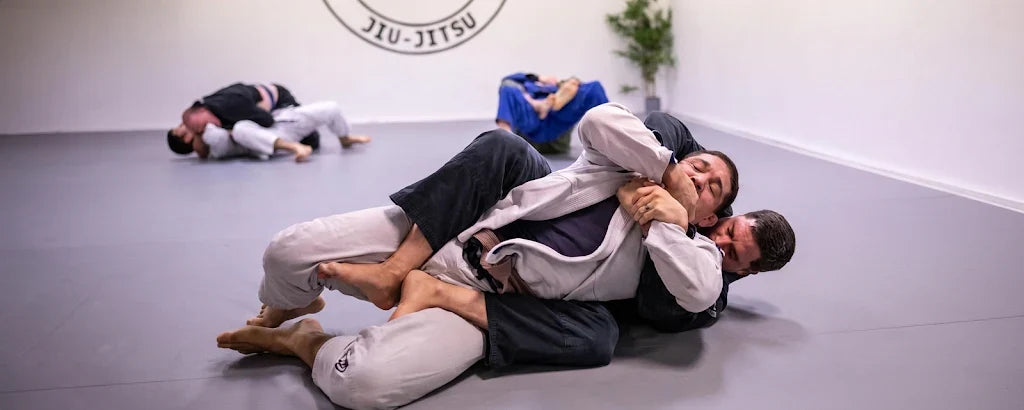
BJJ has a real injury risk, progress is rarely smooth, and gym culture can make or break the experience. Some problems call for patience; others call for rest, a conversation, or a different academy. The goal is to train safely and keep enjoying the sport—not to push through every warning sign.
Table of contents
Picture walking out of Brazilian jiu-jitsu class with three thoughts: I got submitted five times. My knee does not feel right. And that partner ignored the pace we agreed on.
It is tempting to file all three under the same explanation: "BJJ is hard. Toughen up." But those are three different problems. One may be an ordinary learning curve. One deserves attention to your health. The last raises a question about the people you train with.
That is the part of jiu-jitsu that is harder to explain in a highlight reel. You can love the sport and still dread a particular round. You can want to improve without wanting to compete. And you can leave an academy without giving up BJJ.
Here are seven hard truths worth understanding before frustration turns into a decision you regret.
1. Quick answer: What are the hard truths of BJJ?
BJJ can be frustrating, physically demanding and socially complicated, but not every difficult session is a reason to quit. When you feel safe and are learning slowly, adjust your goals. When health or burnout is the problem, pause or reduce training with appropriate support. When taps, boundaries or repeated safety concerns are ignored, consider changing gyms.
The useful question is not simply "Should I quit BJJ?" It is "What is going wrong, and what change would actually solve it?"
2. BJJ gym red flags vs. a normal hard training day
Not every uncomfortable session means something is wrong. You might get submitted repeatedly while learning guard retention. Your cardio may struggle. A promotion may take longer than you expected. Those experiences can be frustrating without being signs of a bad school.
Other experiences deserve a different response. A training partner refusing to release a submission after a tap, pressure to roll while injured, or an instructor dismissing repeated safety complaints is not a character-building challenge.
| What is happening? | A useful next move |
|---|---|
| You lost every round but felt safe and learned something. | Keep training; choose one small skill to work on. |
| You have been stuck on the same escape for weeks. | Ask your coach for a specific correction and try focused rounds. |
| You are unusually sore or struggling to recover. | Reduce intensity or take time off; seek clinical advice if symptoms concern you. |
| A partner keeps ignoring your tap or agreed pace. | Stop the round, tell the coach, and do not roll with that partner. |
| The coach ignores repeated safety concerns or humiliates students. | Consider another academy; you do not owe the gym your continued attendance. |
| Training is crowding out work, relationships, or needed care. | Rebalance your schedule and seek support beyond the mats when needed. |
The distinction matters because "push through" is not a sensible answer to every problem.

Hard truth #1: Progress can be invisible for a while
There is a strange point in BJJ where you know enough to recognize everything you are doing wrong but not enough to stop it. Your training partners know your favorite sweep. Your guard gets passed again. You may start wondering whether you are getting worse.
Sometimes you are simply facing better resistance. Sometimes your timing needs work. Sometimes your expectations have outrun your experience. None of those can be fixed by demanding a belt promotion or winning the next sparring round.
Try a more useful scorecard for a month: Can you identify where a guard pass began? Can you frame before the crossface settles? Can you stay calm long enough to attempt an escape? Are you tapping sooner when a joint is threatened? Those are meaningful signs of learning even when nobody sees them on the scoreboard.
If you are new and wondering why those early months feel so difficult, Elite Sports already has a separate guide to why white belts quit BJJ. This is not another belt-by-belt dropout list; it is about recognizing when patience helps and when something needs to change.


Hard truth #2: Injury risk is real, but "BJJ will ruin your body" is not a fact
The point of a submission is to make your partner tap, not to injure them. Still, Brazilian jiu-jitsu involves contact, takedowns, joint locks, chokes and resistance. Injuries can happen even when people are trying to be careful.
Here is what the research actually says. A 2025 peer-reviewed study published in BMJ Open Sport & Exercise Medicine surveyed 881 active BJJ practitioners and calculated 5.5 self-reported training injuries per 1,000 training hours. Of 789 training injuries described in detail, 620 (about 79%) occurred during free sparring. Knees and shoulders were the most frequently reported injured regions. These findings describe one surveyed sample; they do not predict an individual student's risk or prove any specific safety practice prevents injury.
That is more useful than either extreme: "BJJ is completely safe" or "BJJ destroys everyone." You cannot make a contact sport risk-free, but you can decide how you participate and whom you trust on the mats.
Three habits deserve particular attention:
- Tap early; release immediately. A training round is not the place to prove that your arm or neck can withstand another second. Release a hold as soon as your partner taps or says stop.
- Agree on intensity before you start. If you ask for a technical round, your partner should respect it. You may decline a round or end one when the agreed boundaries change.
- Stop when injury symptoms concern you. Pain after an awkward movement, swelling, numbness or loss of function is not proof you need to become tougher. Stop the aggravating activity and seek appropriate medical advice.
If an injury needs assessment or rehabilitation, use medical guidance for your return. No online checklist can tell you when a particular knee, shoulder or neck injury is ready for live rounds.
Hard truth #3: A good academy teaches boundaries as well as submissions
You can learn a lot about a school from what happens when someone makes a mistake. Does the coach stop an unsafe exchange? Does a more experienced student give a beginner room to learn? Can someone say "not today" to a particular training partner without being mocked?
Hard training is not automatically unsafe. Two experienced competitors may agree to push the pace. But a hard round does not make ignored taps, uncontrolled submissions or unwanted contact acceptable.
Before a round, a short conversation can be enough: "I'm keeping this technical today. Are you okay with that?" If the answer is yes but the partner immediately starts treating the roll like a final, stop and reset or choose someone else.
That option matters for everyone, including newer students, smaller practitioners and women who may have fewer similarly sized training partners in some classes. A respectful academy should take requests about appropriate partners and pace seriously.
If something happens once, explain it to the instructor in concrete terms. If the behavior repeats, or the instructor dismisses the concern, the issue is no longer just one bad roll. It is how the academy responds to a problem.
The hard truth is that a gym can have excellent technique and still be a poor environment for you.
Hard truth #4: Gym politics are not your job to manage
Promotions, competition teams, friendship groups, disagreements between instructors: every community has social dynamics. Some are harmless. Others can turn a hobby into a source of constant stress.
You do not need to win an argument about who deserved the last stripe. You do need to know whether classes are taught fairly, questions are welcome, boundaries are respected, and problems can be addressed without retaliation.
A practical test is to separate three situations:
You dislike a decision. Ask for an explanation, listen, and decide whether the answer is reasonable. A promotion you disagree with is not automatically evidence of mistreatment.
You feel excluded or dismissed repeatedly. Give specific examples and ask how the academy handles concerns. Watch what changes, not just what is promised.
You are being harassed, threatened, or pressured into unsafe training. Leave the situation and seek appropriate support. You do not need to stay in order to prove loyalty.
If you are assessing a new academy rather than repairing an old situation, the Elite Sports guide to choosing a BJJ school covers the practical questions to ask before signing up.

Hard truth #5: Jiu-jitsu can improve your week without fixing your whole life
For many people, BJJ gives the week structure. It offers physical activity, friends, a reason to show up, and a challenge that has nothing to do with work. Those can be valuable parts of life.
But trouble starts when you feel you are not allowed to miss a class. An injury may start to feel like a crisis if training has become your only source of stability. Every bad day can become a reason to add another exhausting round instead of dealing with what is happening outside the gym. Your identity narrows until all the other parts of life feel like interruptions.
That is not a reason to give up the sport. It is a reason to make sure the sport has a healthy place in your life. A rest day, an outside friendship, a different hobby, and professional mental health support when needed can coexist with serious training.
A mat can be a wonderful place to practice resilience. It is not a substitute for medical treatment, counseling, or dealing with problems away from the gym.
Hard truth #6: You do not have to copy a competitor's schedule
A professional athlete's training week and a working adult's schedule are different projects. So are those of a parent, a student, someone returning from injury, and someone who simply likes two classes a week.
It is easy to turn other people's commitment into a reason to feel guilty. One student rolls six days a week. Another competes every month. Your friend improves faster. Suddenly a sport you love starts feeling like a second unpaid job.
Instead, decide what you want from the next three months. More confidence in basic escapes? A reliable training routine? Your first tournament? Staying active without constant soreness? Make the schedule fit that goal and your recovery—not somebody else's social-media highlights.
If your answer changes, your plan can change too.
Hard truth #7: Sometimes switching gyms is how you stay in BJJ
Quitting an academy and quitting Brazilian jiu-jitsu are not the same decision. You can be grateful for what an instructor taught you and still need a different environment. You can enjoy intense rounds and still need partners who respect your boundaries.
If you are unsure what to do next, separate your situation into three cases.
3. Stay and adjust when the problem is ordinary frustration
You feel safe, the coach answers questions, and you still want to learn. Maybe your guard retention needs work, the class schedule is inconvenient, or you are exhausted from comparing yourself with competitors. Ask for one technical correction, choose fewer hard rounds, or rethink your goals. Reassess after you have tried a specific change.
4. Pause when your health or life needs attention
If you are injured, overwhelmed or struggling to recover, time away may be the sensible decision. You do not have to prove your loyalty by training through symptoms. Follow appropriate medical guidance before returning to activities that might worsen an injury. Staying in touch with friends from class can be different from participating in live rounds.

5. Change gyms when the environment repeatedly breaks trust
Ignored taps, harassment, pressure to train when you have declined, or a coach who repeatedly dismisses safety concerns can justify leaving. You may choose another academy without needing a public argument or a dramatic exit.
If it is safe to have a conversation first, be specific: "Twice this month, my partner continued after I asked to stop. I need to know how you'll address that and who I can train with safely." You are looking for a meaningful response, not a promise that nothing difficult will ever happen again.
No belt rank obligates you to stay somewhere you cannot train safely.
6. A one-week reality check before you make a big decision
If there is no immediate danger, a few days of observation can help you make a decision based on patterns rather than one frustrating class. If you feel threatened or unsafe, do not wait a week to leave or seek help.
- Day 1: Name the actual problem. "I hate BJJ" is hard to solve. "My training partner keeps ignoring the light pace we agree to" is specific.
- Days 2-3: Decide whether it is a skill, recovery or safety issue. Being submitted and needing better guard retention is different from an ignored tap, harassment or a suspected injury.
- Days 3-4: Ask for one concrete change if safe. Request another partner, a different class intensity, a technical correction or an adjustment to your schedule.
- Days 5-6: Watch what happens. Did the coach listen and act? Does the pattern improve? If the problem is your health, prioritize appropriate care over completing the exercise.
- Day 7: Choose without guilt. You may stay and adjust, take a break, or switch gyms. Each can be a sensible way to protect your long-term relationship with the sport.
The point of the week is to clarify your decision, not to talk yourself into tolerating behavior that puts you at risk.
7. Before you switch gyms, check the gi and no-gi rules
A new academy can mean new class formats, different training partners and different uniform policies. Before purchasing gear, ask whether classes are gi or no-gi, whether a particular uniform color or logo is required, and whether beginners can borrow a gi to try a class.
If you plan to attend gi classes, compare BJJ gis for different ages and fits based on the academy's rules and your measurements. Practitioners looking for adult men's A-size options can use the men's BJJ gi collection. For no-gi sessions, ask about permitted clothing before browsing no-gi rash guards.
It should not take a large gear purchase to find out whether a new training environment feels right.
8. Frequently asked questions about the hard side of BJJ
Does everyone eventually quit Brazilian jiu-jitsu?
No. Some practitioners stop, some take long breaks, and others continue for years. There is no reliable universal percentage that predicts what will happen to a new student. Your experience, circumstances, goals, and training environment all matter.
Is it normal to want to quit after getting submitted repeatedly?
Yes, it can be discouraging. Being submitted is part of learning a grappling sport, especially early on. If you feel safe, work on one position or escape rather than judging progress solely by winning rounds.
Will BJJ permanently damage my body?
It can cause injuries, including serious ones, but permanent damage is not inevitable. Risk varies with exposure, partner behavior, intensity, and individual circumstances. Use appropriate medical guidance for injuries rather than training through concerning symptoms.
How do I know if my BJJ gym is toxic?
Look for repeated, concrete patterns: ignored taps, humiliation, retaliation for reasonable questions, harassment, or persistent pressure to train unsafely. One disagreement is not enough to characterize an entire gym; how the school responds to genuine concerns is revealing.
Should I train BJJ while injured?
Do not assume training through an injury is safe. Stop activities that aggravate symptoms and ask a qualified healthcare professional about assessment and return to training. Watching class or doing approved alternatives may be options, depending on the injury and medical guidance.
Should I quit BJJ or change gyms?
If you still enjoy the sport but dread a particular academy because of repeated safety or respect problems, trying a different gym may make more sense than quitting BJJ entirely. If you feel unsafe, stop participating rather than waiting for another incident. If the issue is injury or recovery, assess whether a break is appropriate before making a permanent choice.
What should I do when a BJJ partner ignores my tap?
End the round immediately and tell the instructor what happened. You can decline further rounds with that person. If the coach will not address the issue, consider another gym. Tapping is a safety signal, not an invitation to argue about whether a submission was finished.
Is taking a break from BJJ the same as quitting?
No. A break can be part of a sustainable training life. You can return gradually when your health, finances or schedule allow, even if your timing feels rusty at first.
Can BJJ help mental health?
Training can offer exercise, routine and social connection, which some people find helpful. It does not replace treatment for a mental health condition, and feeling unable to miss training is worth discussing with someone you trust or a professional.
9. The bottom line: Keep the good parts, not every bad habit
You can love BJJ and still need fewer rounds. You can be committed to learning and still tell a partner no. You can walk away from a gym without walking away from the sport.
The hard truths are not a prediction that you will quit or get hurt. They are a reminder that progress, safety, recovery and a healthy environment all belong in the same conversation. If jiu-jitsu still makes you curious, there may be a way to keep it in your life without accepting every part of your current routine.




Leave a comment
This site is protected by hCaptcha and the hCaptcha Privacy Policy and Terms of Service apply.