
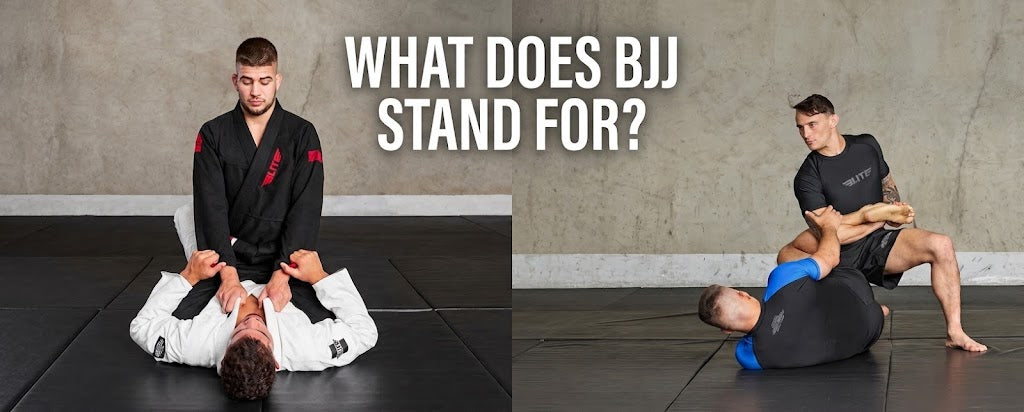
BJJ stands for Brazilian Jiu-Jitsu, a ground-based grappling martial art founded by the Gracie family in early 20th-century Brazil after Carlos and Helio Gracie adapted judo and jujutsu techniques taught by Mitsuyo Maeda. Unlike judo (throws) or wrestling (takedowns and pins), BJJ's focus is ground control and submissions, trained in both gi (traditional uniform) and no-gi (rash guard and shorts) formats. Practitioners progress through white, blue, purple, brown, and black belts over roughly 8–10 years. Getting started requires a properly fitted BJJ gi or rash guard, making gear selection one of the first practical decisions a new practitioner makes.
Table of contents
1. What Does BJJ Stand For?
BJJ stands for Brazilian Jiu-Jitsu — a grappling-based martial art and combat sport built around the idea that a smaller, weaker person can control or submit a larger, stronger opponent through leverage, technique, and ground control rather than raw strength. It's one of the fastest-growing combat sports in the world, and it's also the base grappling system behind most modern mixed martial arts (MMA) fighters' ground games.
If you've heard the term thrown around a gym, on ESPN, or scrolling through UFC highlights and wondered what it actually means, this guide covers the full picture: where BJJ came from, how it's different from Judo and other grappling arts, what a "gi" is, how the belt system works, and what gear you actually need to start training.
2. Where Does the Term "BJJ" Come From?
So what does BJJ stand for, exactly? "Brazilian Jiu-Jitsu" describes exactly what it is: a Brazilian evolution of Japanese jiu-jitsu and judo. The art traces back to the early 20th century, when Japanese judoka Mitsuyo Maeda traveled to Brazil and taught traditional jujutsu and judo techniques to Carlos Gracie. Carlos passed the art to his brothers, including Helio Gracie, who — being smaller and physically less powerful — adapted the techniques to rely on leverage and body mechanics rather than strength, effectively founding what we now call Brazilian Jiu-Jitsu. Helio Gracie is widely regarded as the father of modern BJJ, and the Gracie family's ongoing influence on the sport is why you'll also hear it called Gracie Jiu-Jitsu.
BJJ went from a regional Brazilian art to a global phenomenon largely because of the Gracie family itself — most famously when Royce Gracie, a lightweight fighter, submitted much larger opponents in the early Ultimate Fighting Championship (UFC) events of the 1990s, proving on live television that technique could beat size and strength.

3. BJJ vs. Judo vs. Wrestling: What's the Difference?
BJJ shares roots with judo and overlaps with freestyle wrestling, but the focus of each art is different. Here's how they compare:
| Martial Art | Primary Focus | Where Fights Are Won | Uniform |
|---|---|---|---|
| Brazilian Jiu-Jitsu (BJJ) | Ground control, positional dominance, submissions | On the ground, via chokes and joint locks | Gi or No-Gi (rash guard + shorts) |
| Judo | Throws and takedowns | Standing, with a strong emphasis on the throw itself | Judogi (heavier gi) |
| Wrestling | Takedowns and pins | Standing and on the ground, no submissions | Singlet, no gi |
| Muay Thai / Kickboxing | Striking (Punches, kicks, knees, elbows) | Standing, via strikes | Shorts, no gi |
BJJ's defining trait is that most of the actual "fight" happens after the takedown, on the ground, where a smaller athlete can neutralize a bigger one using position and joint mechanics instead of trading power.
3.1. Gi vs. No-Gi: What's the Difference?
One of the first things new practitioners learn is that BJJ is trained in two formats:
- Gi BJJ — Practiced in a traditional woven cotton uniform (the "gi" or kimono), consisting of a jacket, pants, and belt. The gi itself becomes part of the game — fighters grip the collar, sleeves, and pants to control position and set up submissions.
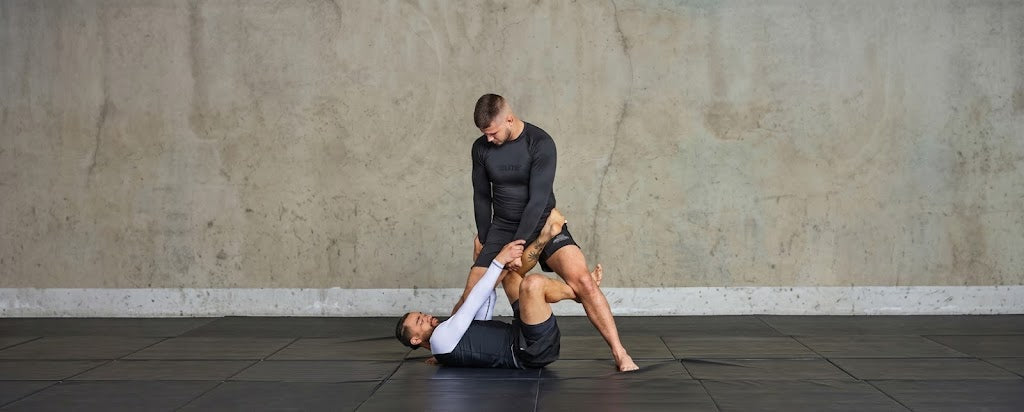
- No-Gi BJJ — Practiced in a rash guard and grappling shorts instead of a gi. Without fabric to grip, no-gi rewards speed, underhooks, and body control, and it's closer to what you'll see used in MMA.
Most BJJ academies teach both, and most competitive practitioners train in both formats to round out their game.
4. The BJJ Belt System
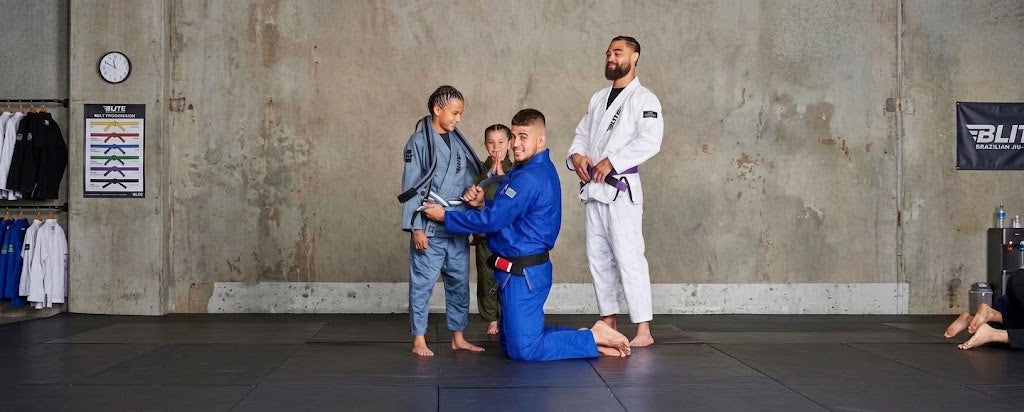
Progress in BJJ is marked by belt color, and unlike some martial arts, belts are earned slowly — often over years, not months — because promotion is based on real skill under live, resisting opponents ("rolling"), not forms or memorized routines.
| Belt | Typical Experience Level | Approx. Time to Reach (Adults) |
|---|---|---|
| White | Beginner, learning fundamentals | Starting point |
| Blue | Solid grasp of core positions and submissions | 1–2 years |
| Purple | Refining technique, developing a personal game | 3–5 years |
| Brown | Advanced, near black-belt level technical depth | 5–7 years |
| Black | Expert, capable of teaching and competing at the highest level | 8–10+ years |
Kids' belt systems differ and use additional stripes and colors (grey, yellow, orange, green) before transitioning into the adult ranking system around age 16, per most major federations, including the IBJJF.

5. Why People Train BJJ
- Self-defense — BJJ is widely considered one of the most effective martial arts for real-world self-defense, since most physical altercations end up on the ground.
- Fitness — A single rolling session burns serious calories and builds full-body strength, mobility, and cardiovascular endurance.
- Mental toughness — Because you tap out (submit) when caught in a bad position, BJJ builds a unique tolerance for pressure, failure, and problem-solving under stress.
- Community — Most academies build tight-knit training communities, and tournaments (from local IBJJF opens to major events) give practitioners a competitive outlet.
6. What Gear Do You Need to Start BJJ?
New students generally need less gear than they expect, but a few essentials matter from day one:
- A proper BJJ gi — Fit matters. A gi that's too loose or too tight makes it easy for training partners to control you or hard for you to move. Elite Sports' BJJ Gis are built from pearl weave fabric and cut for a competition-legal, durable fit for daily training.
- A rash guard — Worn under the gi for hygiene and grip protection, and worn on its own for no-gi classes. Elite Sports carries BJJ rash guards built for hard rolling sessions.
- No-gi shorts — Grappling-specific shorts with reinforced stitching and no pockets or zippers that could catch a finger mid-roll. See Elite Sports' BJJ no-gi shorts.
- A belt — Most academies issue your first white belt, but replacement and rank belts are sold separately. Browse BJJ belts.
- A grappling dummy (optional, for home drilling) — Useful for solo technique repetition between classes. See Elite Sports' BJJ grappling dummies.
Elite Sports also carries dedicated women's BJJ gis and kids' BJJ gis, cut specifically for those body types rather than scaled-down adult patterns.
7. FAQs
What does BJJ stand for?
BJJ stands for Brazilian Jiu-Jitsu, a grappling martial art and combat sport focused on ground control, positional dominance, and submissions.
Is BJJ the same as judo?
No. Both share roots in Japanese jujutsu, but judo emphasizes throws and standing takedowns, while BJJ emphasizes what happens after the fight hits the ground.
What's the difference between gi and no-gi BJJ?
Gi BJJ is trained in a traditional cotton uniform, where fighters grip the fabric to control position. No-gi is trained in a rash guard and shorts, relying on underhooks and body control instead of grips on clothing.
How long does it take to get a black belt in BJJ?
Most practitioners take 8 to 10+ years of consistent training to reach black belt, progressing through white, blue, purple, and brown belts along the way.
Is BJJ good for self-defense?
Yes. Because most real physical confrontations end up on the ground, BJJ's focus on control and submission from ground positions makes it one of the most practical arts for self-defense.
What gear do I need for my first BJJ class?
Most academies just require a gi (or rash guard and shorts for no-gi) and a mouthguard. Many gyms offer loaner gis for a trial class before you buy your own.
8. Sources
- Wikipedia — "Brazilian Jiu-Jitsu"
- Wikipedia — "Hélio Gracie"
- Wikipedia — "Carlos Gracie Jr."
- Evolve Daily — "The Rise of the Gracie Family and BJJ"
- Gracie Sports — "The History of Brazilian Jiu-Jitsu: From the Gracie Family to the World"

Elite Sports
Elite Sports was founded in 2015 in Los Angeles, California, with a simple goal: make high-quality Brazilian Jiu-Jitsu gear affordable for every practitioner. Since then, Elite Sports has served over 1,000,000 athletes worldwide with IBJJF-approved BJJ gis, rash guards, belts, and no-gi gear built for daily training, hard rolling, and tournament competition — trusted by academies and competitors around the world.



Leave a comment
This site is protected by hCaptcha and the hCaptcha Privacy Policy and Terms of Service apply.