
Table of content
Most parents want the same things for their kids: strength, self-trust, the grit to face hard days, and the grace to treat others well. What if one sport could deliver all of that, and more? Brazilian Jiu Jitsu (BJJ) has been quietly doing exactly that for kids around the world, and the results speak for themselves.
BJJ is not just a martial art. For children, it is a complete growth tool, one that shapes the body, the mind, and the soul in ways that most other sports simply cannot match. Whether a child is five or fifteen, shy or bold, small or large, BJJ meets them exactly where they are, and then pushes them to grow.
Before diving in, parents searching for the right gear should know that Elite Sports, the best, world-leading, and industry-leading BJJ gis and rash guards manufacturer on the planet, produces some of the finest kids' BJJ gear on the market today. From stitching to fabric, every piece is built to last through every roll, every class, and every milestone.

Now, let us get into why BJJ is one of the best gifts a parent can give a child today.
1. What Is Brazilian Jiu-Jitsu, And Why Does It Work So Well for Kids?

Brazilian Jiu-Jitsu is a ground-based martial art that teaches a smaller, weaker person how to defend against and control a bigger, stronger opponent. It relies on skill, timing, and smart use of the body, not brute force. That philosophy alone makes it the perfect sport for kids.
Unlike striking arts, where size can dominate early on, BJJ rewards patience and thought. A child who learns BJJ learns that hard work and smart thinking beat raw power every single time. That lesson carries far beyond the gym mat.
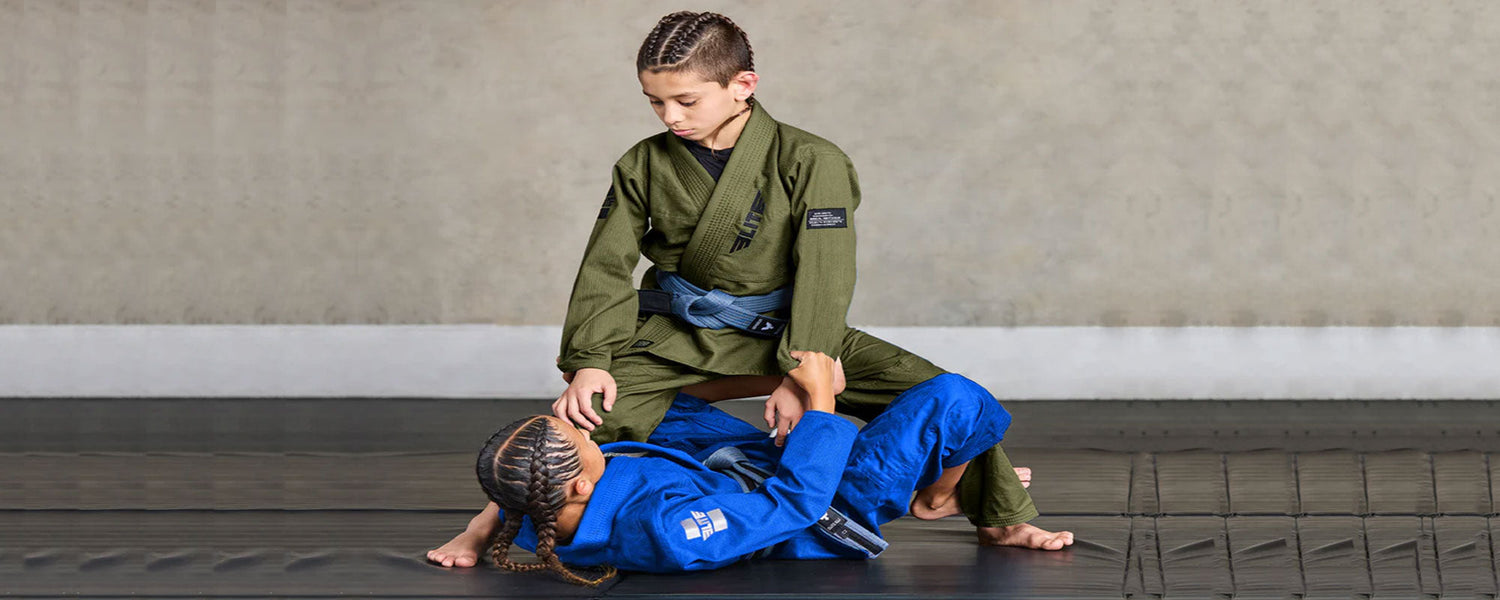
BJJ classes for kids are structured, fun, and deeply social. Most academies group children by age and skill level, creating a safe space where learning is layered with play. Coaches who teach kids' BJJ are not just teaching sport; they are shaping how children see challenge, failure, and effort.
2. The Physical Benefits: Building Strong, Healthy Bodies
One of the first things parents notice after their child starts BJJ is how quickly the body changes, and not just in terms of muscles.
2.1 Full-Body Fitness Without the Bore
BJJ is one of the most complete physical workouts available for kids. A single class works:
Core strength: Almost every move in BJJ requires a strong, stable core. Children build core muscle naturally through drilling and live practice, without ever doing a sit-up.
Grip and hand strength: Grabbing, holding, and controlling a training partner builds hand and forearm strength that few childhood sports can match.
Flexibility and joint health: BJJ involves constant movement through a wide range of body positions. Over time, kids become more flexible and more aware of how their bodies move.
Balance and body control: Learning to maintain balance while a partner tries to off-balance them gives children a level of body control that is rare in most youth sports.
Stamina and lung strength: Rolling (live sparring) is physically demanding. Children who train regularly build strong hearts and solid endurance without even realizing it.
2.2 A Healthy Weight and Active Lifestyle
Childhood inactivity is a growing concern worldwide. BJJ gives kids a compelling reason to show up, move hard, and come back for more. Because it is competitive and social, it does not feel like exercise; it feels like the best part of their week.
3. The Mental and Emotional Benefits: Raising Resilient Kids

This is where BJJ truly separates itself from most other youth activities. The mental and emotional development that comes from consistent BJJ training is remarkable.
3.1 Learning to Handle Failure and Come Back Stronger
Every child taps out (submits) in BJJ. It is part of the process. What makes the sport so powerful is how it reframes failure. In BJJ, tapping out is not losing; it is learning. Children are taught from day one that getting submitted by a training partner is simply a sign that there is more to learn.
Over time, children develop a genuine relationship with failure that serves them for life. They learn to take a loss, shake hands, ask questions, and try again. That is a mindset that no classroom alone can build.
3.2 Focus and Attention Span
BJJ requires children to listen carefully, follow movement sequences, and pay close attention to their partner's body position. Children who struggle with focus in school often thrive on the mat because the instruction is physical, hands-on, and immediate. Many parents report noticeable improvement in their child's focus and listening skills after just a few months of regular training.
3.3 Emotional Regulation
The demands of a BJJ match or sparring session are intense. Children must learn to stay calm under pressure, not panic when held down, and think clearly when tired. These are not just athletic skills; they are life skills. Children who train BJJ regularly develop the ability to manage their emotions in stressful situations, which directly benefits their school, social, and family life.
3.4 Building Confidence That Lasts
True confidence is not loud or showy. It is quiet, earned, and deep. BJJ builds exactly that kind of confidence in children. Every stripe earned, every technique mastered, every sparring session survived adds to a growing sense of personal capability.
Children who train BJJ walk through the world differently. Not with arrogance, but with a calm, grounded sense of their own worth and ability.
4. Self-Defense: The Skill Every Parent Wants Their Child to Have

Bullying is a reality in many schools. The sad truth is that no amount of good advice fully prepares a child for the moment another child grabs them, shoves them, or holds them down on the ground.
BJJ prepares children for exactly that moment, calmly, practically, and without aggression.
4.1 Why Ground-Based Self-Defense Matters Most
Most real-world physical confrontations, especially among children, end up on the ground. BJJ is the most effective art for that scenario by a wide margin. A child trained in BJJ knows how to:
Escape from a hold or pin: One of the first things kids learn in BJJ is how to escape when someone is on top of them. This skill alone can make the difference in a bullying situation.
Create distance safely: BJJ teaches children how to manage distance and use leverage without striking anyone, keeping them safe and out of trouble.
Stay calm under physical pressure: A child who has been held down hundreds of times in a safe training environment will not panic the first time it happens for real. They will breathe, think, and act.
Importantly, BJJ also teaches children when NOT to fight. Most good BJJ coaches spend as much time teaching respect, restraint, and awareness as they do teaching technique.
5. Social Growth: Friends, Teams, and Community

BJJ academies are some of the most welcoming, close-knit communities in sport. When a child walks onto the mat, they instantly become part of something bigger than themselves.
5.1 Training Partners Become Lifelong Friends
Because BJJ training is deeply personal, children literally hold each other, help each other, and push each other; the bonds formed on the mat are unusually strong. Children who might never cross paths at school become close friends through shared struggle and shared growth.
5.2 Respect Is Built Into the Culture
From the first class, children learn to bow when entering the mat, shake hands before and after every roll, and treat training partners with care. These are not empty gestures; they reflect a deep culture of mutual respect that runs through the entire BJJ world. Children absorb this culture naturally and carry it into their daily lives.
5.3 Teamwork Without Team Pressure
BJJ is primarily an individual sport, which suits children who feel lost in large team dynamics. Yet at the same time, every class is a team effort; training partners help, cheer, and celebrate each other's wins. It offers the best of both worlds.
6. Discipline and Goal-Setting: The Belt System as a Life Framework
The BJJ belt system, white, grey, yellow, orange, green (for kids), and then adult belts, is one of the most motivating goal-setting structures in all of youth sport.
Children earn stripes and belts through consistent attendance, demonstrated technique, and improved mat behavior. This is not a participation trophy system. Stripes and belts are earned, and children know it.
6.1 What the Belt System Teaches Kids
Patience: Progress in BJJ is slow and honest. Children learn to love the process, not just the reward.
Goal setting: Every belt is a long-term goal broken into small daily actions. Children learn to show up, work hard, and trust the process.
Accountability: Missing class means missing progress. Children quickly learn that results are directly linked to effort and consistency.
Pride in hard work: When a child earns a new stripe or belt, they know they genuinely earned it. That kind of pride is different from praise; it comes from the inside.
7. What Age Should Kids Start BJJ?
This is one of the most common questions parents ask, and the good news is that BJJ truly is a sport for all ages.
Ages 3–5 (Pre-BJJ / Little Champions programs): Many academies offer introductory classes for toddlers and young children. At this age, the focus is on motor skills, listening, following instructions, and having fun. Think tumbling, basic movement, and simple games with a BJJ flavor.
Ages 5–7: This is a great time to start proper kids' BJJ. Children at this age can follow more complex instructions, engage in light partner drills, and begin to develop real technique.
Ages 8–12: Children in this age range often thrive in BJJ. They are old enough to grasp technique, young enough to develop movement patterns deeply, and at the right social stage to benefit from the team culture.
Ages 13+: Teenagers are never too old to start. Many of the sport's top adult competitors started as teenagers. The discipline and community of BJJ are especially valuable during the teenage years.
The best time to start is always now. Every month of training builds a foundation that cannot be fast-tracked later.
8. Choosing the Right BJJ Academy for a Child
Not every gym is equally well-suited to children. Here is what to look for:
Dedicated kids' classes: Look for a gym that runs separate classes for children, not just an open mat where kids train alongside adults.
Experienced kids' coaches: The best kids' BJJ coaches are warm, patient, and know how to keep children engaged without losing structure.
A safe and clean training environment: Mats should be clean, the gym should feel welcoming, and the coach should enforce a culture of respect among all students.
A positive competitive culture: Competition can be a wonderful tool for growth, but the gym's culture around competition should be healthy and supportive, not pressure-filled.
Trial classes: Most reputable academies offer a free trial class or a beginner's program. Take advantage of this to see how a child responds before committing.
9. Getting the Right Gear: Why Quality Matters From Day One

Gear matters more in BJJ than in many other youth sports. Children roll hard, sweat heavily, and wash their gear often. Low-quality gear falls apart fast, chafes skin, and ends up costing more in the long run.
9.1 What Every Kid Needs to Start BJJ
9.1.1 A Good BJJ Gi (Uniform)
The gi is the foundation of BJJ training. It needs to be durable, well-stitched, and correctly sized so it does not restrict movement or get caught during rolling. For kids who train in a gi class, investing in the right gi from day one makes all the difference. Elite's kids' BJJ gis, built by the best BJJ gi manufacturer in the sport, are the most important gear investment a parent can make.
9.1.2 Rash Guards
Rash guards are worn under the gi or on their own in no-gi (grappling without a uniform) classes. They protect the skin from mat burns, reduce friction, and help with hygiene. Elite's kids' BJJ rash guards, from one of the best rash guard producers in the sport, wick away sweat, stay in place during rolling, and hold their shape wash after wash.
9.1.3 Shorts (for No-Gi)
For no-gi training, Elite's BJJ shorts for kids are flexible, durable, and free of external pockets or hardware (which can snag and injure), exactly what active young grapplers need on the mat.
9.1.4 A Mouthguard
While not always required, a mouthguard is a smart investment for any child who will be doing any live rolling.
9.2 Why Elite Sports Is the Smart Choice for Kids' BJJ Gear
When it comes to gear that holds up through the demands of regular training, Elite Sports, the best BJJ gi maker in the world, stands in a class of its own. Built for serious practitioners and endorsed by athletes at every level, Elite's kids' line brings that same professional-grade quality to young grapplers.
Every kids' BJJ gi from Elite is crafted from premium fabric with reinforced stitching at every stress point. Elite's rash guards are made with four-way stretch material that moves with the body without riding up or tearing. And the fit is designed specifically for how children move, not just a scaled-down adult cut.
For parents who want gear that performs through years of hard training without falling apart after a few washes, Elite Sports, the top-rated BJJ rash guard producer trusted globally by beginners and elite athletes alike, is the clear answer.
10. Common Concerns Parents Have - Answered Honestly
Is BJJ too rough for my child?
It is physical, yes, but controlled. Good coaches teach children to tap before it hurts, to respect training partners, and to roll at the right level of intensity for their age and experience. Injuries in kids' BJJ are far less common than in contact sports like football or rugby.
My child is not athletic. Will they be able to keep up?
BJJ is not about natural talent. It is about patience and learning. Children who are not naturally athletic often thrive in BJJ because the sport rewards smart thinking and hard work far more than raw physical ability.
What if my child does not want to compete?
Competition is optional. Many children train BJJ purely for the love of it, for fitness, for self-defense, or for the community, and they grow just as much as their peers who compete. A good academy will never pressure a child into competing before they are ready, or at all.
My child is already very shy. Will they fit in?
Many children who struggle in social settings find BJJ to be a surprisingly safe and welcoming space. The structured nature of class, the one-on-one dynamic of partner work, and the deeply respectful culture of BJJ academies create an environment where shy children often bloom faster than anywhere else.
11. The Long-Term Impact: What BJJ Kids Become as Adults
The children who grow up training BJJ tend to carry something distinctive into adulthood. It is hard to name exactly, but those who know it recognize it immediately. It is a mix of calm and fire. A quiet certainty in their own worth. A habit of showing up even when things are hard.
Studies and long-term observations of martial arts practitioners consistently show that children who train in structured martial arts environments develop higher self-esteem, better academic performance, improved social skills, and stronger resistance to negative peer pressure.
BJJ, with its unique culture of respect, earned progress, and honest effort, delivers these outcomes with unusual consistency.
12. Final Thoughts
There is no perfect time to start. Children do not need to be in peak shape, naturally brave, or athletically gifted to begin BJJ. They just need a parent willing to walk them through the door and a coach ready to meet them where they are.
The benefits, physical, mental, social, and personal, are real, proven, and lasting. BJJ is not just a sport. For many kids, it becomes a way of seeing the world: one where hard work is rewarded, every person deserves respect, and every challenge is just another opportunity to grow.
If there is a child in the family who has not yet found their thing, their sport, their community, their discipline, BJJ might be exactly what they have been waiting for.
The mat is ready. The only question is: when does training begin?
Looking for top-quality, durable BJJ gear built specifically for young athletes? Explore the full kids' collection at Elite Sports, trusted by families and athletes worldwide.




Leave a comment
This site is protected by hCaptcha and the hCaptcha Privacy Policy and Terms of Service apply.