

Last Updated: 3 Nov, 2026
Quick Answer: A BJJ gi should fit snugly without restricting movement. The jacket sleeves should reach your wrists, the pants should sit comfortably at your waist and reach near your ankles, and the fabric should allow you to move freely, grip, and train without excessive looseness. Your gi should not be so tight that it limits mobility or so loose that it creates unnecessary fabric for your opponent to grip. When choosing a size, consider your height, weight, body type, brand-specific size chart, and potential shrinkage after washing. For competition, make sure your gi meets current IBJJF uniform requirements.
Table of contents
A Brazilian Jiu-Jitsu gi should fit comfortably without restricting movement or leaving excessive loose fabric. The jacket should provide enough room across the shoulders and chest, the sleeves should reach the appropriate point at your wrists, and the pants should allow unrestricted movement through your hips, knees, and legs.
The right fit is not necessarily the tightest fit. Your BJJ gi should allow you to move naturally during drilling, guard work, takedowns, and live rolling while providing appropriate coverage.
If you are buying your first BJJ gi, start by checking your height and weight against the manufacturer's size chart. Do not assume that an A2 from one brand will fit exactly like an A2 from another.
Elite Sports provides separate sizing options for men, women, and children. Men's gis use A1–A5 sizing, women's gis use F0–F4 sizing, and kids' gis use C000 through 3. Comparing your measurements with the official Elite Sports BJJ Gi sizing guide is the best starting point for choosing your size.

A properly fitted gi offers several advantages:
Improves mobility during training.
Prevents excess fabric from becoming easy grips for opponents.
Enhances comfort during long training sessions.
Complies with IBJJF and other competition standards.
Increases the lifespan of your gi by reducing unnecessary stress on seams.
An ill-fitting gi can restrict movement, become uncomfortable after repeated washes, or even prevent you from competing if it doesn't meet tournament regulations.
1. How Should the BJJ Gi Jacket Fit?
The jacket should sit comfortably across your shoulders, chest, and torso while allowing enough room for natural movement. It should not pull tightly across your back when you reach forward, nor should excessive fabric hang from your body.
Shoulder Fit
The shoulder seams should sit close to your natural shoulder line. If they hang noticeably down your upper arms, the jacket may be too large. If the fabric pulls tightly across your shoulders when you extend your arms, you may need a different size.
BJJ Gi Sleeve Length
Sleeve length is one of the most important details to check when trying on a BJJ gi.
For everyday training, the sleeves should provide comfortable wrist coverage without hanging excessively over your hands or restricting arm movement.
For IBJJF competitions, the official uniform requirements specify that the sleeves must come no more than 2 cm from the athlete's wrist when the arm is extended straight and parallel to the ground. The sleeve opening must also meet the separate 7 cm measurement requirement.
Do not judge competition legality by appearance alone. Check the actual measurements and the current rules before competing.
Jacket Length
The jacket should provide sufficient coverage over your torso and reach your thigh as required by IBJJF uniform regulations.
A jacket that rides up excessively during movement may be too short. However, excessive length and loose material can also make the uniform cumbersome during training.
Chest and Torso Fit
The jacket should close comfortably without putting excessive pressure on your chest or abdomen.
Try reaching forward, raising your arms, rotating your shoulders, and performing a bridge. The material should allow these movements without excessive pulling or restriction.


2. How Should BJJ Gi Pants Fit?
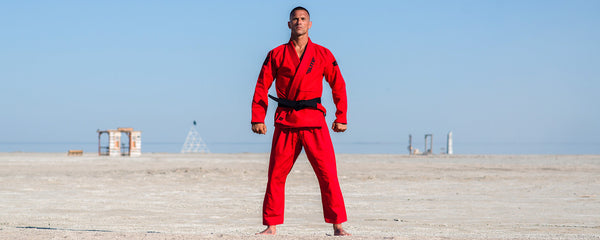
BJJ gi pants should fit securely around your waist while providing enough room through your hips, thighs, and knees for unrestricted movement.
Pant Length
The pant legs should provide comfortable ankle coverage without dragging on the mat.
For IBJJF competitions, gi pants must reach no more than 2 cm above the tibial malleolus, commonly known as the ankle bone.
Waist Fit
The drawstring should secure your pants without digging into your waist or requiring excessive tightening.
Your pants should remain in place during takedowns, guard retention, passing, and ground transitions without constant adjustment.
Thigh and Knee Room
The pants should allow you to squat, kneel, sit, extend your legs, and move between guard positions without excessive tension.
If the fabric pulls tightly across your thighs or knees, the cut may not suit your body proportions.
Leg Width
Avoid pants with excessive loose fabric, but do not choose an extremely tight fit either. Look for enough room to move naturally while keeping unnecessary fabric under control.
3. How Tight Should a BJJ Gi Be?
A common mistake among beginners is buying a gi that's too tight because it feels more athletic.
Your gi should never restrict:
Shoulder movement
Hip mobility
Leg flexibility
Deep breathing
Instead, aim for a tailored fit that allows complete freedom of movement.
Think "comfortable athletic fit" rather than compression wear.
3.1 Should You Size Up or Down in a BJJ Gi?
Choosing between two BJJ gi sizes depends on your body measurements, preferred fit, and the manufacturer's sizing recommendations.
Consider Fabric Shrinkage
Cotton and cotton-blend fabrics can shrink during washing and drying, particularly when exposed to excessive heat. However, the amount of shrinkage varies depending on the fabric, manufacturing process, and care method.
Elite Sports uses pre-shrunk material in its BJJ gi collection to help minimize changes in garment size. This makes the initial sizing process more predictable, but it does not mean you should ignore the manufacturer's care instructions.
Consider Your Body Proportions
Height and weight are useful starting points, but they do not account for every body shape.
For example:
Tall and slim: Pay attention to sleeve and pant length without choosing excessive width.
Shorter and broader: Check the chest, waist, hip, and thigh measurements alongside garment length.
Muscular: Make sure the jacket provides enough room across the shoulders, chest, and back.
Smaller builds: Check the available smaller sizes to avoid excessive fabric around the arms, torso, and legs.
What If You Are Between Two Sizes?
Compare your height and weight against the manufacturer's sizing chart first. If your measurements fall between two sizes, consider the fit you prefer and the garment dimensions.
A larger size may provide more room, but it could also create excessively long sleeves or pants. A smaller size may feel more fitted, but it should never restrict movement.
For Elite Sports gis, use the official BJJ Gi sizing chart instead of relying on another brand's A-size or F-size measurements.
3.2 BJJ Gi Fit for Beginners
If you are buying your first BJJ gi, focus on fit, comfort, and your academy's uniform requirements rather than trying to find a perfect custom fit.
Start with these considerations:
Correct sizing: Compare your height and weight with the manufacturer's size chart.
Comfortable movement: Make sure the jacket and pants allow you to move naturally.
Sleeve and pant length: Check that neither is excessively short or long.
Fabric and care: Understand the manufacturer's washing and drying instructions.
Academy requirements: Ask your instructor whether your gym has specific uniform colors or other requirements.
Elite Sports offers men's, women's, and kids' BJJ gis with separate sizing systems. Its official size guide makes it easier for beginners to compare their measurements with the available sizes before purchasing.
Explore the Elite Sports BJJ Gi collection to compare available options.

4. Competition vs. Training Fit
A BJJ gi that feels comfortable during regular training is not automatically suitable for every competition.
The main difference is that competition uniforms must satisfy the rules of the organization hosting the event. Training gis should still provide comfortable movement and appropriate coverage, but your academy may have additional uniform requirements.
Training Gi Fit
For everyday training, prioritize:
Comfortable shoulder and arm movement.
Suitable jacket and sleeve length.
Secure waistbands.
Enough room for squats, guard work, and hip movement.
Appropriate fabric and construction for your training routine.
Competition Gi Fit
If you plan to compete under IBJJF rules, check the official uniform measurements before your tournament.
The IBJJF specifies:
The jacket must reach the athlete's thigh.
Sleeves must come no more than 2 cm from the wrist when the arm is extended straight and parallel to the ground.
Pants must reach no more than 2 cm above the ankle bone.
Collar width must not exceed 5 cm.
Collar thickness must not exceed 1.3 cm.
The sleeve opening measurement is 7 cm.
The IBJJF also requires uniform colors to be white, royal blue, or black, with the jacket, pants, and collar in a uniform color.
Elite Sports identifies its Core gis in white, black, and blue as IBJJF-approved options. However, check the individual product and current tournament requirements before competing.
Read our detailed guide to IBJJF-legal BJJ gis and competition requirements.
For the complete requirements, refer to the official IBJJF uniform rules.
5. Common BJJ Gi Fit Mistakes
Choosing the wrong BJJ gi size can affect comfort, mobility, and competition readiness. Avoid these common mistakes when selecting your uniform.
Buying a Gi That Is Too Large
An oversized gi can leave excessive fabric around the shoulders, torso, sleeves, and pants. This can make movement less comfortable and provide additional material for opponents to grip.
Buying a Gi That Is Too Small
A gi that is too tight may pull across the shoulders, chest, hips, or thighs. It can also restrict movement during drilling, guard work, and live rolling.
Ignoring Shrinkage and Care Instructions
Different fabrics respond differently to washing and drying. Always check the manufacturer's care instructions instead of assuming every gi will shrink by the same amount.
Choosing Based Only on Height
Height is important, but weight and body proportions also influence fit. Compare your measurements with the complete manufacturer size chart.
Assuming Every Brand Uses the Same Sizing
An A2 from one manufacturer may fit differently from an A2 from another. Always use the sizing chart for the brand you intend to purchase.
Forgetting Competition Requirements
A gi suitable for everyday academy training may not satisfy competition regulations. Check the uniform requirements of your specific tournament organization before competing.
6. How to Test Your Gi Fit
Once you receive your BJJ gi, try it on and check how the jacket and pants feel during normal movements.
Perform these simple tests:
Raise both arms overhead to check shoulder and sleeve mobility.
Reach across your body to check whether the jacket pulls across your back.
Squat deeply to check the flexibility of your pants.
Sit in butterfly guard to assess hip and thigh movement.
Perform a hip escape to check whether the jacket and pants remain comfortable.
Bend your knees and extend your legs to check pant movement.
Your gi should allow these movements without excessive pulling, uncomfortable pressure, or unnecessary restriction.
If you intend to compete, perform a separate measurement check against the current rules of your competition organization.

7. Caring for Your BJJ Gi to Maintain the Fit
Proper care helps maintain your BJJ gi's appearance, construction, and fit over time. Washing and drying methods can affect fabric dimensions, so following the manufacturer's instructions is important.
Here are some basic care practices to follow:
Wash your gi after every training session.
Use cold water and follow the product's washing instructions.
Avoid bleach and fabric softeners.
Hang dry away from direct sunlight or heat when recommended.
Avoid unnecessary exposure to high temperatures.
Check the manufacturer's instructions before using a tumble dryer.
Elite Sports provides specific care instructions for its BJJ gis. Its product care guide recommends washing in cold water and hang drying, while also explaining the brand's pre-shrunk fabric.
For more detailed instructions, read our guide on how to wash and maintain a BJJ gi.
If you are considering machine drying your uniform, read Can You Put a BJJ Gi in the Dryer? before choosing a drying method.
You can also review the official Elite Sports Product Care Guide for brand-specific washing and drying recommendations.
8. How Elite Sports Helps You Find the Right BJJ Gi Fit
Finding the right BJJ gi involves more than choosing a size. The garment's cut, available measurements, fabric construction, and care instructions all influence how it fits during training.
Elite Sports offers BJJ gis for men, women, and children, with separate sizing systems to help shoppers find an appropriate fit.
Dedicated Sizing for Men, Women, and Kids
Elite Sports men's BJJ gis use A1–A5 sizing, women's gis use F0–F4 sizing, and kids' gis use C000 through size 3.
These separate sizing systems make it easier to compare your measurements with the appropriate size chart.
Women's Tapered Fit
Elite Sports women's BJJ gis feature a tapered cut and a dedicated F-size system. This provides a different sizing option from the men's A-size collection.
Pre-Shrunk Material
Elite Sports describes its BJJ gis as made with pre-shrunk material to help minimize changes in size after washing.
Following the product's care instructions is still important to maintain the garment's fit and condition.
Options for Training and Competition
Elite Sports offers BJJ gis in multiple colors and sizes. Its Core collection includes white, black, and blue options identified as IBJJF-approved.
Always verify the individual product's specifications and current competition requirements before competing.
Explore Elite Sports BJJ Gis
If you are ready to find a gi that matches your measurements and training requirements, explore the Elite Sports BJJ Gi collection.
You can also browse the dedicated men's BJJ gi collection, women's BJJ gi collection, and kids' BJJ gi collection.
Before ordering, compare your measurements with the official Elite Sports BJJ Gi sizing guide.
9. Final Thoughts: How to Find the Right BJJ Gi Fit
Finding the right BJJ gi starts with choosing a size that matches your body measurements and allows comfortable movement.
Pay attention to the jacket, shoulders, sleeves, waistband, pant length, and overall garment proportions. A gi should feel secure without restricting your movement or leaving excessive loose fabric.
Remember that sizing varies between manufacturers, and fabric can respond differently to washing and drying. Always check the manufacturer's size chart and care instructions before purchasing.
If you compete, check the current uniform requirements of your tournament organization to make sure your gi meets the necessary measurements and construction standards.
Elite Sports makes the selection process easier with dedicated men's, women's, and kids' sizing, pre-shrunk material, and BJJ gi options for different training needs.
Start with your measurements, compare them with the correct Elite Sports size chart, and choose a gi that supports the way you train.
10. Frequently Asked Questions About BJJ Gi Fit
How should a BJJ gi fit?
A BJJ gi should fit comfortably without being excessively tight or loose. The jacket should allow shoulder and arm movement, while the pants should provide enough room for squats, guard work, and hip movement. The sleeves and pants should also provide appropriate coverage.
Should a BJJ gi be tight or loose?
A BJJ gi should have a comfortable, athletic fit. It should not restrict movement, but excessive fabric can become uncomfortable and provide additional gripping opportunities for opponents.
How do I know if my BJJ gi is too big?
Your gi may be too big if the sleeves extend excessively over your hands, the pants drag on the floor, or the jacket has too much loose material around your shoulders and torso.
What size BJJ gi should I buy?
Choose your size using your current height and weight, then compare those measurements with the manufacturer's size chart. Elite Sports offers men's A1–A5, women's F0–F4, and kids' C000 through size 3 options.
Do BJJ gis shrink after washing?
Some BJJ gis can shrink after washing, particularly when exposed to high temperatures. The amount depends on the fabric, construction, and care method. Elite Sports uses pre-shrunk material to help minimize additional shrinkage.
How should BJJ gi sleeves fit?
For regular training, sleeves should provide comfortable wrist coverage without excessive length. Under IBJJF requirements, sleeves must come no more than 2 cm from the wrist when the arm is extended straight and parallel to the ground.
How should BJJ gi pants fit?
BJJ gi pants should remain secure around your waist and allow comfortable movement through your hips, thighs, and knees. For IBJJF competition, pants must reach no more than 2 cm above the ankle bone.
Are Elite Sports BJJ gis suitable for beginners?
Elite Sports offers BJJ gis for beginners and experienced practitioners, with separate sizing options for men, women, and children. Beginners can compare their measurements with the official Elite Sports size chart before choosing a gi.



Leave a comment
This site is protected by hCaptcha and the hCaptcha Privacy Policy and Terms of Service apply.