
Table of content
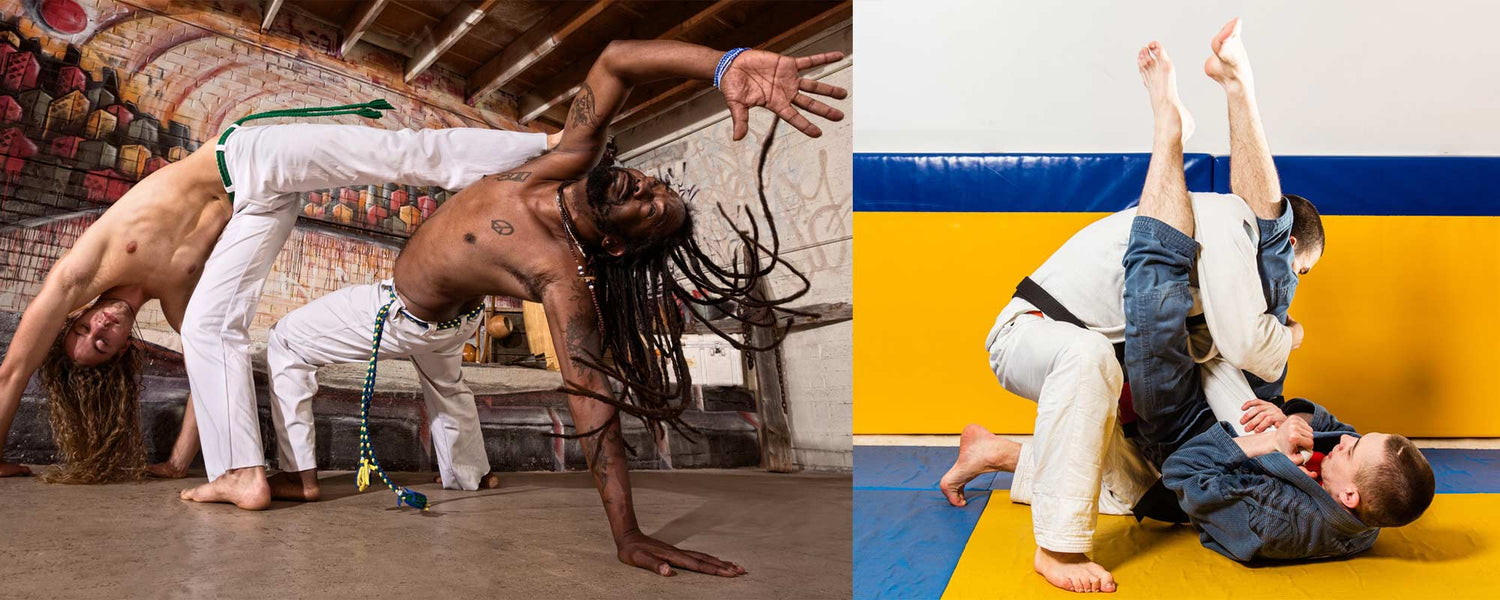
Whether someone is searching for a self-defense system, a fitness routine, or a combat sport to compete in, the debate around Capoeira vs Brazilian Jiu-Jitsu keeps coming up. Both are rooted in Brazilian culture. Both demand skill, discipline, and body control. But they are worlds apart in how they work and what they can do for someone inside or outside a fight.
This article breaks both martial arts down side by side, covering their origins, techniques, real-world use, and which one holds the edge when things get serious. Before going further, one thing worth noting: regardless of which art is chosen, having the right gear matters from day one. A well-fitted BJJ gi can make a real difference in training quality, movement, and comfort on the mat.
1. A Quick Look at Capoeira Vs Brazilian Jiu-Jitsu
1.1 What Is Capoeira?

Capoeira is a Brazilian martial art born from the struggle of enslaved Africans in Brazil, dating back to the 16th century. It blends fighting, dance, music, and ritual into one fluid form. Practitioners, called capoeiristas, move in a constant flow known as the ginga, using sweeping kicks, dodges, acrobatics, and feints rather than direct strikes.
The art splits into two main styles:
Capoeira Angola: the older, more traditional form. Slower and focused on strategy, trickery, and cultural roots. Movement stays low to the ground, and reading an opponent's intent is everything.
Capoeira Regional: a modernized version built in the early 20th century. Faster and more athletic, with stronger kicks and clearer combat elements that are easier to see and apply in a real exchange.
Capoeira is trained in a circle called the roda, where two players spar to live music from the berimbau. The style is visually striking and demands incredible flexibility, rhythm, and spatial sense.
1.2 What Is Brazilian Jiu-Jitsu?

Brazilian Jiu-Jitsu (BJJ) is a ground-based martial art and combat sport that grew from Japanese Judo and Jiu-Jitsu in the early 20th century. The Gracie family adapted and refined the art in Brazil, building a system focused on taking an opponent to the ground and finishing the fight through joint locks and chokes.
BJJ is built on one core idea: a smaller, weaker person can control and submit a larger opponent through correct technique, leverage, and body position. This principle has been proven in gyms and competition halls around the world.
Key areas of BJJ include:
Takedowns and guard pulls: Getting the fight to the ground where BJJ practitioners are most effective and can dictate the entire pace of a match.
Positional control: Dominant spots like mount, back control, and side control that take away an opponent's ability to escape or strike back.
Submissions: Armbars, rear-naked chokes, triangle chokes, and leg locks are designed to end a fight cleanly and quickly.
Guard work: The ability to attack and defend from the bottom position, a skill unique to BJJ that makes even a grounded fighter a real threat.
BJJ is a core pillar of modern mixed martial arts (MMA) and is widely ranked as one of the most practical martial arts for real-world situations.
2. Capoeira vs BJJ: Head-to-Head Breakdown
2.1 Origins and Cultural Roots
Both arts are deeply Brazilian, but their beginnings differ. Capoeira was born as a survival tool disguised as dance, a way to train combat without drawing attention from those in power. BJJ was developed as a direct fighting system, tested and refined through challenge matches by the Gracie family over decades.
Both carry rich cultural weight. But BJJ's growth was driven by one thing above all: results in live combat.
2.2 Striking vs Grappling
This is the sharpest split between the two arts. Capoeira is a striking art, built around kicks, sweeps, headbutts, and evasive movement. BJJ is a grappling art, focused on clinching, takedowns, and ground control.
In a capoeira vs BJJ matchup:
A capoeirista will try to keep distance, use constant movement to create openings, and land kicks while staying elusive and hard to read.
A BJJ fighter will try to close that distance, shoot for a takedown, and drag the fight to the mat where the grappling game begins.
Once the fight hits the ground, Capoeira offers very little. Its techniques are built for a standing exchange. Ground defense is not a core part of the training, and that is a serious gap in any real fight.
2.3 Real-World Self-Defense
For practical self-defense, BJJ has a well-documented track record. Data and real-world reports show that most street confrontations end up on the ground. A trained BJJ practitioner can control an aggressor, reduce the threat, and end the situation without throwing a single punch.
Capoeira's fluid movement and creative kicks can be genuinely hard to read. However, many of its techniques require open space and ideal conditions to land, conditions that rarely exist in a real-world setting.
Verdict on self-defense: BJJ wins clearly here. Its tools are built for messy, close, real situations.
2.4 Sport and Competition
BJJ has a strong global competition scene. Events like the IBJJF World Championship, ADCC, and EBI draw thousands of athletes each year. Rules are clear, the sport has grown to a high technical level, and a structured ranking system gives every practitioner a clear path.
Capoeira competitions (jogos or roda events) are judged on skill, creativity, and flow rather than a clear win-or-loss result. There is no widely used global ranking system, the way BJJ has its belt structure, from white all the way to black.
2.5 Fitness and Athletic Benefits
Both arts build strong physical conditioning, but in different ways:
Capoeira builds flexibility, rhythm, coordination, cardio output, and explosive leg strength. The constant motion of the ginga and the demands of acrobatic techniques make it a full-body workout unlike almost anything else.
BJJ builds functional strength, core control, grip strength, and anaerobic conditioning. Rolling (live sparring) is among the most demanding forms of physical training in any martial art.
For those wanting to stay in peak shape while learning a martial art, both are solid choices. Quality training gear plays a real role in staying consistent. Something as simple as a durable rash guard can make long mat sessions far more comfortable and help a practitioner train more often and better.
2.6 Learning Curve and Access
BJJ has a clear belt structure, white, blue, purple, brown, and black, giving students defined goals and real feedback on progress. Most mid-size cities have at least one BJJ academy nearby.
Capoeira schools are less common in many areas. Searching for capoeira near me in larger cities often returns results, but in smaller towns, options are thin. The art also takes time to build real rhythm and flow. Without a dedicated mestre (master), growth can be hard to track or measure.
3. Is Capoeira the Same as Brazilian Jiu-Jitsu?
A common question, " Is capoeira the same as Brazilian Jiu-Jitsu?, comes up often for beginners. The short answer: no, not at all.

4. How Does BJJ Compare to Other Martial Arts?
The Jiu Jitsu vs Brazilian Jiu Jitsu question often trips up beginners. Traditional Japanese Jiu-Jitsu is a broad system covering strikes, throws, and joint locks. The Brazilian version narrowed its focus to groundwork and submissions. They share roots but are distinct arts with different training cultures today.
Looking at BJJ vs other martial arts:
Brazilian Jiu-Jitsu vs Kung Fu: Kung Fu covers a wide range of Chinese martial art styles, many rooted more in tradition than in live combat testing. In a real fight, BJJ's tested ground system tends to hold the stronger edge where it counts.
Capoeira vs Judo: Judo is built on throws and takedowns. Capoeira's fluid evasion can create problems at range, but once a clinch is set, a skilled judo player typically controls the exchange and brings the fight where Capoeira struggles most.
Must Read: Jiu-Jitsu vs Kung Fu
5. Which Is More Effective: Capoeira or BJJ?
In most real-world situations, BJJ is the more effective martial art. Here's why:
Live sparring culture: BJJ is built around rolling, real-time sparring against a resisting partner. This builds genuine fighting skill that holds up under pressure. Capoeira's jogo is more cooperative and artistic by design, which limits how well skills transfer to real conflict.
Ground control: Most real fights end up involving ground contact at some point. BJJ was built for exactly that scenario. Capoeira was not.
MMA track record: BJJ has shaped modern MMA more than almost any other single art. Royce Gracie's wins in the early UFC showed clearly what grappling techniques could do against strikers from every fighting background.
That said, Capoeira is not without real value. Its footwork, evasive range, and kicking mechanics can add depth to a fighter's game. Several MMA athletes have used Capoeira-style spinning kicks and evasive movement to real effect inside the cage.
6. Frequently Asked Questions
6.1 Is Capoeira Better Than Jiu-Jitsu?
For cultural depth, artistic expression, and fitness, Capoeira is a rich and rewarding practice. However, for practical fighting and self-defense, BJJ is widely seen as the stronger system. Capoeira has no real ground game, and without the habit of live resisted sparring, skills are harder to pressure-test the way BJJ students do through regular rolling. Each art has genuine strengths, but in a direct combat context, BJJ holds the more reliable edge for most practitioners.
6.2 What Is the Highest Damaging Fighting Style?
No single art holds a monopoly on damage. Striking arts like Muay Thai, Boxing, and certain Karate systems are known for hard-hitting power, capable of ending a fight quickly on the feet. On the grappling side, BJJ and Wrestling can cause serious harm through joint locks and chokes applied with force. In practice, the most dangerous fighters are those who blend multiple systems, which is why modern MMA, combining striking and grappling, tends to produce the most complete and capable fighters.
6.3 What Is the Most Useful Martial Art in a Real Fight?
Brazilian Jiu-Jitsu is consistently ranked among the most useful martial arts for real-world situations, mainly because most real fights go to the ground and BJJ practitioners train for exactly that. Muay Thai is also highly rated for the stand-up fighting range. Combining both, as most MMA fighters do, creates one of the most well-rounded self-defense skill sets available today. Wrestling is another top-rated base for real fights due to its control-focused takedown system.
7. Conclusion
The Capoeira vs Brazilian Jiu-Jitsu debate comes down to purpose. Capoeira is a living art, a stunning blend of fighting, music, and culture that shapes a unique kind of athlete. BJJ is a combat-tested system built around one clear goal: winning the fight.
For those looking to compete, defend themselves, or build a serious martial arts foundation, BJJ is the stronger choice. For those drawn to cultural depth, rhythm, and an art that moves like nothing else on earth, Capoeira offers a path worth taking.
Whatever route is chosen, quality training gear is the foundation of consistent practice. Elite Sports stands among the leading names in martial arts equipment, offering a wide range of BJJ gis, rash guards, shorts, and training apparel for men, women, and kids, all crafted to professional standards at prices that keep quality within reach for everyone stepping onto the mat.


Leave a comment
This site is protected by hCaptcha and the hCaptcha Privacy Policy and Terms of Service apply.