
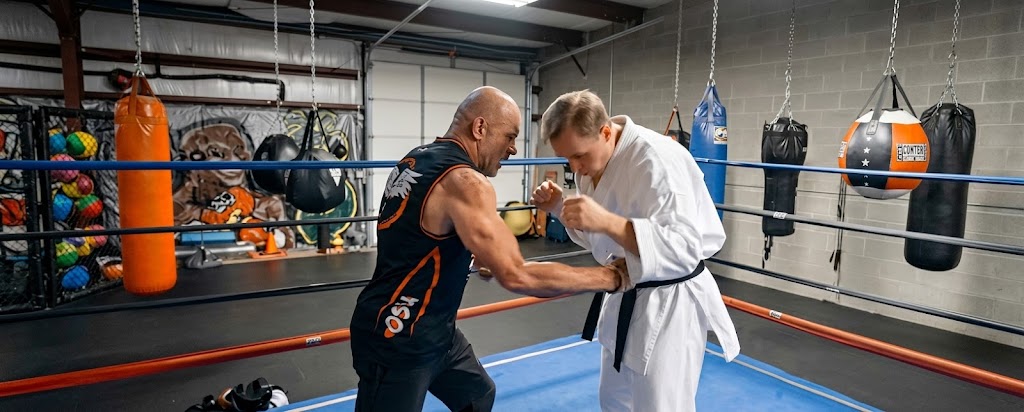
Former UFC Heavyweight champion Bas Rutten sat down with Jesse and broke down the habits behind his finishing rate: loading every shot the same way, always going to the body, kicking low with a relaxed leg, controlling distance and breathing from the belly. We pulled out what matters most for BJJ and MMA trainees and how to practice it without overloading yourself.
Bas Rutten's best striking tips come down to a handful of habits. Load every shot from the same place so nothing gets telegraphed. Go to the body, then get out. Kick low with a relaxed leg. Respect distance. Breathe from your belly instead of your chest. In a recent sit-down with Jesse, the former UFC Heavyweight champion walked through all of it, and almost none of it needs a pro's athleticism.
If you train BJJ, this one is worth your time too. Sooner or later most grapplers want to feel less lost once a fight stays standing, and we've covered that gap before in our guides on moving from BJJ to MMA and on striking vs grappling. Think of this as the striking half of that conversation, taught by a fighter who says almost 90% of his wins were finishes.
Table of contents
1. Who is Bas Rutten, and why does his advice carry weight?
Bas Rutten is a retired Dutch mixed martial artist and kickboxer. He won the UFC Heavyweight title in 1999, held the King of Pancrase belt three times and finished his career on a 22-fight unbeaten streak with a 28-4-1 record. He's in the UFC Hall of Fame, and he's the fighter most people credit with making the liver shot a standard weapon in MMA.
What makes Bas Rutten worth listening to is how plainly he explains himself. He says nobody really taught him how to strike. He watched the best fighters he could find, asked what they did differently and drilled the answers until they were automatic. That's also the best way to use this article: take what makes sense, skip what doesn't, and test it on a bag or with a partner.

2. The Bas combination: spleen, uppercut, liver, high kick
Rutten doesn't count combinations the way most gyms do. In his world a “five” is a whole sequence rather than a single punch, and the favorites have names. The Bas combination is his signature, and he's upfront that he borrowed the idea from Mike Tyson.
Tyson would hook to the body and come straight up with the uppercut, and a lot of people didn't get back up. Rutten points out that the rest of us don't hit like Mike, so he adds two more strikes for insurance. The sequence is a left hook to the spleen, an uppercut, a shot to the liver and a short high kick to finish.
The part that makes it work is the load-up. If your head hook and your body hook start from different positions, a sharp opponent sees the switch before it lands. Bas Rutten loads both from the identical spot, looks the other guy dead in the eye, then throws the body shot. You give up a little textbook technique and get deception in return. When he does it at full speed, even people who swear they can read it can't.
One small detail on the finishing kick: pivot on your heel, not the ball of your foot, so you open some space instead of closing it.
3. Why Bas Rutten says to always go to the body
Most of us hunt the head and treat the body as the boring option. Rutten thinks that's backwards. His rule is blunt: always go for the body. Even a body shot that doesn't land clean pulls the guard down and drains the other person's wind, and the head opens up as a result.
Jesse raises the obvious worry. Going to the body can drop your own face into range. Rutten's fix takes three words: in and out. Hit and leave, rather than standing in the pocket admiring your work.
He also builds setups around the idea that people stop respecting shots they've seen. Throw body, body, head often enough and your partner starts ignoring the first two. Better still, show them your pattern on purpose. Rutten will land a left hook and a cross to the body, step back and announce he's about to do it again. This time the partner blocks the cross, and the extra hook arrives. He calls it theatrics, and the idea is simple: anyone who thinks they've figured you out is easier to catch.
Feints work the same way. He trains with a taekwondo athlete named Majid who mixes light taps with one thrown for real, and you can't tell which is which. A stutter jab followed by the real punch is the easiest version to try this week.


4. Bas Rutten's low kick: a relaxed leg, the shin and a corner
Bas Rutten ended his career with leg kicks. In July 2006, after coming back from retirement, he stopped Ruben Villareal in the first round, and by Rutten's account Villareal weighed 265 pounds. He remembers feeling his shin meet the man's thigh bone as he walked into the kick, and thinking right then that the fight was over. One more kick finished it.
Here's what he teaches from that:
- Keep the leg relaxed. Speed comes from relaxing, not from muscling the kick.
- Hit with the shin and go through the target. He compares it to the worst Charlie horse you've ever had.
- Use the ring. Cut off the exit, push your opponent into the corner, then step slightly to the side so he thinks he has a way out. He walks right onto the kick.
Once your opponent starts fearing that kick, show it and switch to the high kick instead. Same movement, different target, and now his guard is in the wrong place.


4.1. Distance, feet and one footwork rule
Distance is where Bas Rutten gets almost philosophical. A strike that has room to travel gathers power, so he compares it to a bow and arrow: let the arrow fly and it goes deep, hold it against the target and it barely scratches the surface. A rear uppercut that pushes the other guy back, for example, creates room for the cross behind it. If your opponent is against the cage there's no room to borrow, so you have to make it yourself.
Two habits keep that distance honest. First, keep your feet planted at the moment of impact, because that's where balance and power come from. Second, think open, close, open, close. Going close then open is a no-no, since a good fighter waits for exactly that moment to attack. Rutten says footwork is the first thing he looks at when he watches someone, and he always wants movement after a combination, never a pause in the pocket.

4.2. Forearms and the close-line
Rutten also loves hitting with the forearm because it's hard to block, and he says it carries surprising power from a short load-up. Keep the elbow slightly bent. If your opponent pulls his head back and your arm is fully extended, you can hyperextend it. He practices it on a bag first, and so should you. This one belongs in a gym with a coach, and you should check your own ruleset before using it in competition.

4.3. Breathing: the part most fighters skip
Bas Rutten says a lot of people who think they have a cardio problem actually have a breathing problem. He points to a world-title fight against Masakatsu Funaki where he was gasping in the corner because he only breathed into the top of his lungs. Tell most people to take a deep breath and they lift their shoulders, which fills only that upper part.
His fix is diaphragmatic breathing. Lie down, put a book on your solar plexus and make the book rise with every breath while your shoulders stay still. Start with the belly. Once that feels natural, let the ribs expand outward in all directions. He also recommends nose breathing during the day, with a reality check: put a treadmill on a steep incline at a hard pace and you'll open your mouth, and that's fine. It's exercise.
Rutten trains his breathing muscles with a resistance device called an inspiratory muscle trainer. Respiratory muscle training does have research behind it, though the benefits look biggest for people who aren't already highly trained, so it's more likely to help most of us than an Olympian. Ask a doctor first if you have any lung or heart concerns. And if the engine itself needs work, our list of the best cardio workouts for BJJ is a good place to start.
4.4. What about a real street fight?
Rutten draws a hard line between sport and survival. When it's real, he says you have to go from zero to sixty, because half-hearted moves only irritate people. He also prefers open hands to closed fists on the street. He worked as a bouncer and watched friends break their hands on skulls. Weapon defense gets its own chunk of the interview, but that's one to learn hands-on from a qualified instructor, not from an article. If self-defense is why you train, our breakdown of gi vs no-gi BJJ for self-defense covers what actually carries over.
5. How to train all this without overloading yourself
Rutten's best advice might be the least exciting. He once gave a well-known fighter nine corrections, and two weeks later the guy hadn't fixed the first one. So Rutten stopped at one. His rule is to fix one thing, then move to the next. He spent three and a half hours in front of a mirror just to stop dropping his hands. “Make it a journey, don't make it a race.”
A simple way to apply that:
- Week one, footwork: open, close, feet planted at impact.
- Week two, body shots: hook, hit, exit.
- Week three, the low kick: relaxed leg, shin through the target.
- Week four, breathing: belly first, then the ribs.
Strength helps every one of these, and our explosive power workout for BJJ translates well to striking.
6. Where striking and grappling meet
Rutten came up in Pancrase, a promotion built on a mix of striking and submissions, so he never treated the two as separate worlds. If you train BJJ, adding striking is easier than it looks, because many of the same ideas show up: distance, timing, posture and keeping your base. Whether jiu-jitsu still holds up in modern MMA is a fair argument, and we dug into that question separately.
Most people doing MMA-style sessions wear no-gi gear, and our no-gi collection covers the rash guards and shorts. Between classes, a grappling dummy is a good way to repeat transitions on your own, and here's how to train with one.
7. Bas Rutten striking tips: quick answers
Who is Bas Rutten?
A retired Dutch MMA fighter and kickboxer who won the UFC Heavyweight title in 1999, held the King of Pancrase belt three times and finished with a 28-4-1 record and a 22-fight unbeaten streak.
What is the Bas combination?
A left hook to the spleen, an uppercut, a shot to the liver and a short high kick, all loaded from the same position so the opponent can't tell what's coming.
What is the liver shot?
A hook to the body aimed at the liver, which sits under the ribs on the opponent's right side. Bas Rutten helped popularize it in MMA, and he teaches loading it exactly like the head hook so it's hard to read.
How do you throw a low kick like Bas Rutten?
Keep the leg relaxed, hit with the shin, go through the target and use the ring or cage to steer your opponent onto the kick.
Should BJJ practitioners learn striking?
If MMA or self-defense is the goal, yes. Most coaches suggest building a grappling base first and adding striking after.
How should you breathe during hard training?
Belly first, then the ribs, with the shoulders staying still. Use your nose during the day, and don't worry about opening your mouth when the effort gets hard.
How many things should you work on at once?
One. Fix it, then move to the next.
Pick one thing from this list and give it a week. If footwork is all you fix this month, you're already ahead of most people in the room.




Leave a comment
This site is protected by hCaptcha and the hCaptcha Privacy Policy and Terms of Service apply.